A Japanese Experiment Shows How Plasma Waves Heat Ions
During a brief burst in a Japanese plasma experiment, fast particles set off waves and the waves transferred energy to other ions. Researchers at the Large Helical Device recorded the change in motion quickly enough to see which direction the ions accelerated first. The result offers a close look at one mechanism that could help heat fusion plasmas. Japan’s National Institute for Fusion Science announced the findings on 13 November, three days after the paper appeared. NIFS research announcement · Study by Ida and colleagues.
What heats the ions during a plasma burst?
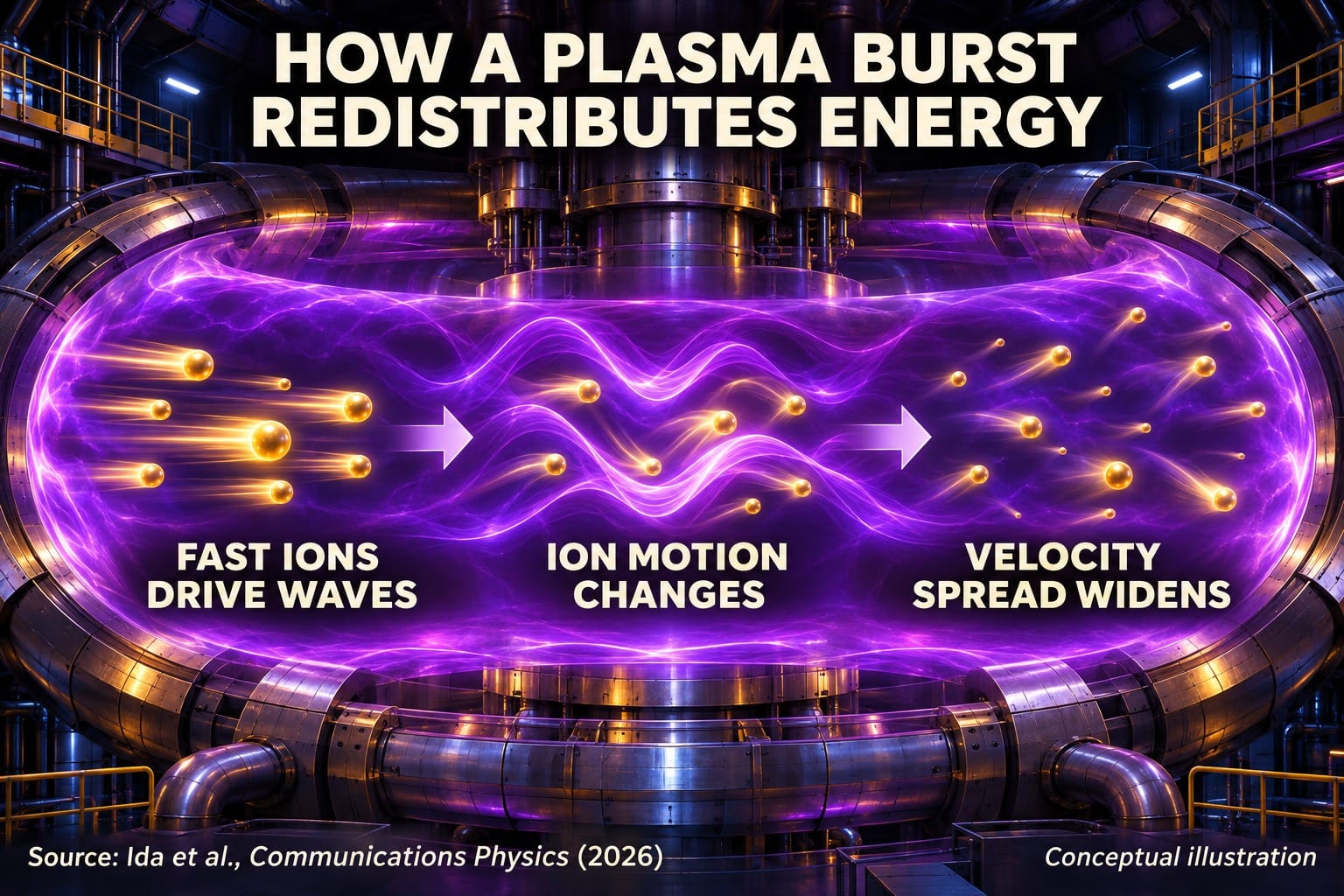
Plasma contains freely moving electrons and ions. In devices that hold plasma with magnetic fields, researchers can inject high-energy particles to help heat it. Fast ions can also excite waves when the plasma becomes unstable. Some other ions interact strongly with those waves and pick up energy. Their motion changes first along the magnetic field. The wave is a route for moving energy from one group of particles to another.
The researchers measured light from ions using fast charge-exchange spectroscopy. Motion shifts the wavelength of the emitted light, so the spectrum contains information about the range of velocities in the observed region. Their 10-kilohertz measurements resolved intervals of about a tenth of a millisecond, short enough to look for changes before collisions redistributed the energy between directions. Looking only at a longer average would lose much of that sequence.
How fast did the plasma respond?
The paper reports that at the location of the burst, energy in ion motion along the field rose by about 30 percent within 0.1 milliseconds of onset. The directional imbalance faded on a timescale of about two to three milliseconds. Near the edge of the plasma, the temporary energy increase decayed within about six milliseconds. In the core it persisted longer. These figures describe different parts and stages of a brief event. The 30 percent figure applies to the measured parallel ion energy near the burst.
The difference between the edge and core matters because a burst can have several effects at once. Instabilities can move energetic particles out of a region while waves deposit energy elsewhere. Assessing the usefulness of such a burst calls for measurements of both where the energy goes and how long it stays there.
What could this mean for fusion heating?
A burning deuterium–tritium plasma relies heavily on energy from helium nuclei produced by fusion reactions. In the Japanese experiment, energetic particles supplied by injected beams drove the bursts. That setup let researchers isolate a route by which fast particles and waves can pass energy to ordinary ions. Whether this route can be used to control heating in a larger burning plasma remains an experimental question. The authors also relate the measurements to wave–particle interactions studied with spacecraft in Earth’s magnetosphere. ITER’s guide to heating and burning plasma.
Energy gain is a different measurement with a different experimental setup. Our report on a National Ignition Facility shot explains how researchers compare fusion yield with the laser energy delivered to a target. Here the measurement follows energy redistribution inside a magnetically confined plasma. Read about the NIF fusion experiment.


latest video



news via inbox
Subscribe to our Cosmic newsletter to get notified when we have new articles.