The 12,000-Year Earth Disaster Cycle
Could a magnetic disturbance in the Milky Way trigger a solar micronova and reshape Earth? Ben Davidson’s The Disaster Cycle connects real discoveries in astronomy and geology to a prediction for the coming decades. Here is what the film proposes, what scientists have measured, and how the proposed cycle could be tested.
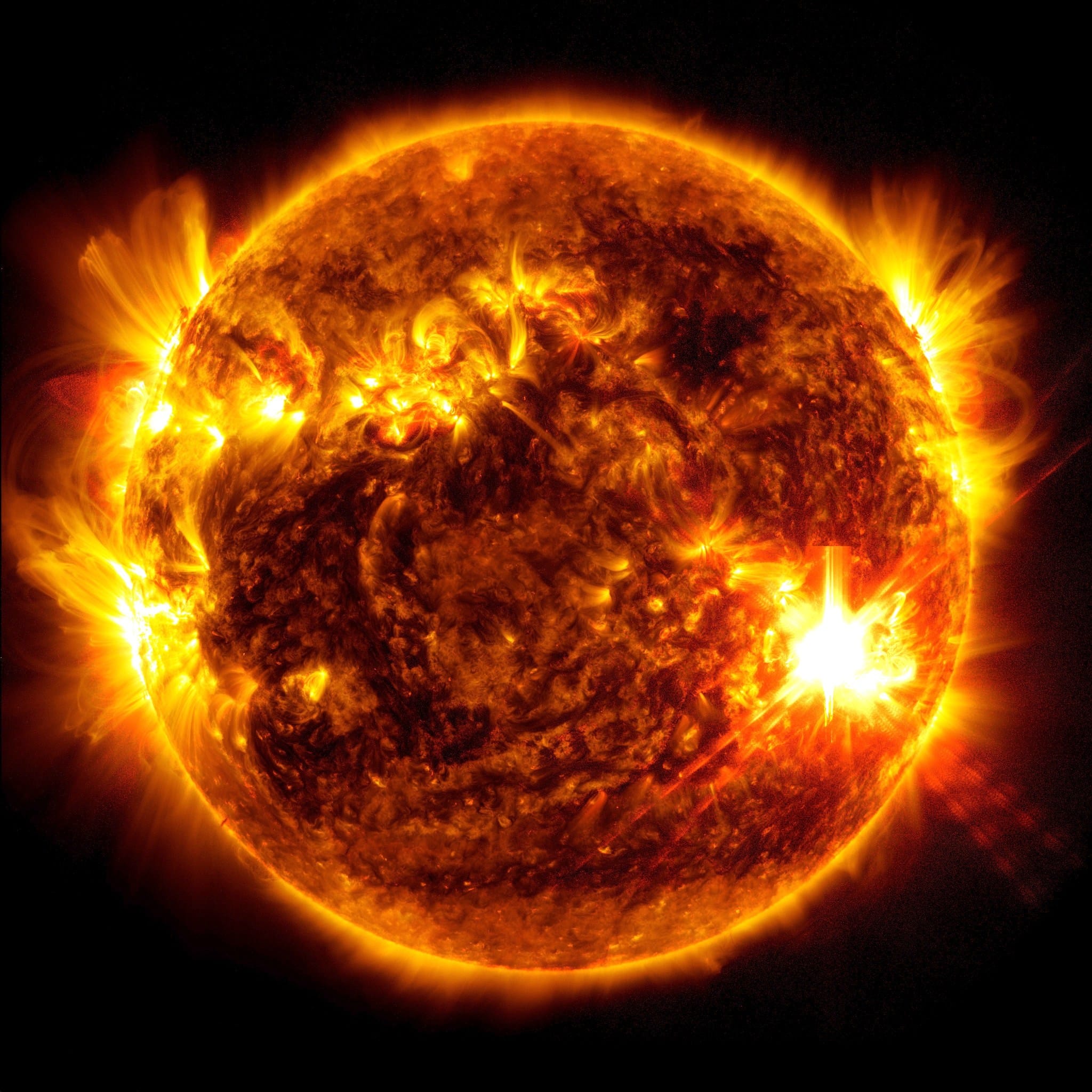
An aurora over a place that rarely sees one is a good reason to ask what the Sun is doing. In May 2024, multiple clouds of plasma and magnetic field reached Earth in quick succession. The resulting G5 geomagnetic storm pushed auroras unusually far toward the equator, affected navigation and increased drag in low Earth orbit. Engineers had a source they could track from the Sun, forecasts they could act on and instruments that measured what happened at Earth. That chain of evidence gives us a way to examine the much larger event proposed in the film. NASA’s account of the May 2024 storm.
Watch the film · Current sheets · Micronovae and the Sun · Earth’s record · Possible effects · Related discoveries · How to test the cycle
What The Disaster Cycle proposes
Davidson’s film proposes a repeating sequence. The solar system encounters a wavy boundary in the Milky Way’s magnetic field. A change in field direction and an influx of dust and gas then trigger an exceptional outburst from the Sun. Earth’s magnetic field, already weakening in the film’s account, offers less protection. Alongside damage to electrical systems, the film pictures a rapid displacement of Earth’s outer shell, seawater surging across continents and a subsequent global winter. It describes major events roughly every 12,000 years, smaller disturbances between them and a possible next major event in the late 2030s or early 2040s. That date is the film’s prediction. It has no independently validated forecasting model. The film’s chronology at 3:45 · Its simulated scenario at 43:06.
What is the galactic current sheet?
A current sheet is a thin region where a magnetic field changes direction or strength sharply and electric current is concentrated. The best-observed example relevant to the film is the heliospheric current sheet, the wavy boundary between sectors of the Sun’s magnetic field carried outward by the solar wind. As Earth orbits the Sun it crosses those sectors. A geomagnetic storm can grow when the arriving magnetic field is oriented to couple efficiently to Earth’s field. Solar-wind speed and density also matter. Spacecraft can measure those local conditions directly. NASA’s heliospheric current sheet · NOAA’s solar wind overview.
The Milky Way has its own magnetic field. Pulsar and radio-galaxy measurements show that the field changes direction in parts of the Galactic disk and halo. Researchers infer the component along their line of sight from Faraday rotation, the change in orientation of polarized radio waves as they pass through magnetized plasma. ESA’s Planck satellite used polarized light from interstellar dust to infer the field’s orientation across the sky. Each method samples a different aspect of the field. Planck’s map is a projected view. The direction of a line on the image gives neither the distance to a reversal nor the direction in which the reversal is moving. Pulsar measurements of Galactic field reversals · Planck’s magnetic map.
Astronomers can take Galactic magnetic structure seriously and still ask for the observations that would connect it to a 12,000-year cycle. That would take a map of a particular boundary near the Sun, measurements of its field strength, density and velocity, and evidence that the solar system repeatedly encounters it on that schedule. The Sun’s motion through the Galactic disk has been studied in connection with comet impacts on timescales of millions of years. Those models offer no physical clock for the film’s proposed moving ripple on millennial timescales. Dynamical study of the Sun’s motion and comet impacts.
Two different magnetic environments
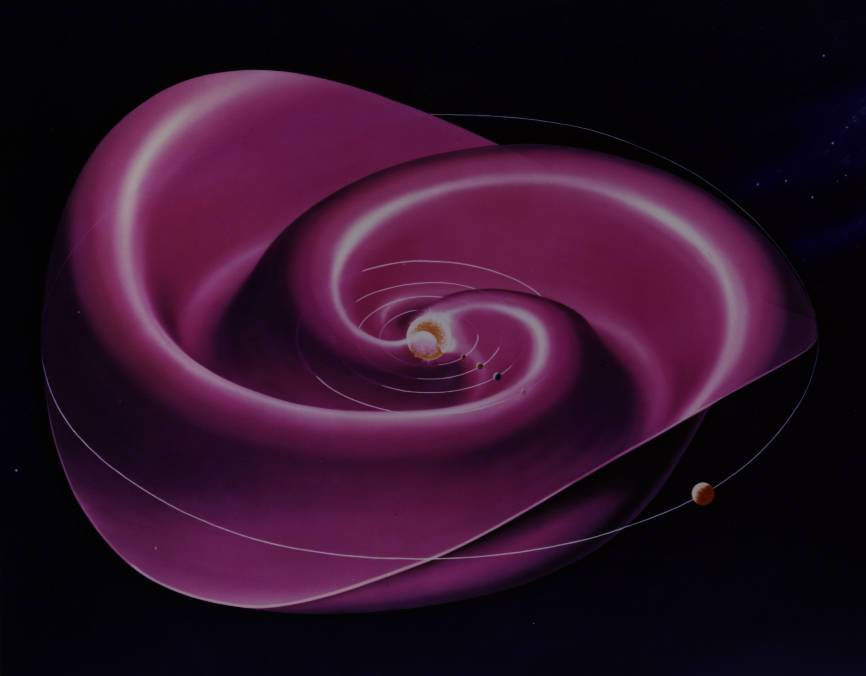
Sun’s current sheet
Solar wind carries a wavy sector boundary outward.
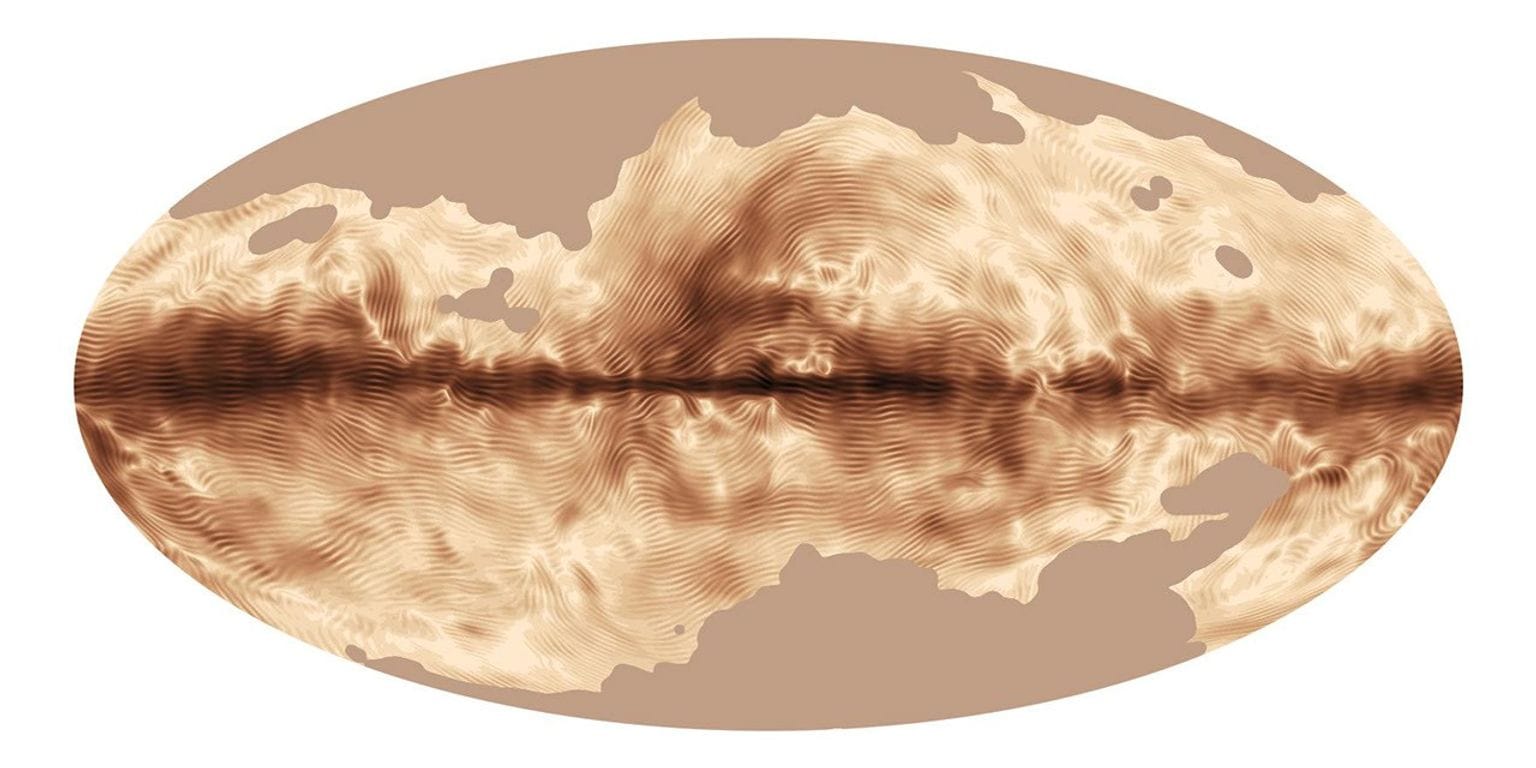
Milky Way field
Dust polarization reveals projected field orientation.
Wavy galactic boundary proposed in the film. Dashed line shows a hypothetical path. Schematic with no measured scale or crossing dates.
What would a solar micronova have to be?
Astronomers have observed short outbursts called micronovae in systems containing magnetic white dwarfs. In the model proposed by Simone Scaringi and colleagues, hydrogen drawn from a companion star is funnelled toward a magnetic pole of the white dwarf. The material accumulates under pressure and can undergo a runaway burst of fusion confined to a small region. The observed bursts released roughly one millionth of the energy of a classical nova. That fraction describes the observed white-dwarf events. It cannot determine the possible energy of a solar outburst. Scaringi and colleagues’ micronova discovery · The model of confined accretion.
The Sun is a hydrogen-burning main-sequence star without a mass-donating companion. A flare releases magnetic energy when stressed fields reorganize in the solar atmosphere. A coronal mass ejection (CME) carries plasma and magnetic field into space. They can happen together, and an eruption can also accelerate energetic particles. The film’s proposed solar micronova needs a mechanism of its own. A model would have to show how enough incoming material reaches the Sun, where it accumulates, what confines it and how the claimed eruption starts. NASA’s guide to flares and CMEs.
In 2024, Valeriy Vasilyev and colleagues used Kepler observations to find that stars with Sun-like properties produced flares above 1034 erg at a sample-average rate of about one per century per star. The rate combines many stars and depends on how the sample is defined. It cannot time the next event on our Sun. The study makes far stronger magnetic flares worth investigating, with a signal telescopes can measure. Vasilyev and colleagues’ Kepler study.
A white-dwarf micronova and a solar flare
White-dwarf micronova
Fuel from a companion → hydrogen accumulates near a magnetic pole → localized fusion runaway.
Solar flare
Stressed magnetic fields reorganize → a burst of radiation and accelerated particles. A CME can accompany the flare.
Film’s solar micronova
Infalling dust and a Galactic magnetic disturbance are proposed triggers. A model for the fuel, confinement and eruption remains to be demonstrated.
Does Earth’s record show a 12,000-year cycle?
The Younger Dryas was real and abrupt
Greenland ice and other archives preserve a pronounced return to colder conditions in the North Atlantic region about 12,800–12,900 years ago. Climate shifts appeared elsewhere on different timescales. The event lasted roughly 1,200 years. Comparisons of well-dated records and climate models point to changes in ocean and atmospheric circulation. The trigger, the route taken by meltwater and the regional response remain active questions. One model shows how freshwater forcing could weaken the Atlantic Meridional Overturning Circulation, which helps transport heat northward, for longer than the initial freshwater pulse. Timing across the climate records · Freshwater and circulation modelling.
A comet impact or airburst has also been proposed. A Greenland ice core contains a platinum anomaly around the transition. An anomaly is a measurement. Its origin and its role in subsequent cooling require further evidence. Proponents and critics disagree about the dates, the interpretation of particles at different sites and whether the observations consistently indicate an externally triggered catastrophe. Hiawatha, a real crater under the Greenland ice sheet, illustrates why dating matters. Two methods put the impact around 58 million years ago. Original platinum study · Review of the impact evidence · Response from proponents · Hiawatha dating study.
Tree rings provide a separate clock for ancient solar storms
High-energy particles striking the atmosphere can increase the production of radioactive isotopes such as carbon-14. A tree adds carbon to a specific annual ring. Measuring the same increase in independently dated rings can help pin an event to a calendar year. Ice cores offer additional checks through other cosmogenic isotopes. An especially large radiocarbon rise from about 14,300 years ago, measured in ancient Alpine pines, is consistent with an extreme solar particle event in modelling studies. It predates the start of the Younger Dryas by roughly 1,400–1,500 years. Spikes around 774–775 CE and 993–994 CE add evidence of extreme space weather at other times. The dates are unevenly spaced, and the isotope record has gaps. A particle fluence inferred from the rings also cannot reconstruct the magnetic orientation of an ancient CME, a major factor in geomagnetic storm severity. The Alpine pine record · Modelling the ancient particle event · Radiocarbon dating with solar storms.
Pole drift, magnetic excursions and physical rotation
Cooling lava and magnetic minerals settling in sediments can preserve a record of Earth’s field. Around 41,000 years ago, during the Laschamp excursion, the large-scale dipole weakened dramatically and the field temporarily changed direction. Mono Lake/Auckland, roughly 34,000 years ago, had different behavior and a less dramatic global signal. A 2021 study proposed that the Laschamp weakening produced a global environmental crisis through changes in atmospheric chemistry and circulation. Other researchers challenged the chronology tying it to extinctions and shifts in human activity. Confirming a large magnetic change still leaves the environmental consequences to be established. Laschamp and Mono Lake field reconstructions · The environmental-crisis hypothesis · Published critique.
Today the north magnetic dip pole moves as the field generated by Earth’s liquid outer core changes. NOAA and the British Geological Survey monitor the movement for navigation. Their 2025 assessment measured about 36 kilometres of north magnetic dip-pole movement per year during the reporting period. A 90-degree reorientation of the solid Earth in a day, as suggested around 30:15 in the film, would require a separate mechanical explanation that accounts for the torque or redistribution of mass, the energy involved and a signature in independently dated records. A compass records the field and cannot supply those measurements. NOAA’s magnetic field assessment · USGS explanation of reversals · The film’s 90-degree scenario.
Five events on different clocks
~41,000 years ago · Laschamp excursion. A pronounced weakening and temporary change in Earth’s magnetic field.
~34,000 years ago · Mono Lake/Auckland. Magnetic behavior distinguishable from Laschamp.
~14,300 years ago · Alpine tree-ring spike. Evidence consistent with an extreme solar particle event.
~12,850 years ago · Younger Dryas begins. Abrupt cooling in the North Atlantic region.
May 2024 · G5 geomagnetic storm. Spacecraft followed solar eruptions and recorded effects at Earth.
What effects could a severe solar event have?
A large eruption, a radiation storm and a geomagnetic storm describe different parts of the Sun–Earth system. A flare’s light takes about eight minutes to reach Earth. The fastest particles can arrive soon after, and a CME’s magnetic cloud takes substantially longer. The effects depend on what was emitted, where it went and how the event interacted with Earth. During a geomagnetic storm, long power lines can pick up induced currents. Heating of the upper atmosphere can increase drag on satellites. Radiation risk is greater for astronauts outside Earth’s atmospheric protection and can affect aviation at high altitude, especially at high latitudes. NOAA’s space weather impact guide · NOAA on arrival times and effects.
From aurora to infrastructure disruption
Observed in space weather
- Auroras at unusually low latitudes
- Navigation errors and HF radio outages
- Satellite charging, drag and radiation exposure
- Induced currents and regional blackouts
Additional effects proposed in the film
- Prolonged worldwide infrastructure collapse
- Rapid displacement of Earth’s outer shell
- Continent-scale inundation and a global winter
- Electrical outages. The March 1989 storm triggered a nine-hour blackout in Québec. In a future storm the extent and recovery time would depend on grid design, ground conductivity and the magnetic disturbance. NOAA case history.
- Loss of cooling at nuclear plants. Loss of off-site power is a recognized hazard. Internal power sources, protection and cooling arrangements have to be evaluated plant by plant. A grid disturbance alone cannot establish that every plant would lose cooling. IAEA design guidance.
- Earthquakes and volcanic activity. Geoelectric fields induced during storms are measurable. A causal link from ordinary solar flares or geomagnetic storms to earthquakes has yet to be established. A model for deep heating or widespread fault triggering would need independent measurements and predictive tests. USGS on induced fields · USGS geomagnetism FAQ.
- Floods and global winter. Large floods and abrupt regional climate changes are documented in geology. Their dates, geography and physical causes have to be established individually. A solar trigger for a rapid physical reorientation would need evidence linking both events at the same time.
Related discoveries that take the question further
Ice cores show patterns near 11,000 and 5,500 years
This is the closest numerical match among the studies considered here. In 2025, Vadim Kravchinsky and colleagues analysed oxygen isotope records from Greenland and Antarctica spanning about 150,000 years. They recovered oscillations near 11,000, 5,500 and 2,750 years. The authors connected the first two to how changes in Earth’s orbit redistribute incoming sunlight by latitude and season, with ocean circulation and climate feedbacks potentially carrying the signal farther. They also discussed a possible connection between the shorter signal and the proposed Hallstatt cycle of solar activity. An oxygen isotope oscillation is a climate pattern. Checking whether it represents a repeating catastrophe would require matching discrete events across independent archives and showing how a solar eruption produced them. The 2025 ice-core study · NASA’s explanation of orbital forcing.
True polar wander has a testable sea-level signature
Geophysicists use true polar wander to describe a reorientation of the solid Earth relative to its spin axis. In a 2026 paper, Mathew Domeier and colleagues looked for the geographic pattern their models predict when oceans adjust during this process. Relative sea levels rise in some regions and fall in others. The study inferred episodes of geologically rapid wander from reconstructed ancient coastlines over intervals of millions of years. The daily timescale in the film would call for a much more sudden and closely dated pattern. Domeier and colleagues’ sea-level reconstruction.
Could solar activity help trigger an earthquake?
A 2026 paper by Akira Mizuno and colleagues proposed that changes in the ionosphere could alter forces across cavities within a fractured zone. The authors discussed the coincidence of strong solar activity with Japan’s 2024 Noto Peninsula earthquake. That case illustrates the proposed mechanism but cannot establish cause on its own. A test would need many earthquakes and comparable periods without earthquakes, with predictions made in advance about where and when a change should be measurable. A possible effect on an individual fault would also leave the film’s claim of worldwide crustal displacement to be tested separately. The proposed ionosphere–crust model.
Could an interstellar cloud expose Earth to more radiation?
Merav Opher and colleagues reconstructed the possible motion of a cold interstellar cloud and modelled a close encounter about two to three million years ago. Under their assumptions, a dense cloud could compress the heliosphere until its upwind boundary was about 0.22 astronomical units from the Sun, inside Earth’s orbit. The work opens a physical route for changes in our Galactic environment to affect Earth’s exposure. Its result is a model for a specific past encounter, with a different timescale and mechanism from the film’s 12,000-year cycle. Opher and colleagues’ cloud study.
Can scientists identify debris from an ancient stellar explosion?
Yes, when a chemical signature, date and origin can be checked independently. Researchers reported excess radioactive iron-60 in deep-sea deposits from roughly 1.5–3.2 million and 6.5–8.7 million years ago, consistent with material from nearby stellar explosions. The film invokes nova isotopes in bone and black glass around 37:15. To test that claim, researchers would need named samples with intact provenance, independent dating, isotope ratios that point to a particular source and controls for contamination and local production. The ages and chemistry of glass beads returned by Chang’e-5 can distinguish different episodes of lunar impact glass. The appearance of a shiny black fragment leaves several possible origins. Deep-sea iron-60 measurements · Chang’e-5 glass-bead study · Film discussion of isotopes and glass.
What does dust near the Sun show?
Parker Solar Probe detected dust in the inner solar system and measured how its contribution to scattered light decreases close to the Sun. Impact measurements also point to particles on trajectories that escape the solar system. Dust can circulate, break apart, vaporize or be expelled. To establish the film’s proposed incoming cloud, observers would have to measure a new population arriving from outside the solar system, determine its speed and direction and calculate the delivery of material to the Sun. NASA’s dust observations · Parker dust-impact study.
What can frozen mammoths tell us?
The film pictures frozen mammoths as a clue that animals were moved abruptly into polar cold. Preserved gut contents can illuminate an individual animal’s diet and habitat. A claim about simultaneous freezing or geographic relocation requires dates and environmental evidence from many sites. An Arctic mammoth skin sample that retained remarkable cellular detail is about 52,000 years old. Mammoths on Wrangel Island survived until around 4,000 years ago. Those cases show that the age of a preserved carcass, the disappearance of a mainland population and the extinction of the species are separate questions. 52,000-year-old mammoth skin study · Wrangel Island genomes.
What evidence would change the picture?
Start by specifying the record to be tested. If a major cycle means a magnetic excursion, a large isotope spike and a geologically abrupt catastrophe occur together, each archive needs a predefined indicator and an age uncertainty. Pick a time window before searching the data, estimate how many coincident events would occur at random and check whether the pattern holds in independent records. A proposed major event every 12,000 years and a smaller event every 6,000 also need a way to classify the two kinds of event in advance. Otherwise, a cooling episode in one interval and a magnetic low in another can be made to resemble a period after the fact. An example of testing proposed periodicity against geological dates.
Astronomers would also need the position, field direction, density and velocity of the approaching structure, with a range of arrival times. Solar physicists would need an independently testable calculation of the response of the heliosphere and Sun, with predictions for radiation, particles and ejecta. Geophysicists could check for the expected signals in rocks, ice and dated archaeological layers. The film gives a decade-scale forecast. The measurements needed to turn that date into a scientific forecast are still missing. The film’s prediction.
Extreme solar storms deserve attention on the strength of observations and their effects on systems people use every day. Tree rings date an ancient burst, pulsars probe magnetic fields, and isotopes identify material that arrived from outside our solar system. Together they show how a genuine link between a cosmic event and Earth’s history can be established.
Related CosmicGravity coverage · What Voyager measured about the magnetic fields of Uranus and Neptune.



latest video

news via inbox
Subscribe to our Cosmic newsletter to get notified when we have new articles.