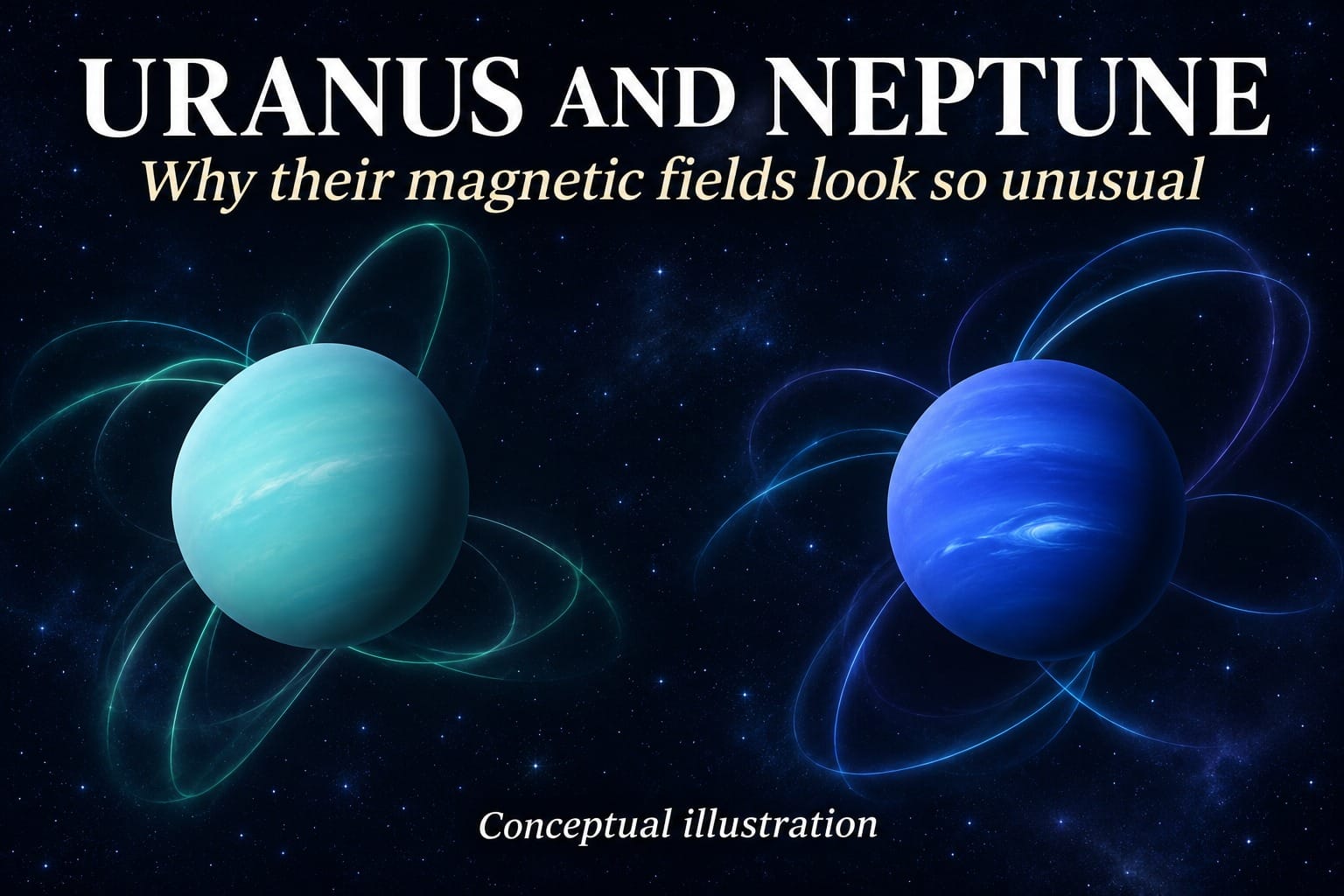
Why Uranus and Neptune Have Such Unusual Magnetic Fields
Voyager 2 found a magnetic field sharply tilted away from the spin axis of Uranus. At Neptune it found another. Both fields also contained strong smaller-scale patterns that a single bar magnet would miss. A November study asks whether the ability of material to conduct electricity changes with depth inside the planets, and whether that change could help produce the fields Voyager measured. Yan and colleagues’ paper in Communications Physics.
Why are the magnetic fields of Uranus and Neptune unusual?
A planet’s field can be described as a combination of patterns. The simplest large-scale part, called a dipole, resembles the field around a bar magnet. For Earth it points roughly along the rotation axis. For the ice giants, the November paper’s authors report tilts of about 59 degrees for Uranus and 47 degrees for Neptune. In both cases other patterns also contribute strongly, so the angle describes only part of the field. University of Texas Institute for Geophysics research account.
Voyager 2 flew past Uranus in 1986 and Neptune in 1989. Its instruments gave scientists direct measurements close to the planets, where they could study how the field changed along the spacecraft’s trajectory. Each encounter was brief compared with the decades since. To measure change directly, researchers would need new observations close enough and detailed enough for a fair comparison. NASA’s Voyager encounter history.
What changes when conductivity varies with depth?
Moving fluid that conducts electricity can generate and sustain a magnetic field. This process is called a dynamo. The efficiency of that process depends partly on how easily electric current flows through the material. The researchers ran simulations with different interior configurations, including cases where electrical conductivity increased inward. Under those assumptions, different layers can contribute differently to the field seen outside the planet.
Some snapshots from the simulations resembled the Voyager maps. This shows a way to produce a field with comparable features. It does not uniquely identify the material at a given depth or show that the planets have exactly the modelled interiors. Pressure, temperature and composition can all affect conductivity. A single flyby also gives researchers few opportunities to test a prediction about how the field evolves.
Different parts of the field also fade with distance at different rates. The smaller-scale components generally weaken faster than the dipole. That makes the flight path important when comparing measurements. A spacecraft passing close to an ice giant can pick up structure that would be much harder to detect farther away, even if the field itself had barely changed.

Could the fields have changed since Voyager?
In some simulations the tilt and shape changed substantially within decades. Others evolved more slowly over comparable intervals. The model examples therefore suggest a reason to look for change, but there is no direct measurement here of a shift since either Voyager flyby.
Auroras provide an indirect line of evidence because charged particles follow magnetic fields into the upper atmosphere. Researchers are examining infrared images of the ice giants for patterns that might constrain today’s field. A future spacecraft carrying a magnetometer could sample the field more directly and revisit regions that Voyager passed once. Our Voyager retrospective covers the earlier encounters and their role in opening up the study of the outer planets. Read about the Voyager missions.



latest video



news via inbox
Subscribe to our Cosmic newsletter to get notified when we have new articles.