What NASA Measured During the 2026 Total Solar Eclipse
For millions of people, the 12 August 2026 total solar eclipse was a few minutes of darkness. For scientists, it was a moving laboratory thousands of kilometres long. NASA-backed teams positioned an aircraft, balloon networks, cameras and atmospheric sensors along the path from the Arctic to Spain. Their aim was not simply to photograph the corona. They wanted to watch Earth’s atmosphere react when daylight is switched off at impossible speed.
The raw observations are now moving into analysis, so this is not yet a catalogue of final discoveries. It is a guide to what the experiments measured, what signals researchers expect and which claims would require more evidence.
A jet chasing the Moon’s shadow
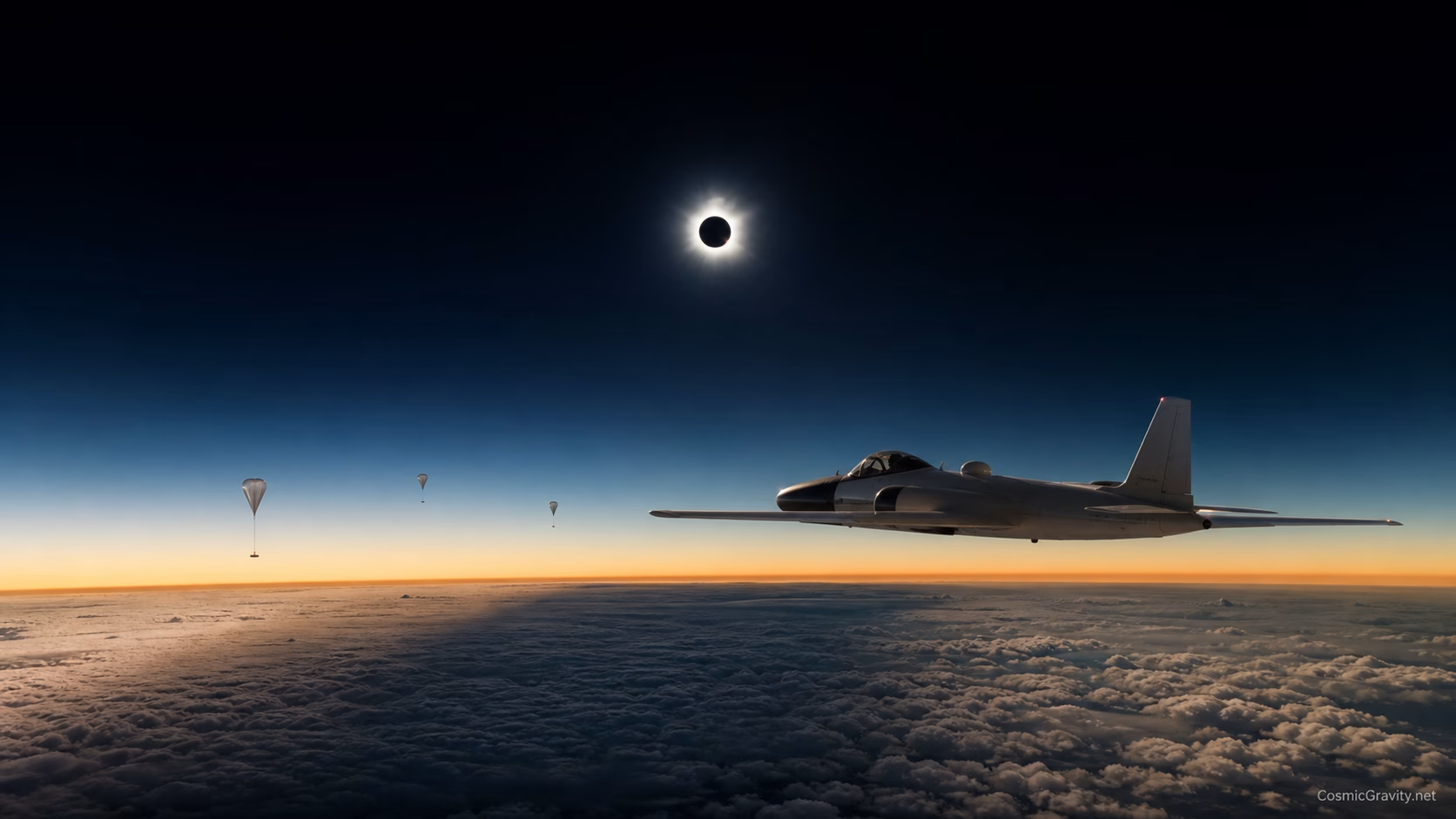
A NASA WB-57 research aircraft flew at roughly 50,000 feet. From that altitude the sky is darker, weather is less disruptive and instruments can observe wavelengths partly blocked by the lower atmosphere. By flying along the eclipse path, the aircraft can also extend the useful observing time compared with a fixed telescope on the ground.
The main target was the solar corona: extremely hot plasma structured by the Sun’s magnetic field. Totality blocks the much brighter photosphere and briefly exposes fine coronal loops, streamers and plumes. Those structures connect directly to space weather—the solar eruptions capable of disturbing satellites, radio links and power grids.
Eighty balloons over Iceland
Teams launched around eighty balloons from Iceland, beginning approximately eighteen hours before totality and continuing until eight hours afterwards. That long window was deliberate. A single balloon would show only one slice of the atmosphere; a sequence can reveal how temperature, pressure and turbulence evolve before, during and after the shadow passes.
Explore the four main experiments
1. Corona from the stratosphere
The WB-57 watched faint solar structures above much of the weather.
2. Atmospheric wake
Iceland’s balloon chain sampled temperature, wind and pressure as the shadow moved through.
3. Immersive shadow mapping
Six balloons launched from Spain carried 360-degree cameras to record the geometry of approaching and departing darkness.
4. Ozone response
Sensors tracked how rapidly photochemistry responds when ultraviolet sunlight briefly collapses.
Can an eclipse change the weather?
Locally and briefly, yes. The surface cools, convection weakens and winds can shift. The difficult question is not whether changes occur, but how the response propagates through different atmospheric layers. The eclipse creates a clean natural experiment: the Sun’s input changes rapidly while geography and season remain almost constant.
Researchers are especially interested in atmospheric waves generated by the moving shadow. Like a boat moving through water, the rapid cooling region may produce a wake. Detecting that signal requires measurements spread across time and altitude—which is exactly what the balloon network was designed to provide.
The ozone experiment
Ozone in the lower atmosphere is shaped by sunlight-driven chemistry. During totality, ultraviolet radiation drops abruptly. Instruments can test how quickly ozone production and destruction respond, then compare the recovery as daylight returns. The change is short-lived, but it provides a valuable check on atmospheric chemistry models.
What to look for when results appear
- Temperature and wind profiles before, during and after totality.
- Evidence of gravity waves or an atmospheric shadow wake.
- High-resolution changes in coronal magnetic structure.
- Measured ozone response compared with model predictions.
- Agreement between airborne, balloon and ground observations.
The 2026 eclipse was visually spectacular, but its scientific value lies in synchronization. Dozens of instruments watched the same predictable disturbance from different places. That gives researchers something rare in Earth science: a planetary-scale experiment whose timing was known to the second.
For the orbital oddity behind the Arctic path, read our earlier analysis of the “backward” 2026 eclipse shadow.
Sources and further reading
latest video

news via inbox
Subscribe to our Cosmic newsletter to get notified when we have new articles.