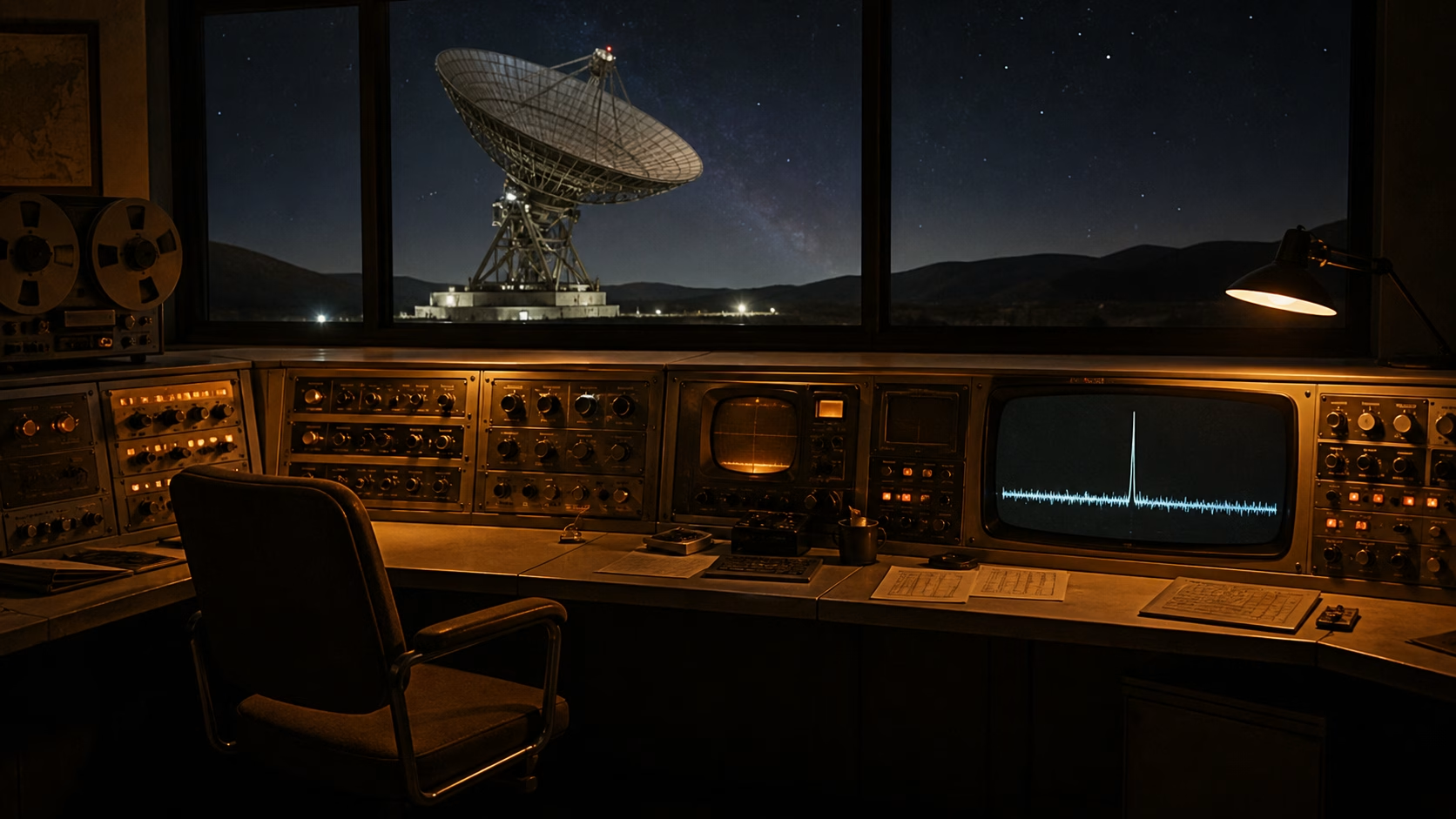
The Wow! Signal: Our Best Candidate for an Alien Message?
On August 15, 1977, a radio telescope in Ohio detected a narrowband signal so strong and unusual that astronomer Jerry Ehman circled the computer printout and wrote one word beside it: “Wow!”
The signal lasted 72 seconds. It appeared near a frequency astronomers consider especially meaningful for interstellar communication, rose and fell in a pattern consistent with a fixed source drifting through the telescope’s beam, and then vanished.
Nearly half a century later, it has never been detected again. The Wow signal explained as evidence is compelling but incomplete: a genuine astronomical-looking event recorded once, without enough data to establish its source.
How Big Ear listened to the sky
Ohio State University’s Big Ear radio telescope surveyed the sky for narrowband radio signals. Natural sources usually emit across broad ranges of frequency. A concentrated signal can therefore attract attention as a possible sign of technology.
The telescope did not record audio. Its computer measured signal intensity across channels and printed alphanumeric codes. The sequence “6EQUJ5” described the rise and fall in strength that caught Ehman’s attention.
The strongest point, represented by U, was far above the background noise. The entire event matched the time a fixed celestial source would take to pass through Big Ear’s observing beam as Earth rotated.
Why the frequency mattered
The signal appeared near 1420 megahertz, the natural emission frequency of neutral hydrogen. Hydrogen is the most abundant element in the universe, and its spectral line is known to any civilisation capable of radio astronomy.
SETI researchers have long considered this part of the spectrum a logical meeting place. It is comparatively quiet and has universal physical significance.
The Wow signal was close to the hydrogen line but not exactly on it. Terrestrial transmissions near this protected band are restricted, making ordinary radio interference less likely—but never impossible.
The 72-second limit
Big Ear used two separate feed horns. A real fixed source should have appeared first in one beam and then, minutes later, in the second. The signal was detected in only one.
Its 72-second duration was not necessarily the time the source transmitted. It was the maximum time the telescope could observe a fixed point as it crossed the beam.
A continuous source should have reappeared. A short or intermittent transmission could have ended before reaching the second beam.
Where did it come from?
The telescope’s design produced two possible sky positions, both in the direction of the constellation Sagittarius. The region contains many stars, but no specific star or planet was identified as the origin.
The positional uncertainty remains a major limitation. Modern telescopes could focus on candidate stars, yet the original signal does not tell them exactly where to look.
Could it have been interference?
Terrestrial interference can enter a radio telescope through reflections, equipment faults or transmissions outside intended regulations. A reflected Earth signal might imitate some celestial behaviour.
Investigators found no confirmed transmitter that matched the event. The smooth rise and fall followed Big Ear’s beam pattern, which supports a source fixed relative to the sky rather than a nearby moving transmitter.
Support is not proof. A rare combination of interference and telescope response remains possible.
The comet hypothesis
One proposed explanation linked the signal to hydrogen clouds surrounding comets that were in the general region of the sky. Comets can release hydrogen as sunlight breaks down water molecules.
Many radio astronomers remain unconvinced. A cometary hydrogen cloud would normally produce a broader, weaker and more persistent signal than the narrow, intense event Big Ear recorded.
The hypothesis illustrates an important standard: naming a natural object is not enough. Its predicted signal must match frequency, strength, bandwidth, timing and telescope response.
What an alien transmission might look like
A deliberate beacon could use a narrow frequency to concentrate energy and stand out from natural background. It might transmit intermittently to cover many target stars or conserve power.
An accidental leakage signal would likely be weaker and more complex. Detecting it across interstellar distance would require a civilisation using powerful radar or directed communication.
The Wow signal is compatible with a beacon in a general sense. It contains no decoded message, modulation or repeated pattern that identifies intelligence.
Why repetition is decisive
Science depends on verification. If the signal repeated, multiple observatories could confirm its position, bandwidth, drift and information content.
Many follow-up searches have revisited the region without finding the same event. That absence weakens the alien interpretation but does not erase the original measurement. A transmitter might be intermittent, directional or no longer active.
It also means the case cannot progress far beyond informed possibilities.
What makes the signal enduring
The Wow signal is famous because it occupies a narrow evidential middle ground. It was not a visual story remembered years later. It was recorded by a scientific instrument and inspected by an experienced astronomer.
At the same time, it was a single detection by one facility. No independent telescope confirmed it. No second signal supplied more information.
The evidence is strong enough to resist casual dismissal and too incomplete to support certainty.
A message or a reminder?
We may never know what produced the Wow signal. Its lasting value is methodological. It showed that a search instrument could find an event resembling some expectations for a technosignature—and that one exciting detection is not enough.
The next signal must be preserved in greater detail, checked immediately by other observatories and followed across the sky.
“Wow!” was the right first reaction. The final word still has not been written.
Related reading


latest video


news via inbox
Subscribe to our Cosmic newsletter to get notified when we have new articles.