Macroscopic Quantum Entanglement: Does It Change What Consciousness Could Be?
Inside a quantum optomechanics laboratory, the object at the centre of the experiment may look almost disappointingly ordinary. It can be a tiny aluminium drumhead, a silicon resonator or a thin dielectric membrane suspended inside an optical cavity. It has a shape, a measurable mass and billions—or even trillions—of atoms.
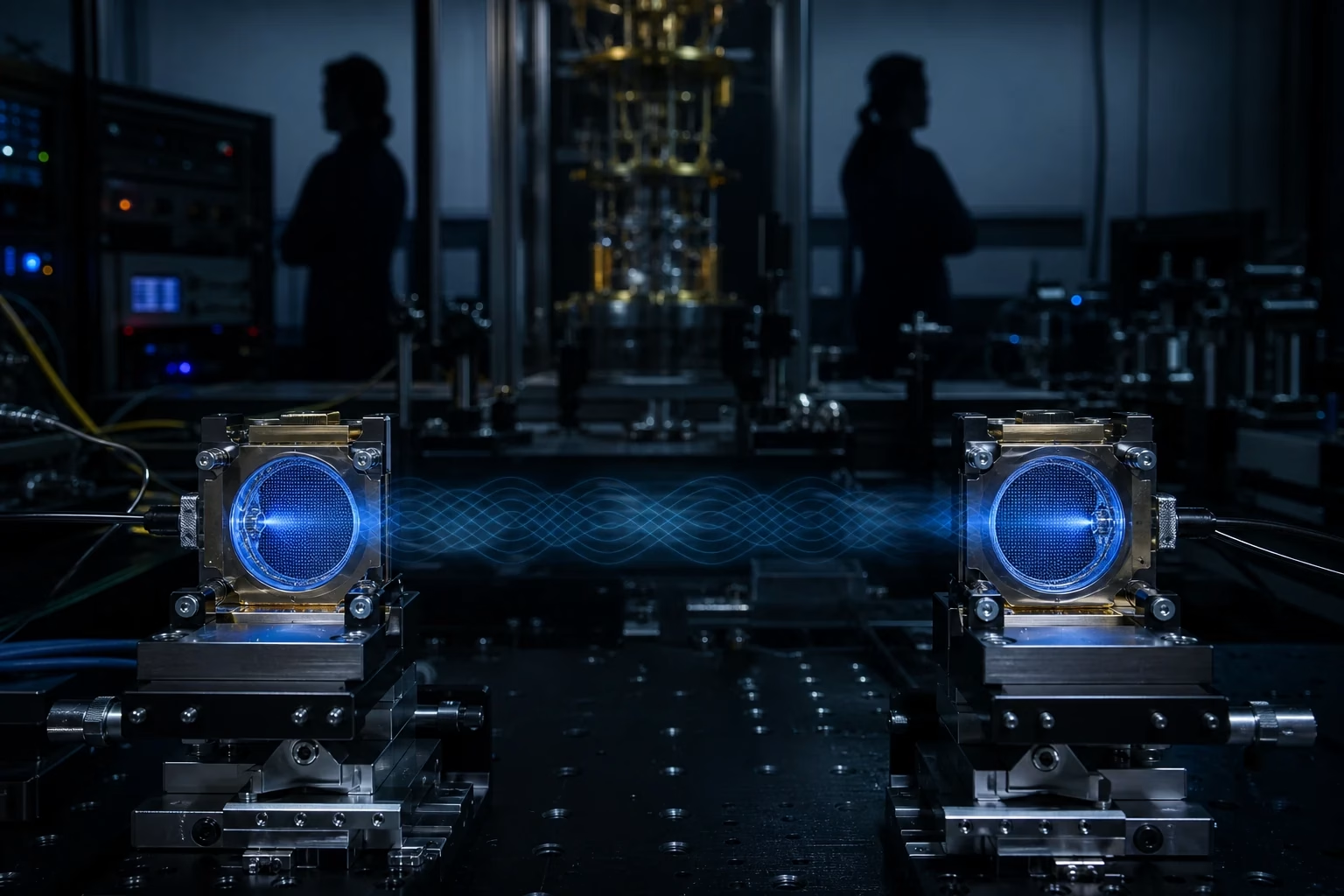
Yet under the right conditions, its motion cannot be described independently from another object. The two mechanical systems share a quantum state. Measure their vibrations separately and the results reveal correlations that classical physics cannot reproduce.
This is macroscopic quantum entanglement: one of the clearest signs that quantum mechanics does not simply stop when an object becomes “too large.” As laboratories push quantum control toward larger masses, warmer conditions and more complex networks, an unavoidable question follows. If sizeable objects can become non-locally connected, does that make telepathy, non-local consciousness or instantaneous communication across the cosmos more plausible?
The short answer is subtle. These experiments widen the territory in which quantum mechanics has been tested. They do not currently validate telepathy or prove that consciousness is non-local. And standard quantum theory still forbids entanglement from being used to send a controllable message faster than light.
But the longer answer is worth exploring, because the experiments are more remarkable than either the sceptical or mystical version of the story suggests.
What laboratories have actually entangled
In 2018, researchers reported stabilized entanglement between the motion of two micromechanical drumhead oscillators. Each device contained roughly a trillion atoms and was coupled to the same microwave cavity. Carefully chosen microwave tones cooled and correlated the two vibrational modes strongly enough for the researchers to infer a shared entangled state.
Another 2018 experiment entangled micromechanical oscillators fabricated on separate chips. The devices were physically separated by about 20 centimetres, while the optical route connecting the apparatus extended to roughly 70 metres. A detected photon heralded the entangled mechanical state.
In 2021, a different team demonstrated entanglement between the motion of a millimetre-size dielectric membrane and the collective spin of approximately one billion caesium atoms. The two systems were about a metre apart. Light travelling through both systems acted as the mediator, and the measured Einstein–Podolsky–Rosen variance fell below the limit allowed for separable states.
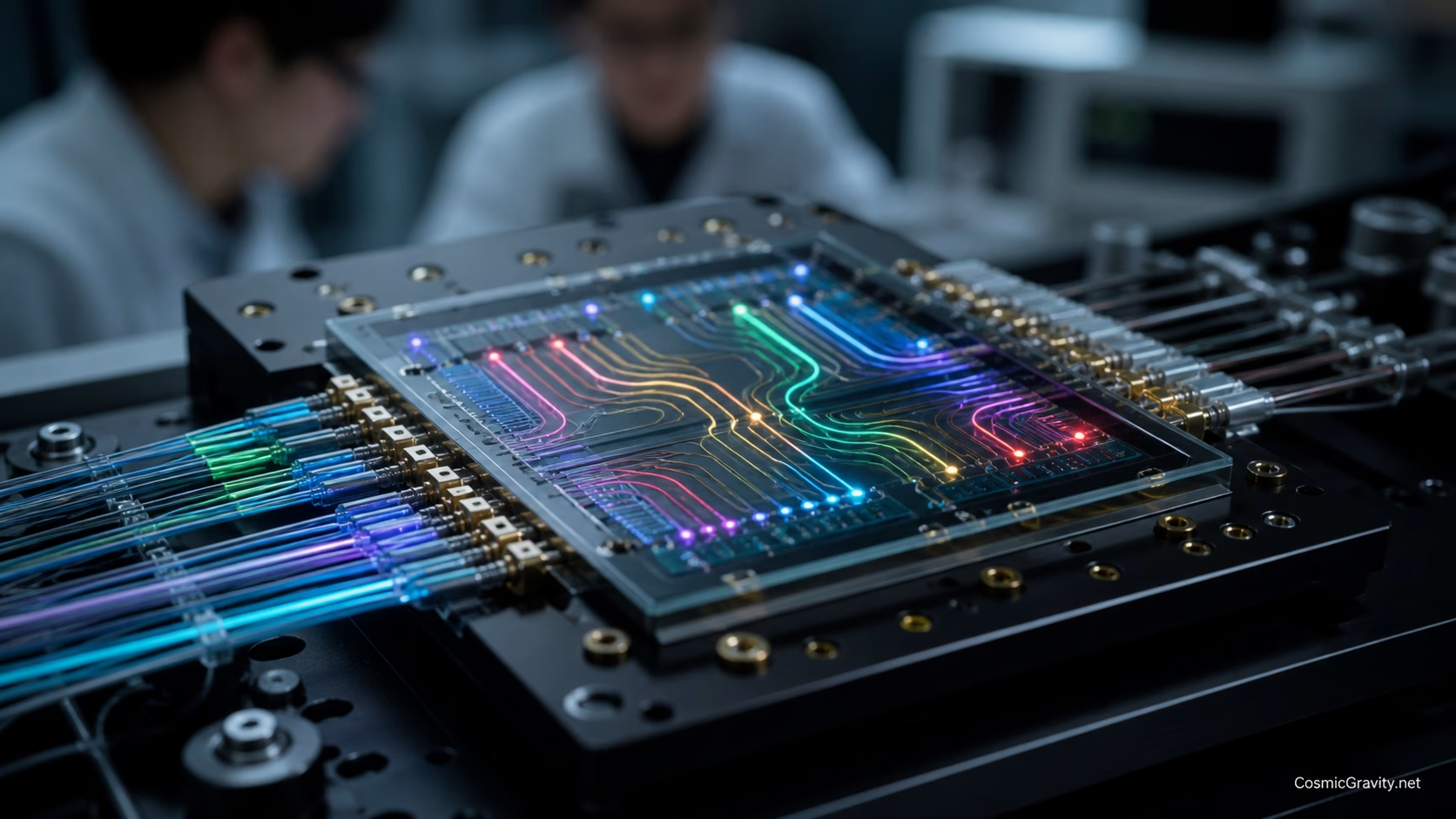
The scale increased again in 2024 when an EPFL team controlled the collective quantum motion of six mechanical oscillators in a superconducting optomechanical circuit. The six devices entered a common collective mode, which was cooled close to its quantum ground state. That experiment did not itself claim six-way mechanical entanglement, but it built a platform on which multipartite entanglement may become possible.
Progress is also weakening the assumption that mechanical quantum behaviour always needs an extreme freezer. A 2024 membrane experiment approached the quantum measurement limit at room temperature, and a 2025 experiment cooled a levitated silica nanoparticle’s librational motion to a reported 0.04 phonons at room temperature. Neither result demonstrated telepathy—or even macroscopic entanglement at room temperature—but both show how quickly the thermal barrier is being pushed back.
“Macroscopic” does not mean what a headline may suggest
When physicists call these systems macroscopic, they mean that the device contains a very large number of atoms and can often be seen with an optical microscope. They do not mean that the whole membrane visibly jumps between two positions or that every atom has been independently placed into a cat-like superposition.
The entangled quantity is usually a collective mechanical mode: a coordinated vibration described by position and momentum variables. The quantum displacement involved can be far smaller than an atomic nucleus. The surrounding chip, cables, refrigerator and laboratory remain firmly classical for practical purposes.
This distinction is not a technical escape clause. A guitar string also contains countless atoms, yet a single vibrational mode can be described as one collective object. Quantum optomechanics asks whether that mode can be cooled, squeezed, superposed and entangled strongly enough that no classical noise model explains the measurements.
The answer is increasingly yes.
Why the quantum world normally disappears
Quantum mechanics does not include a rule saying that an object becomes classical at a particular size. The real enemy is decoherence. Every collision with a gas molecule, absorbed photon, thermal vibration or electrical fluctuation can leak information about a quantum state into the environment.
For an isolated atom, that leakage can be slow. For a warm object made of trillions of particles, there are countless ways for the environment to learn what it is doing. The delicate phase relationships that make entanglement detectable are rapidly scrambled.
That is why experiments use vacuum chambers, cryogenic refrigeration, vibration isolation, ultralow-noise lasers and elaborate statistical tests. The apparatus does not reveal that everyday objects are routinely exchanging detectable quantum thoughts. It reveals that larger mechanical systems can retain a controlled quantum relationship when almost every ordinary source of disturbance is suppressed.
What entanglement’s “instantaneous” connection really means
Suppose two systems share an entangled state and are moved far apart. When each is measured, the results can be correlated more strongly than any local classical model permits. Bell-test experiments have repeatedly confirmed that nature permits this form of non-local correlation.
But neither observer controls the individual outcome. Each local result looks random. Only after the two observers compare their records through an ordinary classical channel do they discover the pattern.
This is the no-signalling principle. Entanglement can be a resource for quantum teleportation, cryptography and networks, but those protocols still require classical information to complete the task. That classical information cannot outrun light.
An entangled pair therefore behaves less like a hidden telephone and more like a relationship written into the joint state. The relationship is real; the message channel is not.
No-signalling lab
Can entanglement send a message?
Reveal a sample run and see why correlation is not communication.
Alice
Bob
Awaiting measurements
Each observer will see a locally random sequence.
Alice
Bob
18/20 correlated after comparison
Neither observer controlled a message; a classical comparison remains required.
Simplified demonstration of the no-signalling principle.

Could entanglement enable instantaneous cosmic communication?
Not according to quantum mechanics as it is presently understood and tested. Giving one person half of an entangled pair does not allow the sender to choose a result that spells out a message. Changing the measurement setting changes which correlations can later be revealed, but it does not produce a readable signal at the remote detector by itself.
This remains true whether the entangled systems are photons, atoms, membranes or hypothetical objects the size of planets. Making the objects larger does not remove the randomness that protects causality.
Quantum networks may one day connect satellites, telescopes and computers over enormous distances. They could distribute encryption keys, link quantum sensors and transfer quantum states. They will still need conventional light-speed communication to turn correlations into usable information.
For the search discussed in our Fermi Paradox overview, this means an advanced civilisation could exploit quantum technology without gaining a simple instantaneous interstellar radio.
Does macroscopic entanglement support telepathy?
It removes one simplistic objection: quantum behaviour is not confined to isolated subatomic particles. Collective motion involving enormous numbers of atoms can retain entanglement. Size alone is not an absolute wall.
However, that is only the first of many steps a quantum theory of telepathy would need. A working explanation would have to identify:
- a physical degree of freedom in the brain that can form and preserve entanglement;
- a mechanism that entangles corresponding systems in two different brains;
- a way neural activity encodes a thought into that state;
- a measurement process that makes meaningful information available;
- and experimental results that survive blinding, preregistration and independent replication.
No experiment has established that chain. The brain is warm, chemically active, electrically noisy and strongly coupled to its environment. Biological systems can certainly use quantum chemistry, but the existence of quantum effects in biology is not evidence that whole thoughts become entangled across people.
There is also the signalling problem. Even if two neural systems could share entanglement, standard quantum mechanics would not allow one person to choose and transmit a thought through that entanglement alone.
What about non-local consciousness?
“Non-local consciousness” can mean several different things. In spiritual language, it may describe the idea that awareness is not generated solely by the brain. In physics-inspired models, it may refer to quantum states that extend across multiple locations. In philosophy, it can be a claim about the relationship between mind and matter rather than a laboratory mechanism.
Macroscopic entanglement does not select between those ideas. It shows that spatially separated physical systems can share an inseparable state. It does not show that the state is conscious, that consciousness causes collapse or that subjective experience exists outside the brain.
At the same time, the experiments make one philosophical lesson harder to ignore. The classical picture of reality is not fundamental. Separateness, definite properties and local explanation are not as simple as everyday experience suggests. That may inspire theories of mind, but inspiration is not validation.
How could an edge theory become science?
The strongest approach is not to forbid unusual hypotheses. It is to make them risk failure.
A serious experiment on non-local neural correlations would need isolated participants, independently generated measurement choices, precise timing, shielding against ordinary sensory and electromagnetic communication, predefined neural variables and an analysis published before the results were known. A statistical anomaly would then need to repeat in other laboratories.
Even that would be the beginning, not the end. Researchers would have to distinguish ordinary correlations, experimental leakage, shared environmental influences and statistical selection from a genuinely non-classical effect. An entanglement claim would require an appropriate witness or inequality, not merely two brain scans that appear similar.
If such evidence were produced, physics would have to engage with it. The current macroscopic experiments show that “too large to be quantum” is not a sufficient dismissal. They do not lower the evidential standard for telepathy; they help define how high that standard must be.
The implications that are already real
Macroscopic entanglement matters even without a theory of consciousness. Mechanical devices can serve as bridges between microwave and optical quantum systems, as memories inside future quantum networks and as sensors whose precision exceeds classical limits.
They also allow physicists to probe whether quantum mechanics changes at larger mass scales. Some proposed experiments would test models in which gravity or spontaneous collapse destroys large superpositions. Others aim to determine whether gravity itself can transmit entanglement—a result that would strongly suggest the gravitational field has quantum properties.
The most important frontier may therefore be neither telepathy nor faster-than-light messages. It may be the discovery of how the classical world emerges from a universe that remains quantum all the way up.
So, does it validate the edge theories?
No—not yet. Mechanical membranes and oscillators demonstrate that engineered macroscopic degrees of freedom can become entangled. They do not demonstrate entangled minds, non-local awareness or controllable instantaneous communication.
But they do change the tone of the question. It is no longer accurate to say that quantum entanglement belongs only to an invisible microscopic realm. The boundary is being moved, experiment by experiment, into devices built from astonishing numbers of atoms.
That invites imagination, provided imagination remains attached to a test. The mystery is real. The extrapolation is still waiting for evidence.
Sources and further reading
- Nature: Stabilized entanglement of massive mechanical oscillators
- Nature: Remote quantum entanglement between two micromechanical oscillators
- Nature Physics: Entanglement between distant macroscopic mechanical and spin systems
- Science: Quantum collective motion of macroscopic mechanical oscillators
- Nature: Room-temperature quantum optomechanics using an ultralow-noise cavity
- Nature Physics: High-purity quantum optomechanics at room temperature
- Physical Review Letters: Non-local correlations and the limit on communication



latest video


news via inbox
Subscribe to our Cosmic newsletter to get notified when we have new articles.