An Ice Age Camp in Alaska Reveals How People Lived in Beringia
The oldest layer of an Ice Age camp in Alaska contains the dark outline of a hearth, a shallow pit and a patch of soil where a wooden post may once have stood. Although the wood itself has vanished, the distribution of stone chips and bone around those stains gives archaeologists a way to ask what happened there. One possibility is that people spent time under a simple shelter on this bluff above the Tanana River, roughly 13,800 years ago.
The camp is called Shég’ Xdaltth’í’, meaning “They were there” in Alaska Native Athabascan. In an October 2026 study, Kelly Graf and colleagues describe several periods of activity preserved at the site. The oldest deposits show a range of tasks that makes this place unusually informative about life on the Alaska side of the Bering Land Bridge. Graf and colleagues in Science Advances.
Reading the floor of an Ice Age camp in Alaska
Imagine excavating a room after every wall and all the furniture have gone. You would start with what the people who used it left behind. In this case, the excavation exposed about 25 square metres of the oldest living surface. The team identified eight features, including an oval of charcoal-stained sediment that still extends beyond the edge of the excavation.
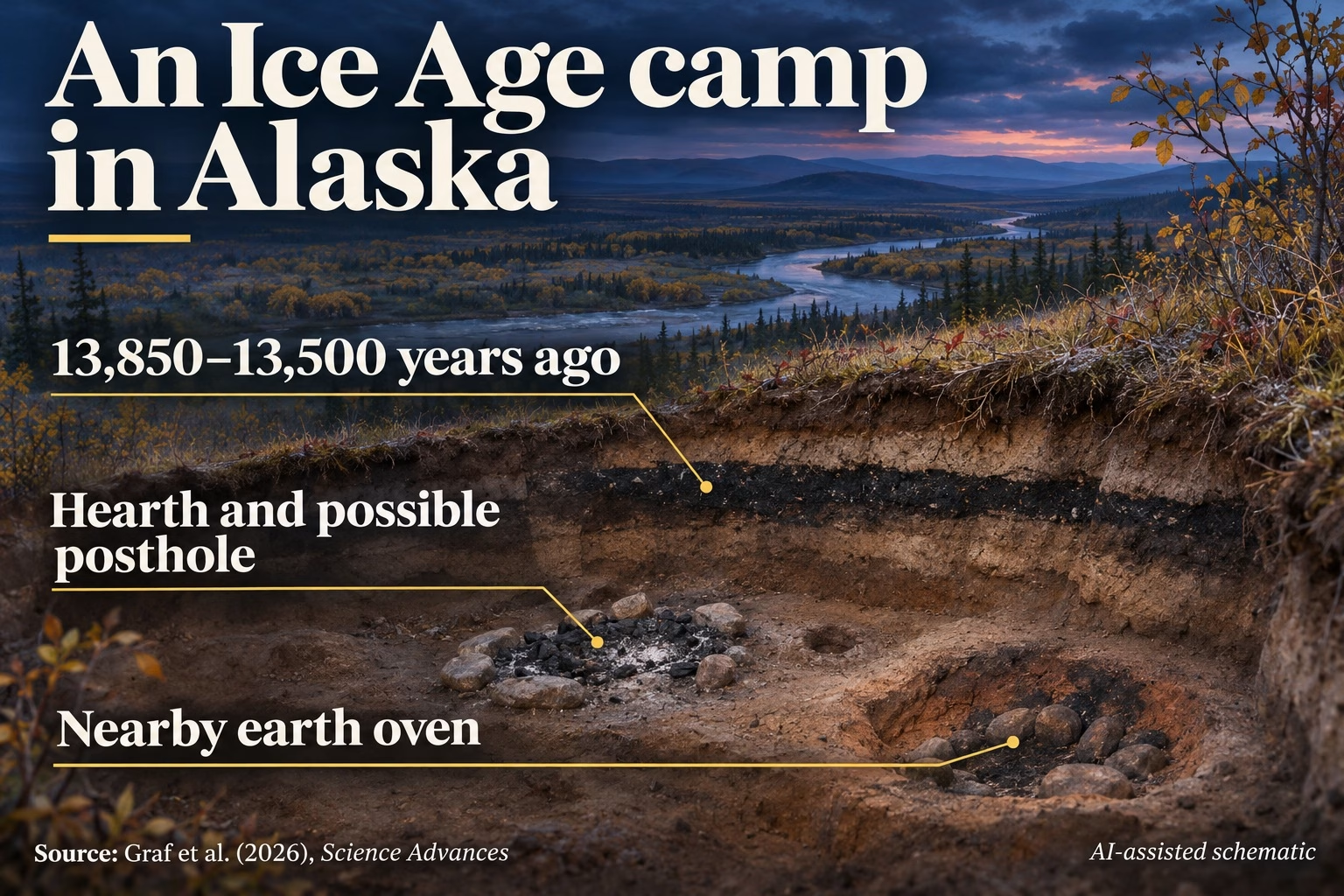
Within that oval, a denser patch of charcoal looks like a hearth. A shallow pit held fragments of bone, stone and charcoal. Just southeast of the oval was a mark in the soil that could have been left by a post. The excavators considered where the fragments clustered in relation to those features. Together, they suggest a partially covered shelter with an opening to the south. The roof shape, materials and full footprint remain uncertain.
That is why the researchers describe the feature as a potential early dwelling. It is an interpretation of several clues in combination. The hearth is easier to recognize on its own. By comparison, a possible posthole takes on meaning because it sits near the hearth, the pit and the surrounding finds. Excavation results and site figures.
A hearth, an oven and evidence of work
Elsewhere in the excavation, the team identified a separate feature rich in charcoal and animal remains. They interpret it as an earth oven that may have been used to cook meat slowly. They also found implements for sewing and stone tools that had been worked and refurbished. In addition, the study points to bone processing near the possible shelter opening and to a concentration of discarded bone a few metres away.
Those spatial relationships tell us more than a list of artefacts does. Toolmaking creates stone chips, cooking leaves burnt material, and throwing scraps aside can build a pile in a recognizable place. Each trace has its own ambiguities. Put them together and you get a picture of people organizing several kinds of work at the same camp.
The dates require a little care. The researchers calibrated radiocarbon measurements from materials including charcoal and bone, then used the order of the deposits to model the ages of the archaeological layers. Their final model places the oldest component between about 13,850 and 13,500 calendar years before present, with evidence for later occupations above it. The range can contain separate visits. Its endpoints give a window for the deposits, while the duration of any one stay is harder to estimate. Study methods and chronology.
What does this Ice Age camp in Alaska tell us about migration?
During the last Ice Age, lower seas exposed land between northeastern Asia and Alaska. That connection was part of a much larger region called Beringia. Shég’ Xdaltth’í’ lies well inland in what is now Alaska, so its evidence speaks most directly to how people were living in eastern Beringia after they were already there. National Park Service background on Beringia.
One clue to a connection across that region is a distinctive biface, a stone tool shaped on both faces and designed to fit a handle. The study draws parallels with tools of a similar age on the western side of the former land bridge. Tool design can travel through people moving, learning from one another or inheriting a shared practice. From the tools alone it is difficult to tell which process brought this particular form to the Tanana basin.
There is also evidence of movement closer to home. The team traced obsidian from the oldest layer to a source about 370 kilometres west-northwest of the site. That tells us where the stone came from. However, the people who used it could have fetched it themselves or acquired it through others. Local stoneworking and long-distance connections can leave traces in the same handful of debris. The peer-reviewed Beringia study.
How settled were the people who used it?
The authors see the density of remains, possible shelter and investment in cooking as evidence for a base camp. That could mean fairly long stays, repeated use of a good location or some combination of both. Seasonality is an open question. Future work on plant remains and animal bones may help show when people hunted, cooked and returned.
Today the site lies on the traditional lands of Mendas Cha’ag and Nenana communities. Coauthors Evelynn Combs of the Healy Lake Tribal Council and Donald Charlie of the Nenana Native Association contributed to the research. The name they helped carry into the scientific record is an apt description of what the excavations can establish. People were there, and the things they did left a recognizable pattern.
For another example of what archaeologists can learn by tracking the position of bones and other finds, read our coverage of the burials at Göbekli Tepe.



latest video



news via inbox
Subscribe to our Cosmic newsletter to get notified when we have new articles.