The Almost Invisible Galaxy Dominated by Dark Matter
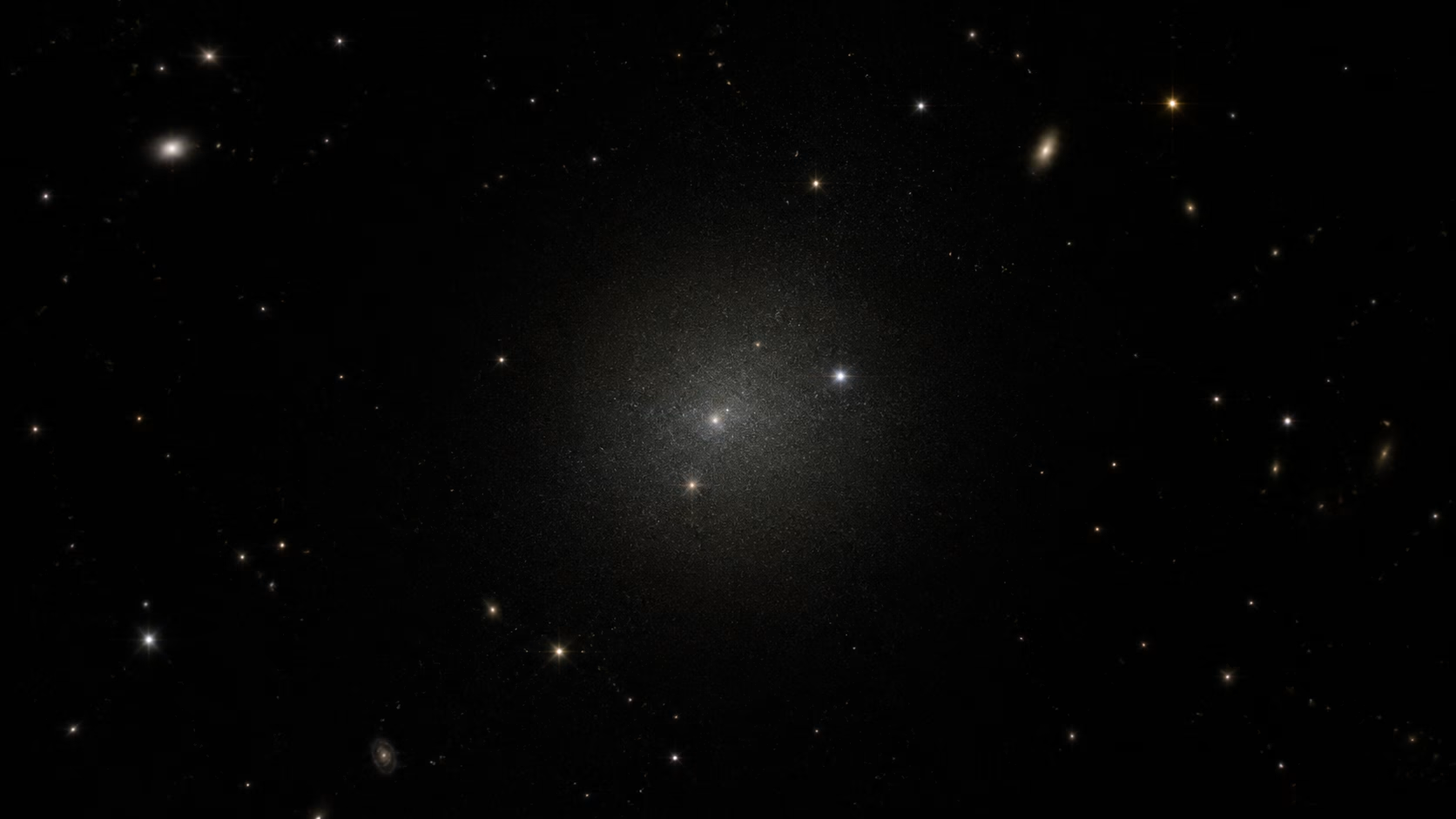
At first glance, there is almost nothing to see. A few faint points of light sit against the crowded background of the Perseus galaxy cluster. Yet those points may mark one of the most extreme galaxies astronomers have found: a small, ghostly system whose visible stars account for only a tiny fraction of its estimated mass.
The object is known as Candidate Dark Galaxy-2, or CDG-2. It was identified by combining observations from ESA’s Euclid space telescope, the NASA/ESA Hubble Space Telescope and Japan’s Subaru Telescope. The result is not a photograph of dark matter itself—dark matter does not emit or reflect light—but a careful measurement of how much unseen mass must be present to hold the galaxy together.
CDG-2 matters because it brings an abstract idea into focus. Dark matter is usually discussed on the scale of enormous galaxies and galaxy clusters. Here, astronomers may be looking at a compact system in which the invisible component overwhelms almost everything we can see.
A galaxy with barely any starlight
Most galaxies announce themselves through billions of stars. CDG-2 is different. ESA describes it as shining with the light of roughly one million Suns—faint for a galaxy—and apparently containing only four globular star clusters. The Milky Way has more than 150 known globular clusters and hundreds of billions of stars.
That comparison can be misleading if taken too literally. CDG-2 is not a miniature Milky Way. It belongs to a class of low-surface-brightness systems whose stars are spread thinly and can easily disappear into the background. Finding one near the bright, busy Perseus cluster is like noticing a charcoal smudge on a black wall.
Euclid was designed for exactly this kind of work. Its wide field of view can survey large regions of sky while preserving enough detail to reveal faint structures. Hubble then adds sharper imaging, while Subaru contributes deep observations from the ground.
How do you weigh something you cannot see?
Astronomers estimate a galaxy’s mass by studying motion. Stars and globular clusters orbit according to the gravitational pull of everything inside and around the system. If the visible matter cannot provide enough gravity to explain those motions, an unseen component is required.
This is the same basic logic that led astronomers to dark matter in the first place. Galaxies rotate too quickly to be held together by their visible stars and gas alone. Galaxy clusters bend background light more strongly than their luminous matter can explain. Across the universe, gravity repeatedly points to more mass than telescopes can see.
For CDG-2, researchers used the velocities of its globular clusters to estimate the underlying mass. The result suggests an extraordinary ratio of dark to visible matter. Because the galaxy is so faint and the sample is small, follow-up measurements are essential. The word “candidate” in its name is doing real work.
Is it truly a dark galaxy?
The phrase sounds dramatic, but it has a specific meaning. A completely dark galaxy would contain dark matter and perhaps gas while producing virtually no stars. CDG-2 does contain visible stars, so it is not literally dark. It is better described as heavily dark-matter-dominated.
There are also alternative explanations to test. The four bright points identified as globular clusters must genuinely belong to CDG-2 rather than being unrelated objects along the same line of sight. Their measured speeds need to be precise. Interactions with the Perseus cluster could also have stripped stars away, leaving an unusually faint remnant.
None of these possibilities makes the discovery less interesting. If the galaxy lost most of its stars, it becomes evidence of the violence inside galaxy clusters. If it formed inefficiently and never produced many stars, it becomes a laboratory for understanding why some dark-matter halos light up while others remain almost invisible.
Why dark matter is still mysterious
Dark matter is not a convenient label for ignorance. It is a working description supported by several independent lines of evidence: galaxy rotation, gravitational lensing, cluster dynamics, the cosmic microwave background and the large-scale structure of the universe.
What remains unknown is its physical identity. It may consist of particles that interact only weakly with ordinary matter. It could involve axions, weakly interacting massive particles or something not yet proposed. Direct-detection experiments have become remarkably sensitive, but none has produced a universally accepted dark-matter signal.
That leaves astronomers in an unusual position. We can map where dark matter must be and measure how it shapes galaxies, yet we still cannot put a sample in a detector and say, “This is it.”
Why ghost galaxies help
Bright galaxies are complicated. Stars explode, gas cools, black holes feed and radiation pushes material outward. These processes can hide the simpler relationship between a galaxy and its dark-matter halo.
A faint system such as CDG-2 contains less luminous clutter. If its mass can be measured reliably, it may offer a cleaner test of how dark matter gathers and how star formation begins—or fails to begin—inside a halo.
It can also help researchers test computer simulations. Modern cosmological models produce enormous populations of dark-matter halos. Many should be too small or too quiet to form visible galaxies. Finding objects near that boundary tells us whether the simulations resemble the real universe.
A discovery made by cooperation
CDG-2 is also a reminder that major discoveries do not always come from a single spectacular image. Euclid found faint candidates across a large field. Hubble supplied resolution. Subaru added the deep measurements needed to study the system’s motion. The conclusion emerged from those datasets together.
Future observations may strengthen the dark-galaxy interpretation or reveal a more complicated history. Either outcome will be useful. Science advances not by protecting the most exciting label, but by exposing it to better evidence.
For now, CDG-2 sits at the edge of visibility: a handful of stars outlining something much larger that we cannot see.
Related reading


latest video

news via inbox
Subscribe to our Cosmic newsletter to get notified when we have new articles.