NIF’s 8.6-Megajoule Fusion Record: Why a Diamond Capsule Changed Everything
The most important object in a building the size of three football fields was a capsule small enough to rest on a fingertip. On 7 April 2025, the National Ignition Facility delivered 2.08 megajoules of laser energy to a target containing deuterium and tritium. The implosion produced 8.6 megajoules of fusion energy—a target gain above four and the facility’s record.
In April 2026, NIF researchers explained how improvements to the high-density carbon, or diamond, capsule helped make that result possible. The lesson is less glamorous than “unlimited energy,” but more useful: fusion performance depends on microscopic manufacturing quality.
How inertial-confinement fusion works
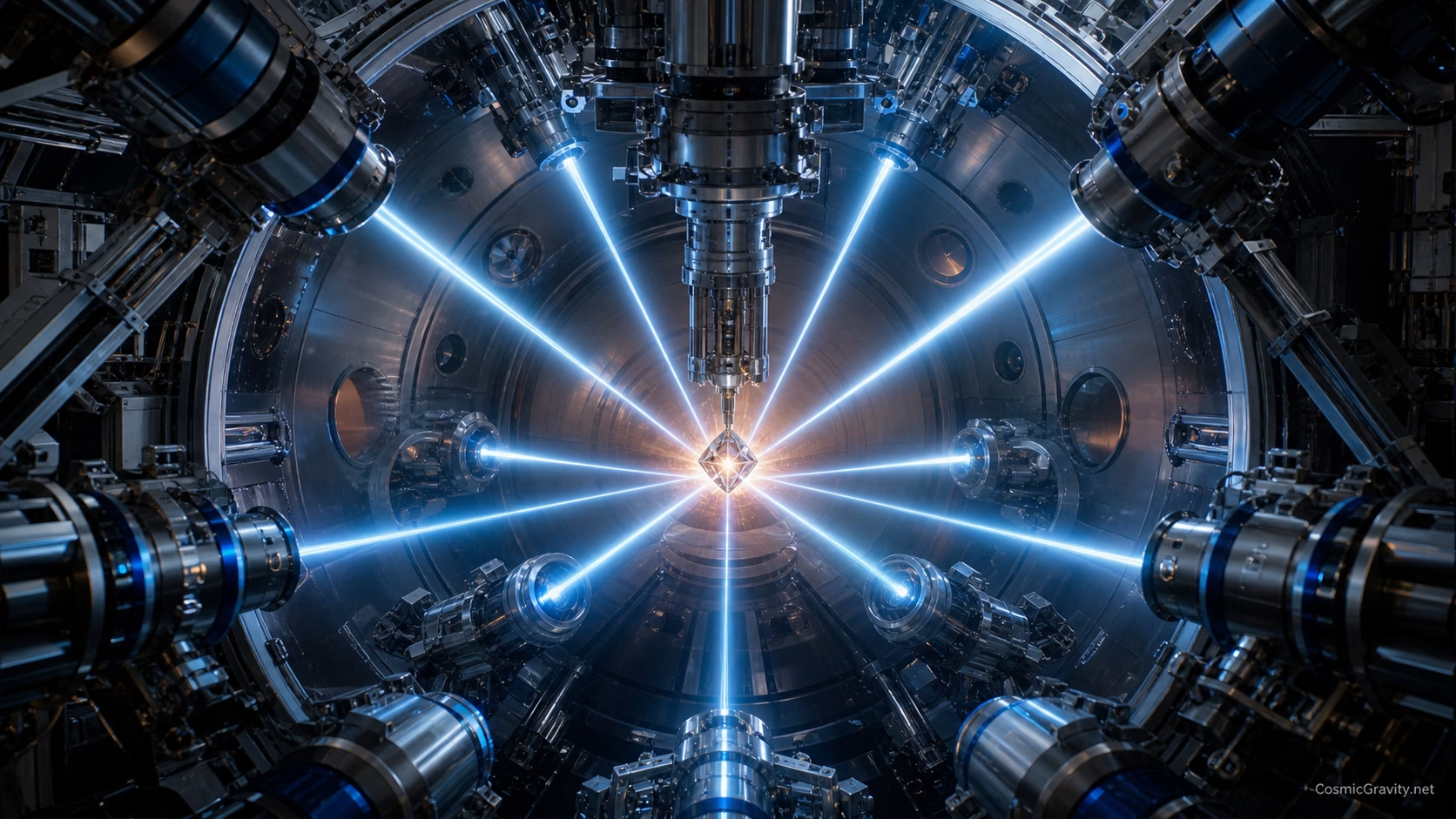
NIF’s lasers do not strike the fuel capsule directly. They heat the inside of a small gold cylinder called a hohlraum. The hot interior produces X-rays that compress the capsule from all directions. If the implosion is sufficiently symmetric, the fuel’s center reaches conditions where fusion reactions heat the surrounding plasma and drive additional reactions.
The entire event lasts a tiny fraction of a second. There is no sustained flame. Each shot is a single, carefully prepared experiment.
Follow the energy through the target
- Facility power: electrical energy charges the laser system. This is much larger than the laser energy delivered to the target.
- Laser pulse: 2.08 MJ reached the target in the record experiment.
- X-ray drive: the hohlraum converted part of that laser light into X-rays.
- Implosion: X-rays compressed the diamond capsule and fusion fuel.
- Fusion yield: reactions released 8.6 MJ, giving a target gain of approximately 4.13.
Key distinction: target gain describes energy at the target, not net electricity from the whole facility.
Why the diamond capsule mattered
The shell must collapse almost perfectly. Tiny defects can seed hydrodynamic instabilities that mix cold material into the hot fuel and quench the burn. NIF uses high-density carbon because it is strong, smooth and efficient at transferring pressure to the fuel.
Researchers also adjusted how dopant was distributed through the capsule. Earlier step-like layers created boundaries where instability could begin. A more continuous profile reduced those interfaces, allowing cleaner compression. The result came from target fabrication, laser timing, diagnostics and simulations working together—not one magic material.
Is this ignition?
Yes, by NIF’s scientific definition: fusion heating became strong enough to create a self-sustaining burning plasma, and the fusion output exceeded the laser energy delivered to the target. NIF has repeated ignition multiple times. Its official timeline lists an eleventh ignition on 20 June 2026, yielding 7.9 MJ with a target gain of roughly 3.8.
Repeatability matters. A one-off record demonstrates possibility; repeated ignition shows that researchers can explore the regime rather than merely touch it.
Fusion claim checker
| Claim | Verdict |
|---|---|
| “The capsule produced more energy than the laser delivered to it.” | Correct. 8.6 MJ out versus 2.08 MJ on target. |
| “NIF produced net electricity.” | Incorrect. The facility consumed far more energy than the fusion yield. |
| “Ignition has been repeated.” | Correct. NIF lists eleven ignition shots through June 2026. |
| “A commercial reactor is now ready.” | Incorrect. Repetition rate, efficiency, fuel supply and economics remain unsolved. |
What a power plant would need
- Efficient lasers that convert electricity into target energy far better than NIF.
- Targets manufactured cheaply and injected many times per second.
- A chamber able to survive continuous neutron and debris exposure.
- A practical tritium-breeding fuel cycle.
- Heat capture and turbines that deliver reliable electricity.
- Maintenance systems that operate around activated materials.
NIF was built primarily for stockpile stewardship and extreme-physics research, not as a prototype utility. Judging it as a commercial generator misses its purpose. At the same time, the physics data are directly relevant to groups trying to design inertial-fusion energy systems.
Why 8.6 MJ still matters
The record shows that once an implosion crosses the ignition threshold, small improvements can create large increases in yield. It also demonstrates that computer models are becoming better at identifying where mix and asymmetry begin. That feedback loop—fabricate, fire, diagnose, model, improve—is the actual technology story.
Fusion has not solved the world’s energy problem. But a diamond capsule turning a 2.08-MJ laser pulse into 8.6 MJ of fusion energy is no longer a theoretical promise. It is an experiment that happened, was measured and has been followed by additional ignition shots. The distance from that event to a power grid remains enormous. The door to that distance is now open.
Sources and further reading


latest video


news via inbox
Subscribe to our Cosmic newsletter to get notified when we have new articles.