A Silicon Quantum Processor That Controls Itself Inside the Cryostat
The most intimidating part of a quantum computer is often not the quantum chip. It is everything hanging above it. Today’s systems depend on racks of room-temperature electronics and a dense forest of cables descending into a refrigerator. That works for dozens or hundreds of qubits. At a million, the wiring becomes a physical problem before the algorithm even begins.
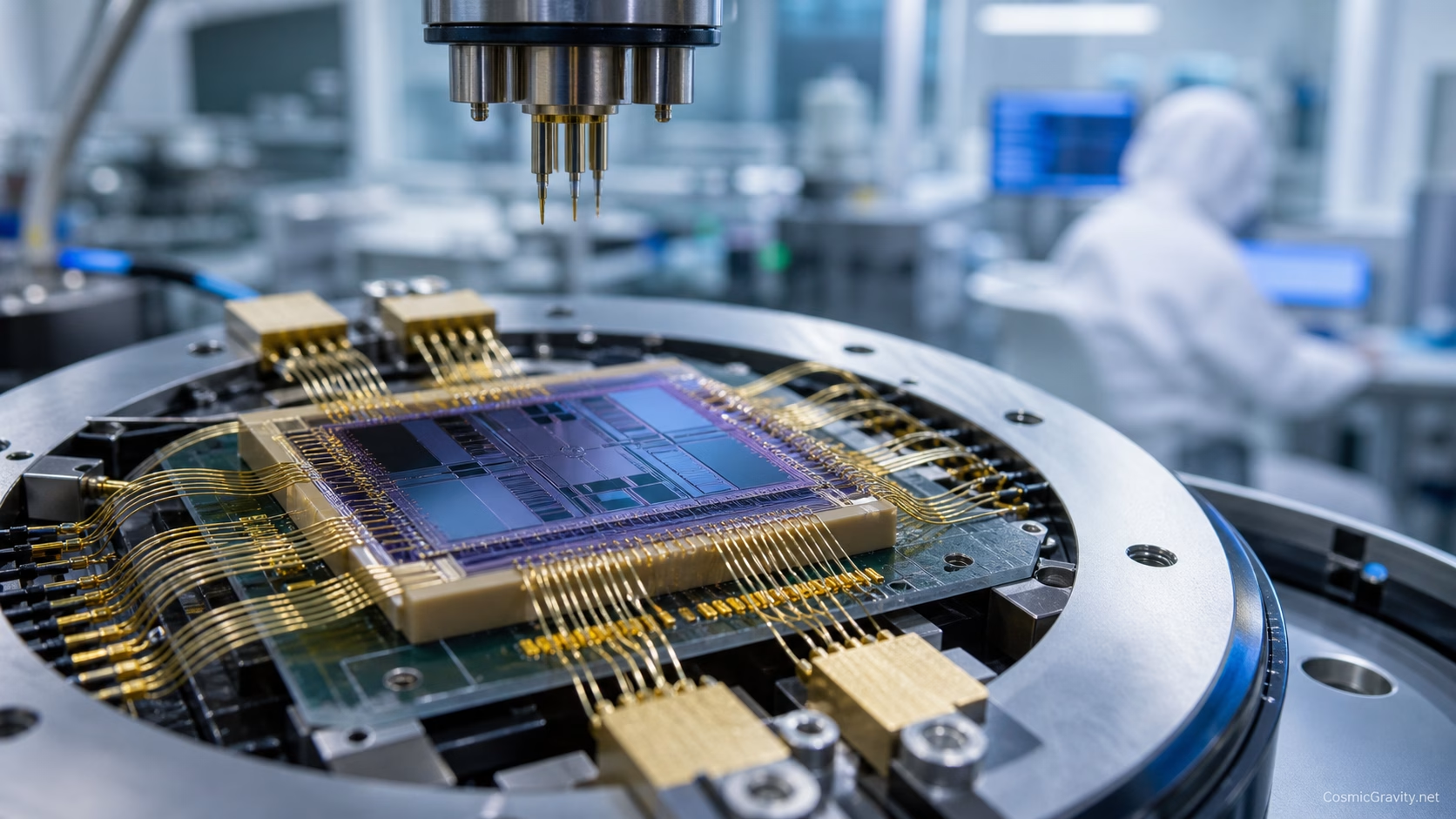
On 29 July 2026, HRL Laboratories described a different architecture in Nature: an 18-qubit silicon processor whose custom digital controller operates inside the cryostat and runs error-correction routines without real-time commands from room-temperature equipment.
The wiring wall
Every qubit needs precisely timed signals. Conventional systems generate those signals at room temperature, route them through filters and coaxial cables, then deliver them to a device a fraction of a degree above absolute zero. Each cable carries heat and occupies space. Increasing the qubit count eventually turns the refrigerator into a crowded plumbing problem.
HRL’s solution places the programmable controller at roughly –450°F inside the cryostat. It generates the necessary signals near the qubits. A superconducting ribbon carries hundreds of control lines toward the colder quantum layer while limiting heat transfer.
Trace one quantum instruction
- Program: a digital instruction enters the cryogenic controller.
- Pulse generation: the controller creates the timing and voltage pattern required by the silicon qubit.
- Cold connection: a superconducting ribbon carries many signals through a compact path.
- Quantum operation: the exchange-only qubits execute sub-microsecond gates.
- Error correction: the cold controller coordinates the repetition code without a live room-temperature feedback loop.
Why silicon matters
Silicon has an enormous industrial advantage: the world already knows how to manufacture it. Exchange-only spin qubits can be patterned using semiconductor techniques, and the controller was made at a commercial foundry. That does not mean an ordinary laptop factory can start producing quantum processors tomorrow. The tolerances, materials and cryogenic packaging remain specialized. It does mean the architecture can borrow decades of manufacturing knowledge.
The paper reports control errors roughly ten times lower than earlier demonstrations of this qubit type. Operations took less than a microsecond, and adding more qubits to the repetition code reduced errors by about a factor of five. That trend—errors falling as protection increases—is essential. An error-correcting code that creates more trouble than it removes cannot scale.
Does “runs itself” mean autonomous quantum AI?
No. The phrase describes local control, not independent intelligence. The system executes programmed routines with its controller inside the cold environment. It does not choose research questions or rewrite its own algorithms. The achievement is engineering autonomy: the quantum layer no longer needs every pulse improvised by external racks in real time.
The three temperatures inside the machine
- Room temperature: user interface, compilation and high-level orchestration.
- Cryogenic control stage: digital electronics work in extreme cold but remain warm relative to the qubits.
- Quantum stage: the silicon qubits sit much closer to absolute zero, protected from thermal noise.
The superconducting interconnect must carry information between these zones without carrying too much heat.
What still has to scale?
- The demonstration used 18 qubits, far from a fault-tolerant general-purpose machine.
- Cryogenic controllers consume power, and refrigeration capacity is limited.
- Manufacturing yield must remain high across far larger arrays.
- Error-correction overhead may demand many physical qubits for every logical qubit.
- Packaging, calibration and readout must scale together.
Those caveats are exactly why the work is interesting. It treats the quantum computer as a complete system rather than a chip surrounded by temporary laboratory equipment. The companion story is the 70-logical-qubit quantum advantage experiment, which shows what protected circuits can do when the control stack succeeds.
The future quantum computer may not resemble today’s chandeliers of cables. If silicon qubits and cryogenic digital control mature together, much of the machinery could collapse into a manufactured module inside one refrigerator. That is less visually dramatic—and far more useful.
Sources and further reading


latest video



news via inbox
Subscribe to our Cosmic newsletter to get notified when we have new articles.