The Herculaneum Scrolls Are Finally Revealing Lost Books
For nearly two thousand years, the Herculaneum scrolls survived as blackened, brittle cylinders that could be destroyed by the act of opening them. In June 2026, researchers announced a breakthrough: entire stretches of lost philosophy are now being read without physically unrolling the papyrus.
The Vesuvius Challenge and its academic partners have virtually unwrapped scrolls in Naples and Oxford, recovering new titles, authors and enough continuous text to follow arguments across dozens of columns.
A library buried by Vesuvius
When Mount Vesuvius erupted in AD 79, hot gases and ash buried Herculaneum. The same disaster that destroyed the Roman town also carbonised papyrus rolls in a villa later known as the Villa of the Papyri.
Carbonisation preserved the scrolls, but left papyrus and ink almost the same dark colour. Early attempts to peel them open damaged many fragments. Hundreds remained closed because the mechanical risk was too high.
How virtual unwrapping works
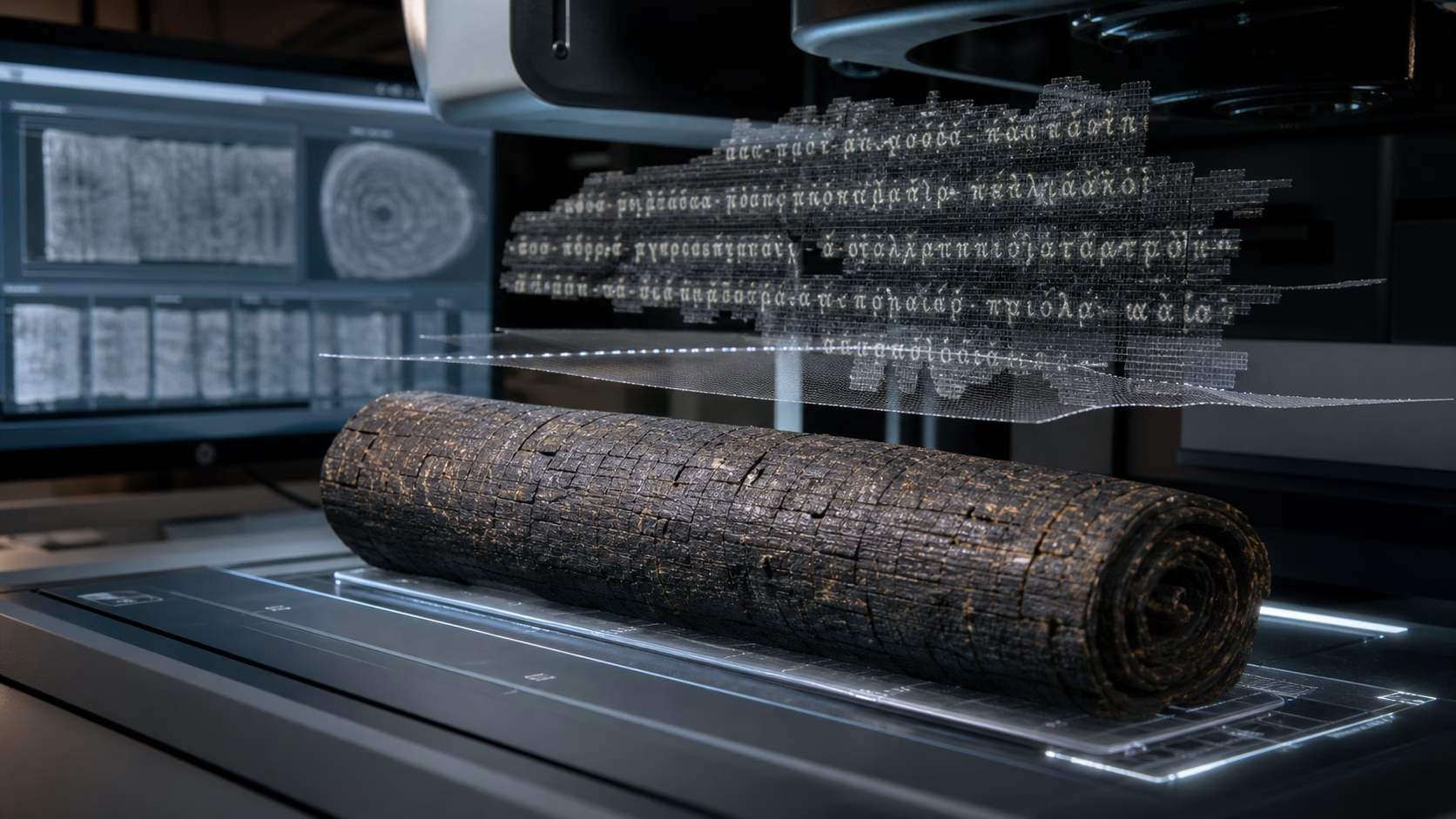
Researchers scan an intact scroll with high-resolution X-ray tomography. Software maps the tightly folded layers inside the three-dimensional volume. It then separates those surfaces computationally and flattens them into images that a papyrologist can read.
The hardest step is detecting ink. Ancient ink may produce only a subtle texture or density difference. Machine-learning systems trained on visible and hidden writing help identify patterns consistent with strokes, while experts verify letter forms and language.
Artificial intelligence is important, but it does not translate a scroll by itself. Imaging specialists, computer scientists and scholars of Greek papyri work in sequence. Each discipline checks the others.
PHerc. 1667 speaks across twenty columns
One of the major results concerns PHerc. 1667, housed in Naples. A section considered unreadable after an attempt to open it in the 1980s has now yielded nearly 1.5 metres of continuous text across about twenty columns.
The work discusses Stoic concepts including impulse and practical wisdom. Its early date and content suggest that the author may not be Philodemus of Gadara, whose Epicurean writings dominate the known Herculaneum library.
If the attribution remains outside Philodemus, the scroll could preserve a philosophical voice not otherwise represented in surviving literature. That is more than recovering words; it is restoring an argument lost from intellectual history.
A missing volume of On Gods
Another scroll, PHerc. 139, revealed an end title identifying “Philodemus, On Gods, Book 8.” Previously, only the first book of that work was securely known.
The title proves that the series extended to at least eight books. Early readings contain references to providence, invisible entities, nature, living beings and the future. Scholars can now reconsider related theological fragments as possible parts of the same larger work.
More than seventy columns from Oxford
Researchers also reported more than seventy recovered columns from PHerc. 172 in Oxford’s Bodleian Library. The scale matters because isolated letters or phrases provide limited context. Long passages reveal structure, reasoning and how one section responds to another.
For the first time since antiquity, scholars can prepare new critical editions from texts that were physically present but intellectually inaccessible.
Why the discovery is different from a normal excavation
An archaeologist usually removes soil to expose an object. Here, the object has been known for centuries. The excavation takes place inside data, with software separating layers that cannot safely be touched.
The method resembles the reconstruction of the Antikythera mechanism, where scans reveal hidden gears and inscriptions inside corroded fragments. Both projects show that new technology can reopen questions about artefacts discovered generations ago.
What may still be inside the villa?
The excavated collection is the only substantial library surviving from the ancient Greco-Roman world. Some archaeologists believe additional rooms or scrolls may remain buried at the Villa of the Papyri.
Even without new excavation, hundreds of existing rolls await scanning and analysis. The challenge is enormous: every scroll contains tangled layers, cracks and distortions. But the 2026 results prove that sustained passages and complete book titles can be recovered.
Technology does not remove uncertainty
Virtual readings must still be reviewed. Damaged letters can support more than one reconstruction, and philosophical context may change an interpretation. Responsible editions show uncertain characters rather than silently guessing.
That humility is familiar across archaeology. At Göbekli Tepe, remarkable evidence invites big stories, but the strongest history keeps a visible line between material facts and interpretation.
A lost library becomes readable
The Herculaneum scrolls are no longer sealed in the same way. Their papyrus remains rolled and fragile, but the text can travel through scanners, algorithms and scholarly review without the original being destroyed.
Future recovered works may alter what we know about Epicureanism, Stoicism, science, religion or Roman literary culture. Some may confirm known ideas; others may return authors whose names have disappeared.
The breakthrough is a rare meeting of preservation and discovery. The scroll survives, the method is repeatable and a voice silent since the eruption of Vesuvius can be heard again.
Source: University of Kentucky: 2026 Herculaneum scroll breakthrough.

latest video

news via inbox
Subscribe to our Cosmic newsletter to get notified when we have new articles.