Gemini Robotics-ER 1.6: When AI Starts Reading the Physical World
A language model can be confidently wrong and still leave nothing worse than a bad paragraph. A robot does not have that luxury. When software touches valves, tools, doors and people, reasoning errors become physical events. Google DeepMind’s Gemini Robotics-ER 1.6, released in April 2026, is an attempt to make that transition safer and more useful.
The model is not a motor controller. It acts more like a high-level supervisor: interpreting scenes, locating objects, reading instruments, planning a task, calling digital tools and checking whether the job succeeded.
Why reading a gauge is harder than it looks
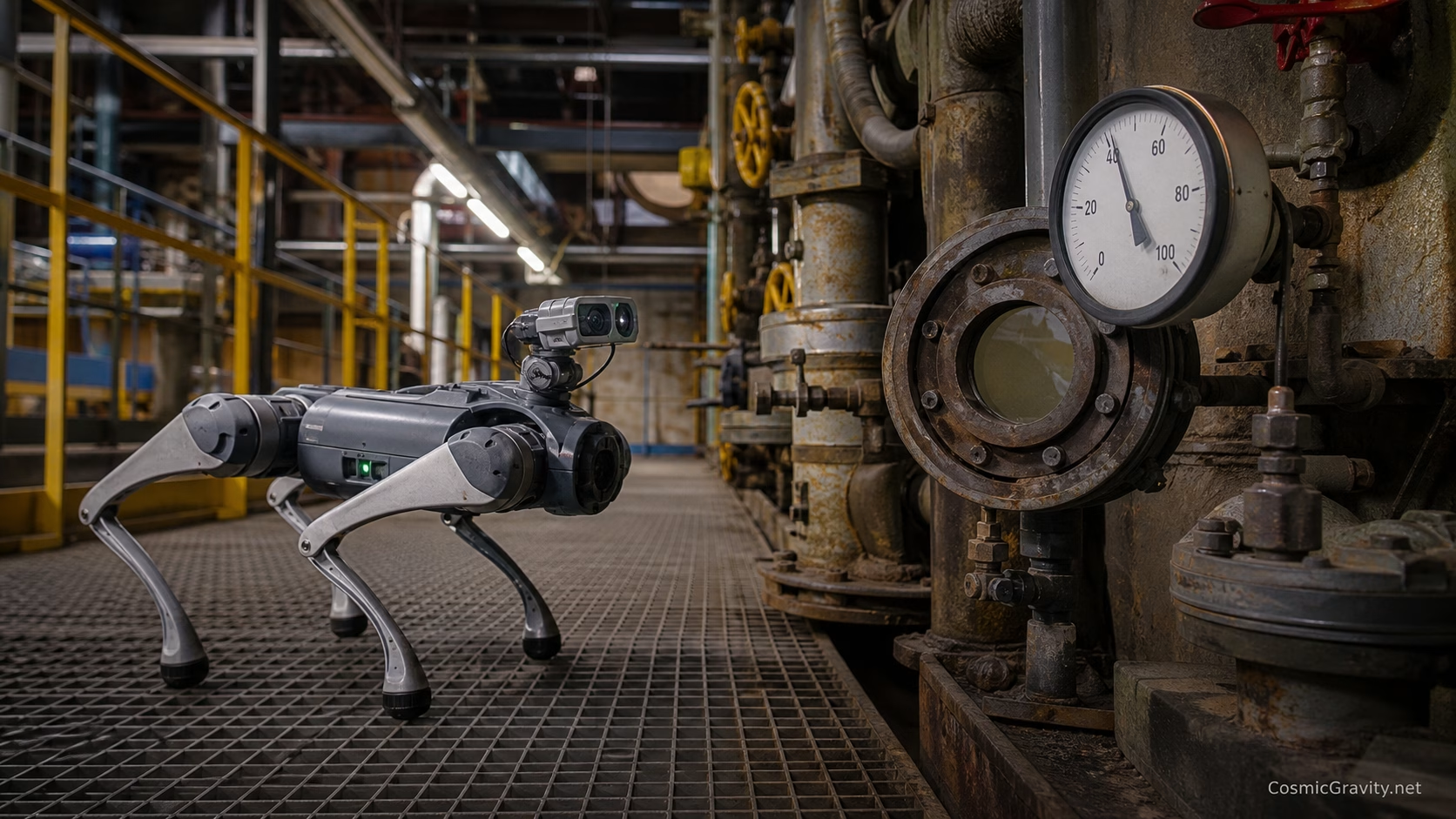
A human technician sees a circular dial and immediately combines several facts: where the needle begins, which scale applies, what units are printed, whether perspective distorts the view and whether the value is safe. A vision model must reconstruct all of that from pixels.
Sight glasses add another difficulty. The apparent liquid level changes with camera angle, reflections and the shape of the container. Reliable reading therefore requires geometry, not just text recognition. DeepMind developed the feature with industrial inspection scenarios in mind, including work with Boston Dynamics.
How an embodied AI inspection could work
- Observe: capture the instrument from one or more viewpoints.
- Identify: distinguish the needle, scale, units, tick marks and safe range.
- Calculate: correct perspective and estimate the reading.
- Verify: compare another view or digital sensor when available.
- Decide: log the value, continue the route or alert a human.
- Confirm: check that the action produced the intended result.
From chatbots to physical agents
Embodied AI links language and perception to action. Gemini Robotics-ER can call a lower-level vision-language-action model, a robot’s navigation stack or external tools. The high-level system plans; specialized components execute. That separation is similar to how a human supervisor coordinates technicians and instruments rather than controlling every muscle directly.
According to DeepMind, version 1.6 improves spatial reasoning, pointing, counting and success detection compared with its earlier model. Success detection is particularly important. A robot that can plan but cannot recognize failure may repeat the wrong motion or leave a task half finished.
Where this becomes useful first
- Routine inspection of industrial gauges and valves.
- Warehouses where objects and layouts change frequently.
- Hazardous areas that are expensive or unsafe for human entry.
- Maintenance documentation built from images and sensor readings.
- Laboratories that need consistent visual checks.
Domestic robots are the obvious popular image, but industry is the more realistic early market. A plant has defined routes, known equipment and measurable outcomes. A cluttered home contains soft objects, pets, children and countless exceptions.
Risk dashboard: what must be checked?
| Failure mode | Practical safeguard |
|---|---|
| Misread gauge | Second viewpoint, calibrated uncertainty and sensor cross-check. |
| Wrong object selected | Human-readable confirmation before irreversible action. |
| Outdated procedure | Version-controlled instructions from an approved source. |
| Unsafe movement | Independent collision avoidance and emergency stop. |
| False success signal | Verify the physical outcome, not only the robot’s planned action. |
The uncomfortable question: who is responsible?
When a physical agent makes a mistake, responsibility cannot disappear into the word “AI.” Developers define the model, integrators choose tools, operators approve procedures and site owners decide where autonomy is acceptable. Logging must show what the system saw, which tools it called and why a safety limit triggered.
The same visual trap that complicates UAP video analysis also applies to robots: perspective can turn ordinary motion or an ambiguous shape into a confident but false interpretation. Multiple sensors and measured geometry remain more trustworthy than appearance alone.
What version 1.6 does not mean
It does not create a general-purpose human replacement. It does not remove the need for low-level safety systems. And benchmark improvements do not guarantee performance in every factory. The practical breakthrough is narrower: a reasoning model can now read more of the physical world and coordinate tools around that understanding.
That narrow step may prove consequential. Once robots can reliably interpret gauges, instructions and outcomes, they stop being machines that repeat one taught motion. They become adaptable inspectors and assistants. The decisive word is not intelligent. It is reliable.
Sources and further reading

latest video


news via inbox
Subscribe to our Cosmic newsletter to get notified when we have new articles.