Andromeda’s Star Formation Is Fading Faster Than Expected
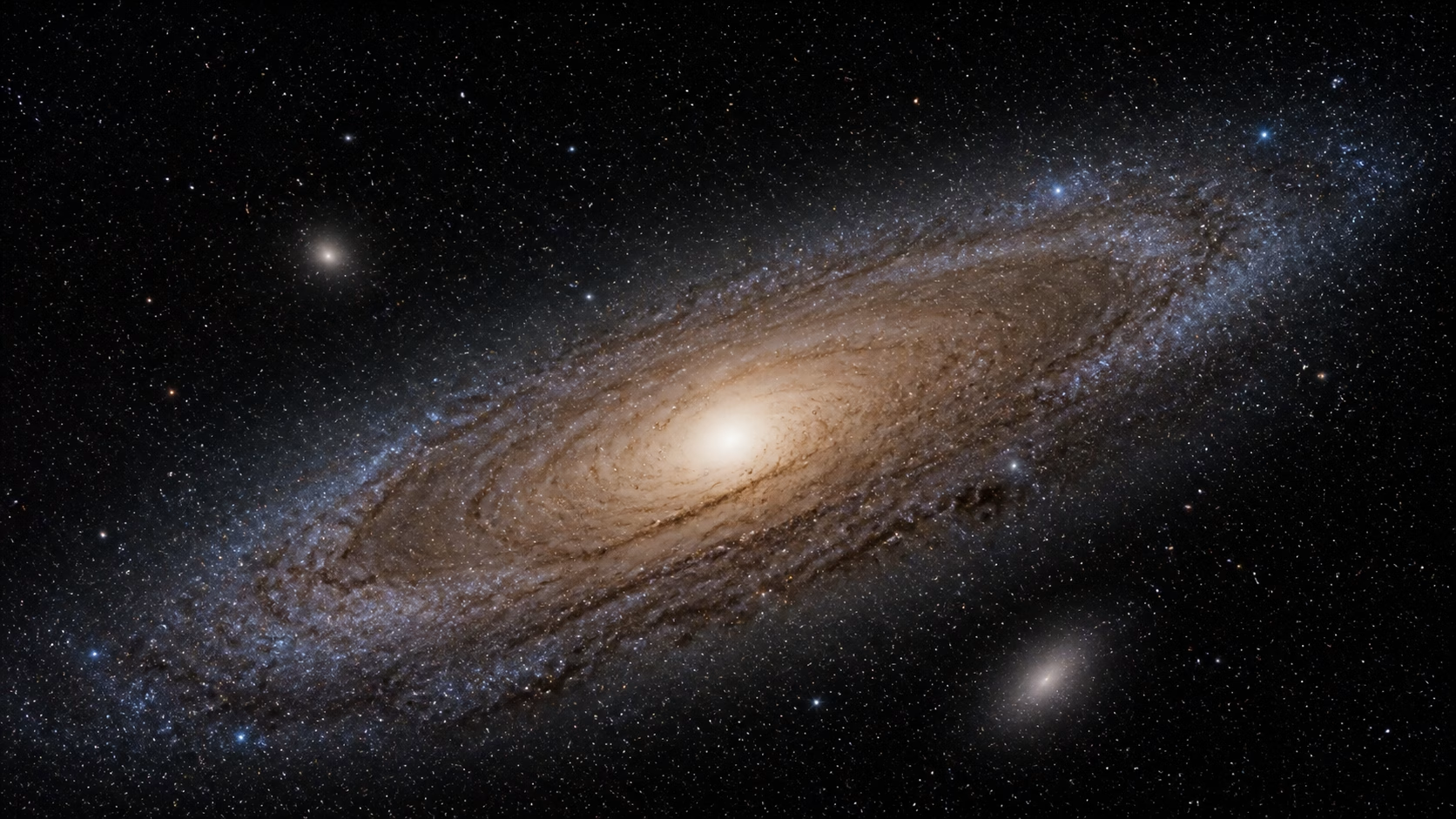
The Andromeda Galaxy looks serene in a dark sky, but its recent history has been surprisingly restless. A new Hubble study finds that Andromeda star formation has declined for roughly 500 million years and dropped even more steeply during the last 40 million years.
Andromeda, also called M31, lies about 2.5 million light-years away. That is distant by everyday standards but close enough for astronomers to study millions of individual stars. The galaxy therefore acts as a detailed neighbourly comparison for our own Milky Way.
A galaxy divided into thousands of histories
Researchers used Hubble observations to divide part of Andromeda into thousands of squares, each about 300 light-years across. By measuring the colours and brightness of stars in every section, they reconstructed when those stars formed.
Blue, massive stars live fast and die young, so their presence marks recent star formation. Older stellar populations appear redder and more settled. Combining these populations produced a map not only of where stars are forming now, but how activity changed over hundreds of millions of years.
The numbers show a long slowdown
About 500 million years ago, Andromeda converted gas into new stars at a rate close to one solar mass per year. By 40 million years ago, that rate had fallen to about half a solar mass per year. Today it is near one-fifth of a solar mass annually.
The decline is not perfectly uniform. Much of Andromeda’s recent activity has been concentrated in a ring roughly 32,000 light-years from the centre. As that ring quieted, the galaxy-wide rate fell with it.
This does not mean Andromeda is dying tomorrow. Galaxies evolve on enormous timescales. Even a reduced rate can continue producing stars for a very long time. But the pattern shows that M31 has moved away from a more energetic phase.
What happened two billion years ago?
Earlier work found evidence for a burst of star formation about two billion years ago. A collision or close interaction with another galaxy may have compressed gas and triggered that surge. Since then, the system appears to have been gradually winding down.
Astronomers first ask whether a galaxy is running short of cold gas, the raw material for new stars. In Andromeda, the new results suggest that simple fuel exhaustion does not tell the whole story. The decline may be the natural aftermath of the earlier burst.
Is the small galaxy M32 responsible?
M32, a compact satellite galaxy, appears close to Andromeda in the sky. Researchers examined the area of M31 nearest to it and found a stronger local decline beginning around 60 million years ago.
That timing makes M32 an attractive suspect. A passage through Andromeda’s disk could disturb gas, alter orbits and temporarily change star formation. The difficulty is that astronomers do not yet know M32’s exact three-dimensional position and past trajectory. The evidence is suggestive, not a final reconstruction.
This careful distinction matters. A visible correlation can point toward a cause without proving it. The same discipline is essential when interpreting unusual sensor observations: location and timing are clues, but a robust conclusion needs geometry and independent measurements.
What Andromeda can tell us about the Milky Way
From inside the Milky Way, dust and our position in the disk make it difficult to obtain a single clear overview. Andromeda gives us an external view of a broadly similar spiral galaxy. We can map its disk as a whole and still resolve individual stellar populations.
That makes M31 a bridge between local stellar astronomy and the study of very distant galaxies, where individual stars blur together. If researchers can connect Andromeda’s present structure to its merger history, they gain a template for interpreting galaxies across cosmic time.
Roman will expand the view
NASA’s Nancy Grace Roman Space Telescope is expected to image Andromeda’s entire disk and parts of its halo after launch. Roman combines sharp infrared vision with a field of view at least 100 times larger than Hubble’s.
The resulting survey could measure hundreds of millions of stars. It may show whether the decline seen by Hubble continues across the far side of the galaxy, reveal additional structures left by past mergers and better constrain the orbit of M32.
The finding also complements work on nearly invisible systems such as dark-matter-dominated galaxies. Bright spirals and ghostly dwarfs look very different, yet both record their past through the distribution and ages of their stars.
A quieter neighbour, not a dead one
The new study replaces a static picture of Andromeda with a living history. Its star-forming ring is fading, a satellite may have disturbed part of the disk, and the whole galaxy still bears signs of an ancient burst.
Andromeda remains one of the best laboratories for understanding how spiral galaxies age. Its light has travelled 2.5 million years to reach us, but within that light astronomers can read changes spanning hundreds of millions of years.
Source: NASA Hubble: star formation in Andromeda winding down.
latest video

news via inbox
Subscribe to our Cosmic newsletter to get notified when we have new articles.