How S301’s Orbit Could Reveal the Spin of Sagittarius A*
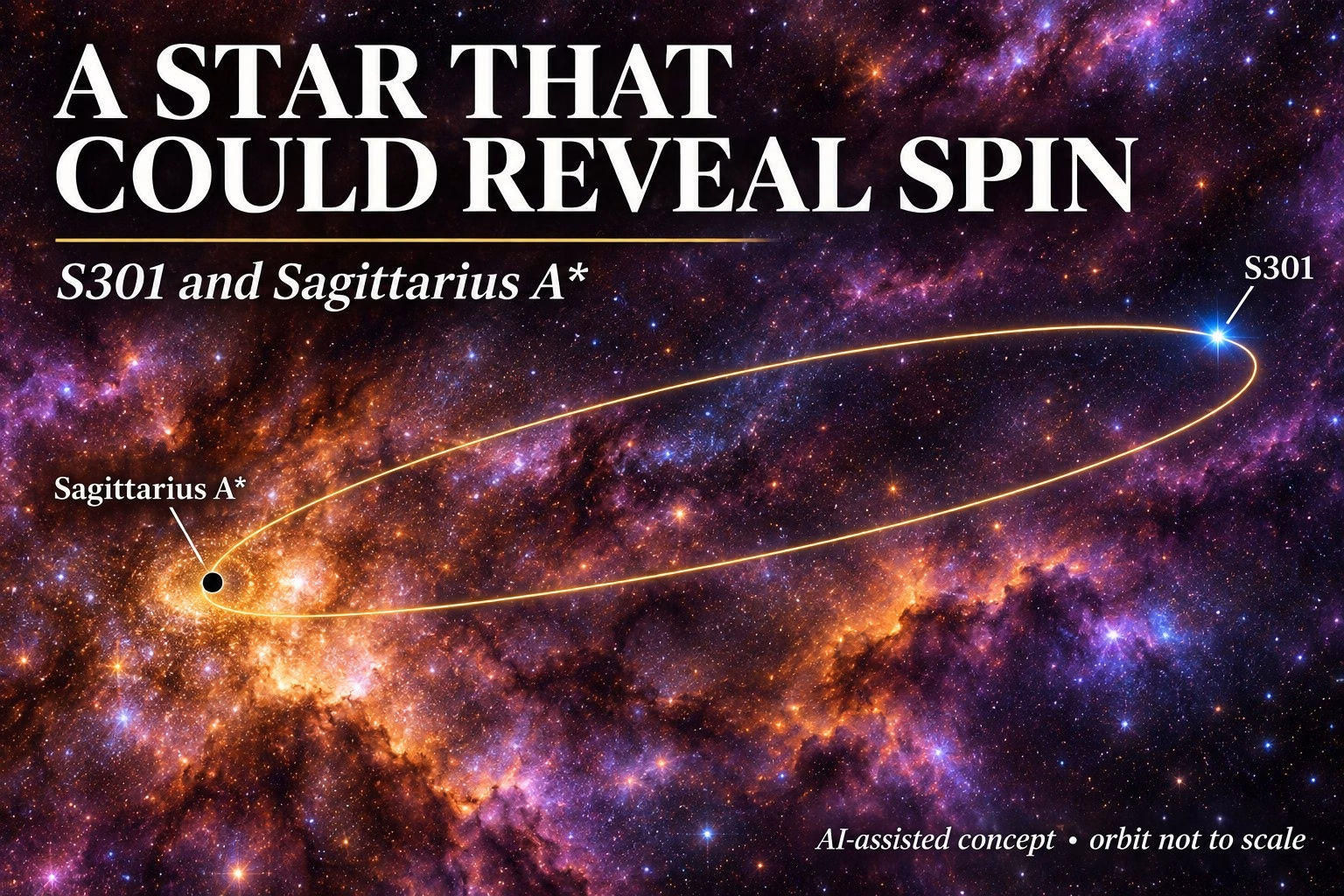
The S301 orbit offers astronomers a way to ask a difficult question about the Milky Way’s central black hole. Can the motion of one faint star reveal how Sagittarius A* spins? The discovery, announced on 19 August 2026, identifies a promising natural experiment whose most demanding measurements still lie ahead.
The distinction matters. Finding a star sensitive to a black hole’s rotation creates an opportunity. Turning that opportunity into a measurement requires observations over time and a model that separates the effects influencing the star’s path.
Why is the S301 orbit so useful?
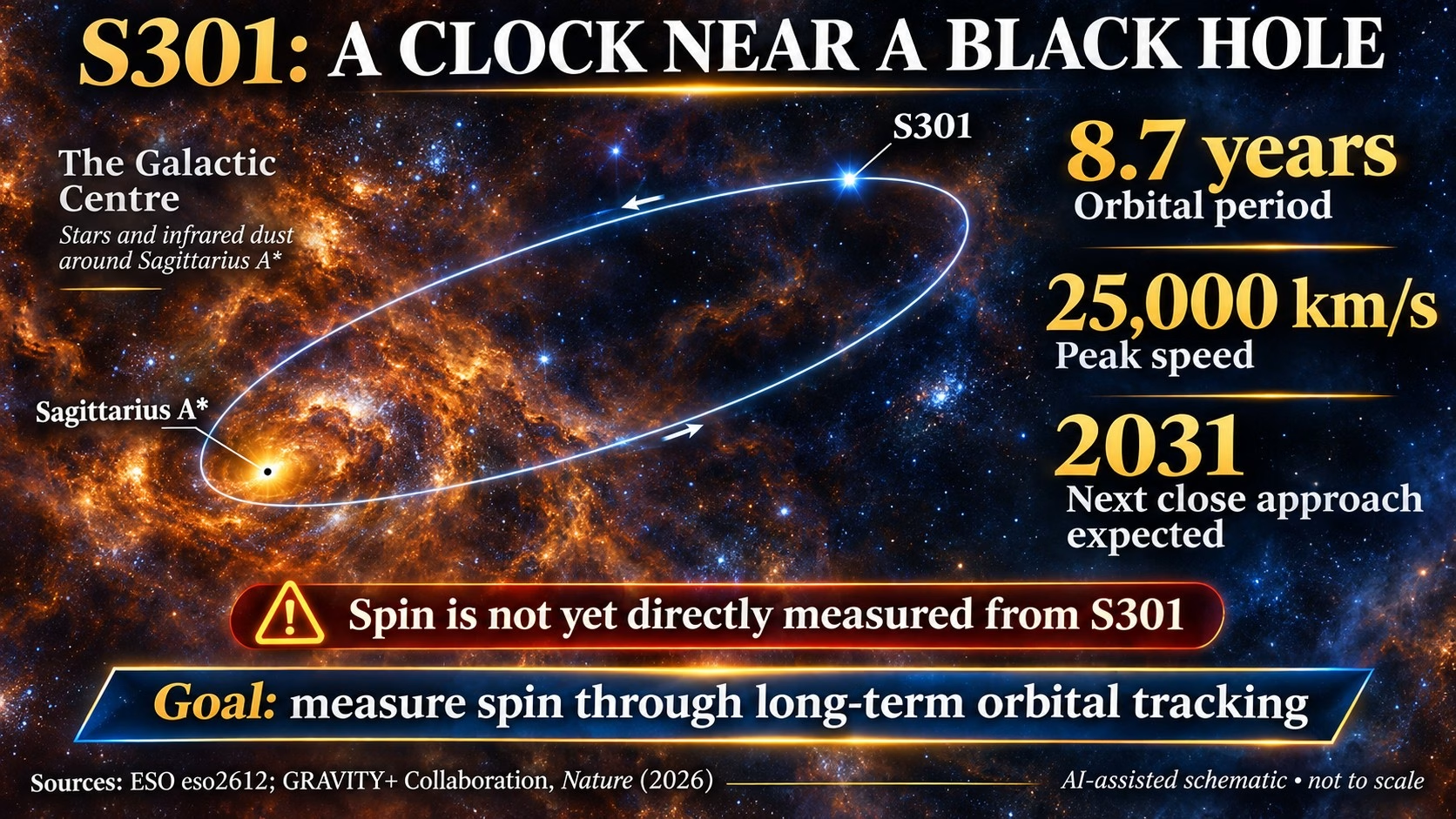
The GRAVITY+ Collaboration reports an orbital period of about 8.7 years and a peak speed of roughly 25,000 kilometres per second, around eight per cent of light speed. The highly elongated path takes S301 close enough to Sagittarius A* for its motion to offer access to the smaller relativistic effects associated with rotation.
The research paper describes the star as a faint main-sequence object. Its authors also argue that the extreme orbit is consistent with capture from a binary system disrupted by the black hole, with the former companion expelled at high speed. That is an interpretation of the orbit, rather than an observation of the proposed breakup. Read the GRAVITY+ research paper.
How can black hole spin alter the S301 orbit?
General relativity predicts that mass curves spacetime and rotation drags it. Researchers call the latter effect frame dragging, or Lense–Thirring precession. Both can influence an orbit, so a changing trajectory has to be analysed carefully before its behaviour can be attributed to spin.
The Max Planck Institute for Extraterrestrial Physics distinguishes the larger Schwarzschild precession associated with the central mass from the smaller rotational effect. Earlier work on the star S2 demonstrated the value of stellar orbits as tests of gravity. S301 moves through a region where the spin contribution is more accessible.
Think of an orbit as a set of measurements rather than a line painted in space. Each observing campaign adds positions, uncertainties and, where available, information about motion toward or away from us. The scientific question is which physical model best accounts for that accumulating record.
How did astronomers pick out such a faint star?
GRAVITY combines light from the Very Large Telescope Interferometer in Chile. The discovery team used this capability to distinguish S301 in the crowded Galactic Centre. MPE describes the combination of instrumental improvements and analysis methods needed to extract the star’s faint signal from its brighter surroundings. MPE’s account explains the observing challenge.
ESO reports that the team first identified S301 in spring 2023 and traced its earlier positions back to 2017. The star’s most recent close passage occurred in early 2023. Recovering those earlier measurements extends the observed arc and helps constrain the orbit.
What must happen before S301 yields a spin measurement?
ESO expects the next closest passage in 2031. The team plans continued tracking with GRAVITY+ and future observations using MICADO on the Extremely Large Telescope. Observations covering at least two complete orbits are intended to constrain the trajectory well enough to determine Sagittarius A*’s spin directly from the stellar motion. ESO’s discovery announcement sets out that programme.
The research paper also explains why closeness matters. The influence of spin falls steeply with distance, making stars that approach the black hole especially valuable. Its discussion places S301 alongside other ways of estimating black-hole spin, including accretion-based methods and gravitational-wave measurements. The aim here is a dynamical measurement using a star as the probe.
That gives the S301 orbit a clear place in black-hole research. It can help test the description of rotating spacetime through an observable object’s motion. For the separate question of how enormous black holes formed, see our explainer on stellar collisions and early black-hole seeds.

latest video



news via inbox
Subscribe to our Cosmic newsletter to get notified when we have new articles.