Gravitational Lensing: How Galaxy Clusters Become Cosmic Telescopes
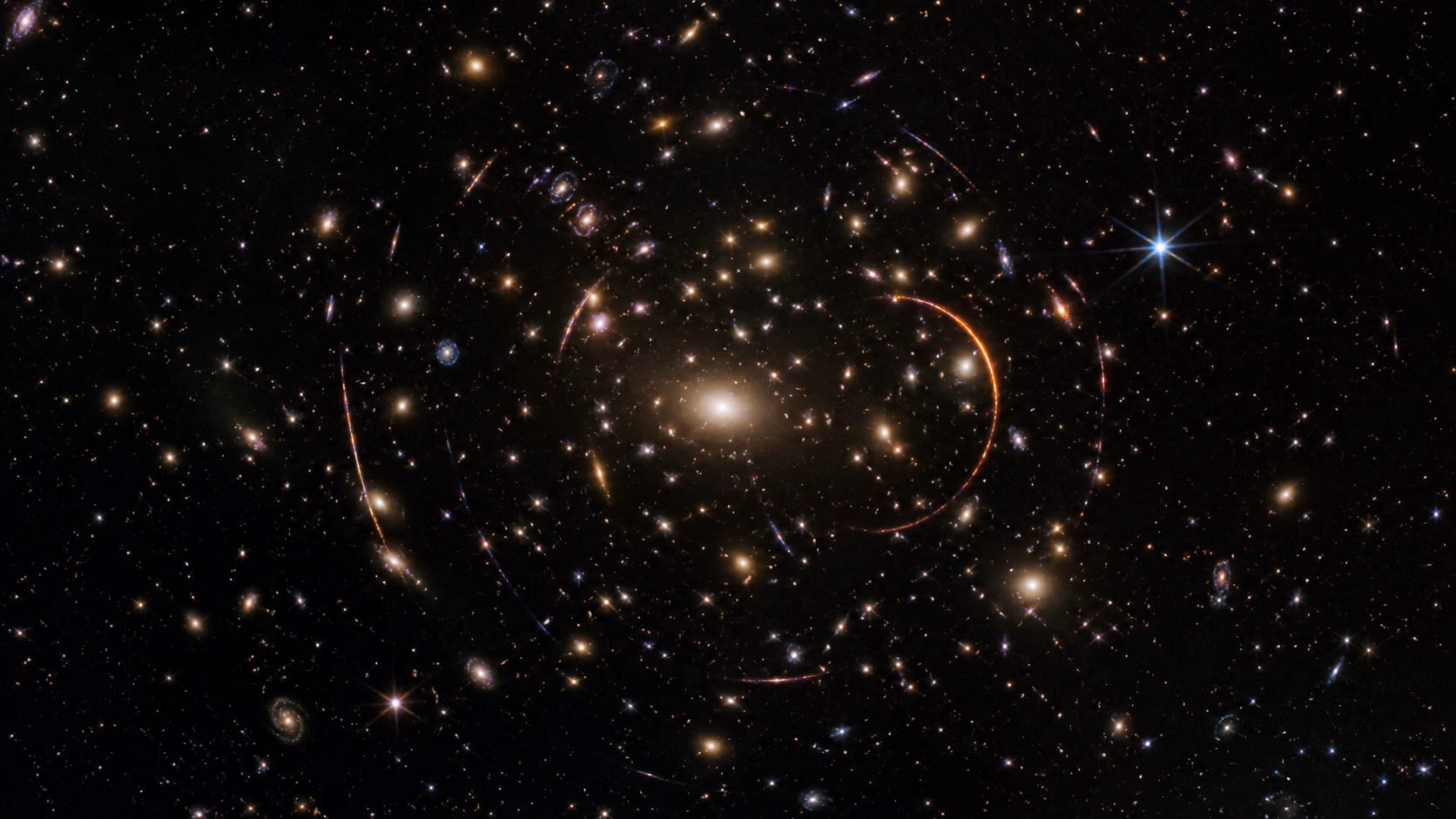
Some of the most distorted galaxies in space photographs are not malformed at all. Their light has been bent, stretched and multiplied by the gravity of a massive object between them and Earth.
Deep-space gravitational lensing turns galaxies and galaxy clusters into natural telescopes. When the alignment is favourable, these cosmic lenses magnify sources too faint or distant for even Webb and Euclid to study on their own.
Gravity bends the path of light
General relativity describes mass and energy as curving spacetime. Light follows the straightest possible route through that curved geometry, which can look bent to a distant observer.
A single star produces a tiny effect. A cluster containing hundreds of galaxies, hot gas and an even larger amount of dark matter can bend light strongly enough to create long arcs, repeated images and rings.
The foreground cluster is the lens, the distant galaxy is the source and Earth is the observer. Change the alignment and the same ingredients produce very different patterns.
Strong, weak and microlensing
Strong lensing creates visible distortions. A background galaxy may appear several times around a cluster or stretch into a bright arc. Near-perfect alignment can form an Einstein ring.
Weak lensing is subtler. Individual galaxies look almost normal, but the shapes of thousands show a small statistical alignment. Astronomers use that shared distortion to map the gravity—and therefore the mass—between us and the galaxies.
Microlensing usually involves a star or planet briefly magnifying a more distant star. It rarely produces a resolvable arc, but the changing brightness can reveal objects that emit little or no light.
A free telescope with a complicated prescription
Magnification is the great advantage of lensing. It can make a young galaxy brighter and spread its image across more detector pixels, revealing structures that would otherwise blur together.
The price is distortion. Researchers must build a mathematical model of the foreground mass to reconstruct the original source. Small errors in the cluster’s dark-matter distribution can change the estimated brightness, size and even shape of the distant galaxy.
Multiple images help. If one galaxy appears in three or five places, every copy constrains the same lens model. Spectra and redshifts provide additional geometry.
Webb sees the first small structures
Webb’s infrared sensitivity and cluster lenses are a powerful combination. Lensing has helped it detect star clusters in a galaxy seen only about 460 million years after the Big Bang. In another system, astronomers resolved at least fifteen dense star-forming clumps in a rotating early disk sometimes called the Cosmic Grapes.
These details address a central question: did the first galaxies grow smoothly, or assemble from smaller clumps and mergers? A lens can turn an unresolved dot into a laboratory of star formation.
The same technique magnified the early black hole Abell2744-QSO1, allowing Webb to examine evidence that some black holes became massive before their host galaxies fully developed.
Euclid is turning rare lenses into a catalogue
ESA’s Euclid telescope surveys huge areas of sky, making it ideal for finding lenses rather than studying only targets already known. In 2026, ESA expanded the Space Warps citizen-science project so volunteers could help recognise arcs and rings in Euclid images.
Euclid also captured a striking Einstein ring around the nearby galaxy NGC 6505. The ring is light from a much more distant galaxy, wrapped around the foreground system by gravity.
Large lens catalogues will show how dark matter is distributed inside galaxies and clusters and how that distribution changes over cosmic time.
Seeing the invisible mass
Most of a cluster’s mass is not visible as stars. Weak and strong lensing respond to all gravitating matter, making them direct tools for mapping dark matter.
That is why lensing complements studies such as the almost invisible galaxy CDG-2. In both cases, the motion or distortion of light reveals far more mass than the stars alone can explain.
Colliding clusters are especially useful. Hot gas can be slowed by collisions while galaxies and dark matter continue moving, separating luminous plasma from the main gravitational mass.
Time itself takes multiple routes
When a lensed supernova or quasar appears in several images, its light follows paths with different lengths and gravitational delays. The copies can brighten at different times.
Measuring those delays helps estimate cosmic expansion. A future supernova image may even be predicted from earlier copies, turning a lens into a replay mechanism on a scale of galaxies.
A magnifying glass is not a mirror
Lensed images are real measurements, but they are not direct photographs of how a source would look without the foreground mass. Colour processing, magnification estimates and lens models must be reported carefully.
That caution matters when headlines describe a “record-breaking” early object. The inferred age may be secure while its intrinsic brightness or size still depends strongly on the lens model.
Deep-space gravitational lensing is most powerful when multiple teams, telescopes and models agree. It has already helped reveal ancient quasars in the early universe, and Euclid’s wide survey promises thousands of new cosmic telescopes waiting to be recognised.
Sources: ESA Euclid Space Warps, Euclid’s 2026 Einstein ring, and NASA Webb early-universe research.


latest video

news via inbox
Subscribe to our Cosmic newsletter to get notified when we have new articles.