August 28, 2026 Partial Lunar Eclipse: Visibility, Timing and How to Watch
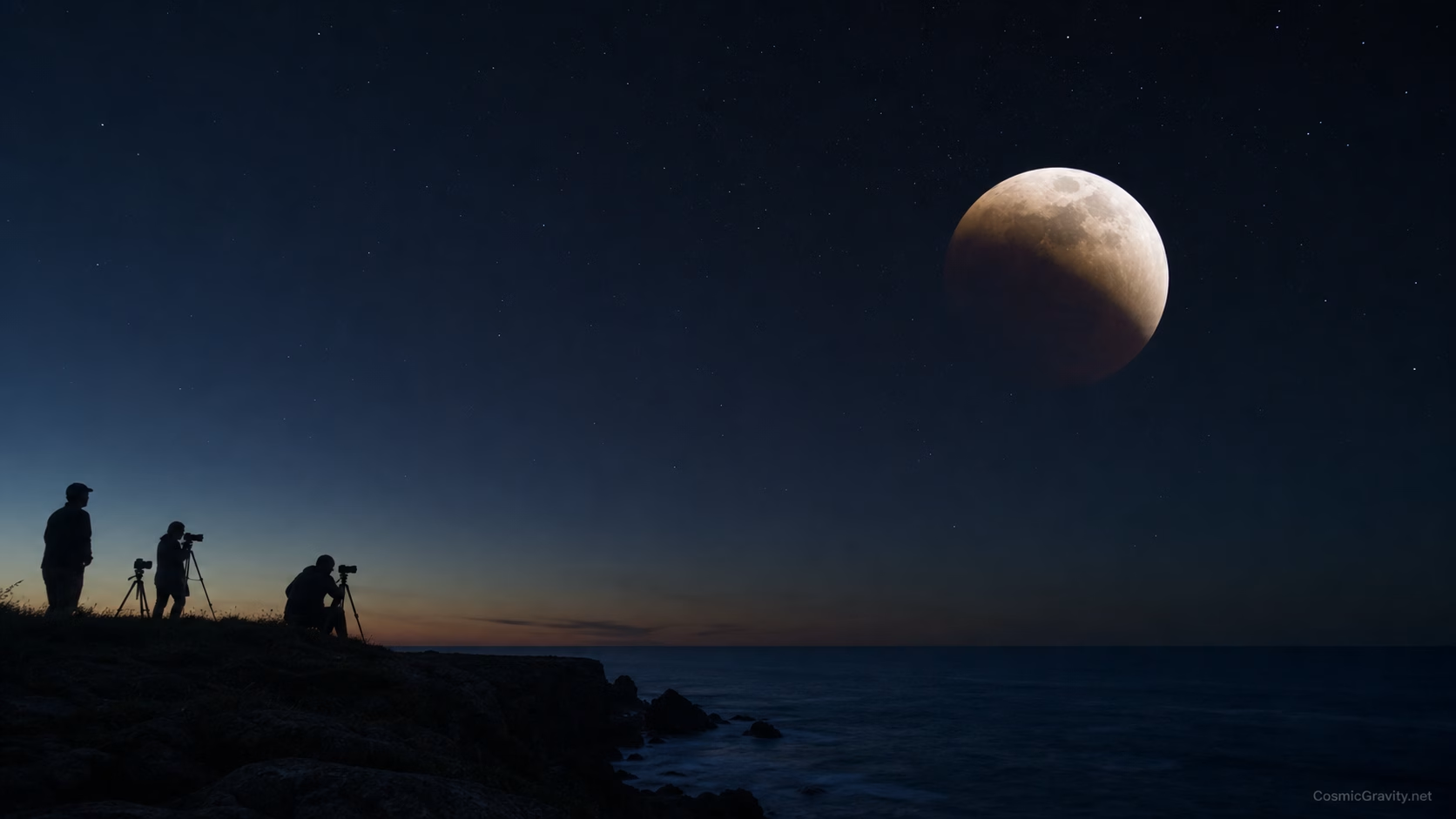
Before dawn on 28 August 2026, the full Moon will slide through Earth’s shadow. It will not be a total eclipse, but the event offers a clear view of orbital geometry in action: one edge of the Moon will appear darkened while the surrounding lunar surface remains bright.
NASA’s eclipse tables place the event around 04:14 UTC, with the complete eclipse sequence lasting about three hours and eighteen minutes. Visibility favors the Americas, the Pacific and parts of Africa. Local circumstances vary sharply because the Moon may be rising or setting during the event.
Will the eclipse be visible from your location?
The safest method is to convert 04:14 UTC to local time and check whether the Moon is above the horizon. A clear western sky helps where the Moon is setting. Observers in the Americas and across much of the Pacific receive the most favorable geometry; western Europe is close to morning moonset and local visibility may be limited.
Quick visibility checklist
- Step 1: convert 04:14 UTC to your local clock.
- Step 2: check Moon altitude and moonset time for 28 August.
- Step 3: find an open horizon, especially if the Moon is below 15 degrees.
- Step 4: allow at least 45 minutes around the central phase; lunar eclipses unfold slowly.
Tip: NASA’s SkyCal lets you generate location-specific astronomical events and avoids guessing from a global map.
Why the Moon does not disappear
Earth casts two overlapping shadows. The faint outer region is the penumbra; the darker central region is the umbra. During a partial eclipse, only part of the Moon enters the umbra. The boundary may look soft because Earth’s atmosphere refracts and scatters sunlight around the planet.
Close to the shadow edge, the Moon can take on copper, grey or brown tones. The color depends on dust, aerosols and cloud in Earth’s atmosphere. In effect, the eclipsed portion of the Moon is illuminated by the combined sunsets and sunrises around our planet.
How to photograph it
- Use a tripod and a telephoto lens if available.
- Focus manually on the lunar edge, then leave focus fixed.
- Bracket exposures: the bright and shadowed parts differ greatly.
- Include a landscape foreground for scale when the Moon is low.
- Do not overexpose the uneclipsed surface; lunar detail is easy to lose.
A phone can capture the scene if it is held steady and exposure is lowered, but a dedicated camera will preserve more detail in the shadow. Unlike a solar eclipse, a lunar eclipse is safe to watch with the naked eye, binoculars or a telescope.
Why this eclipse matters after August’s totality
It arrives only sixteen days after the widely watched 12 August total solar eclipse. The pairing is not accidental. Eclipses occur in seasons when the Sun, Earth and Moon are close to the line where the Moon’s tilted orbit crosses Earth’s orbital plane.
The partial lunar eclipse will be quieter than totality—no sudden darkness, no corona and no dramatic rush of a lunar shadow across Earth. That is part of its appeal. It is a slow, observable demonstration that our planet is round, our Moon is moving and all three bodies occupy a precise three-dimensional dance.
Sources and further reading


latest video

news via inbox
Subscribe to our Cosmic newsletter to get notified when we have new articles.