The “Backward” Arctic Eclipse of 2026: What Really Happened
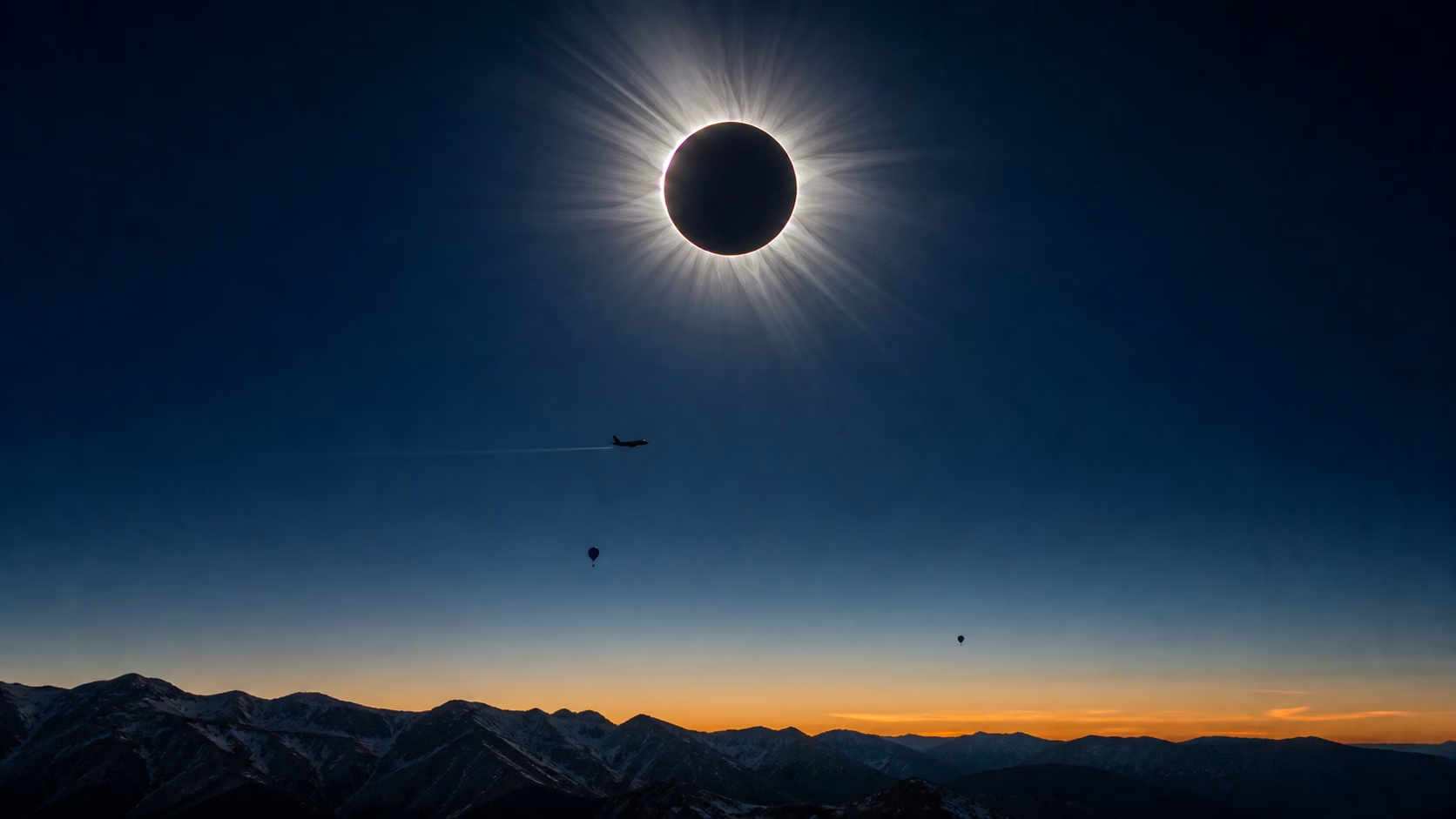
For a few hours on 12 August 2026, the Moon’s shadow crossed some of the most dramatic terrain on Earth. It touched the Russian Arctic, swept over Greenland and Iceland, crossed the North Atlantic and reached northern Spain before sunset. On many tracking maps, however, the route seemed to do something impossible: the shadow appeared to travel the “wrong” way.
That visual oddity helped turn an already spectacular eclipse into a small online mystery. Was the shadow moving from east to west? Did the midnight Sun reverse the usual motion? Had observers caught a rare time-twisting effect near the pole?
The real explanation is less supernatural, but no less fascinating. The shadow never reversed. What changed was our point of view.
The short answer: the map was playing a trick
The Moon moves eastward around Earth. During a solar eclipse, that orbital motion carries its shadow across Earth’s surface generally from west to east. The August 2026 eclipse obeyed the same physics as every other total solar eclipse.
Yet the path passed close to the North Pole and curved around the top of the globe. A flat world map has to stretch and split that polar region. When the curved track is projected onto a rectangle, the first segment can look as if it runs east to west or doubles back on itself. The effect becomes even more confusing near the International Date Line, where map labels and local dates jump abruptly.
Imagine drawing a smooth line over the top of an orange and then cutting the peel open to make it flat. The line has not changed direction, but its flattened shape can look distorted. That is essentially what happened to the eclipse track.
Did the midnight Sun cause the “backward” path?
No. Polar daylight made the event feel unusual, but it did not reverse the Moon’s shadow. The first portion of totality occurred near sunrise in the high Arctic. Because summer daylight circles the horizon at those latitudes, ordinary ideas such as morning, evening and “which way the Sun should move” become poor guides.
Local clock time added another layer of confusion. Time zones are political slices laid over a spherical planet, and they converge awkwardly near the pole. Two observers separated by a modest distance could describe the same advancing shadow with different dates or apparently contradictory directions. The celestial mechanics remained perfectly normal throughout.
NASA’s eclipse calculations place greatest eclipse at 17:47:05 UTC. At that point the Sun stood about 25.8 degrees above the horizon, the path of totality was roughly 294 kilometres wide, and maximum totality lasted about two minutes and eighteen seconds.
Why this path looked unlike a familiar eclipse
Many people picture a total eclipse as a dark spot crossing a mid-latitude continent in a neat diagonal. The 2026 path was different. It began in a region where compass directions become visually slippery, then descended across Greenland and Iceland before racing toward Spain late in the day.
In Spain, the Sun was low in the western sky. That produced a very different experience from totality near noon. The shadow approached across a long, illuminated atmosphere, the eclipsed Sun hung close to the landscape, and the orange horizon remained bright even while the sky overhead darkened. Mountains, sea haze and scattered cloud could exaggerate the layered appearance.
None of this requires anomalous physics. It is the normal eclipse geometry seen under uncommon polar and near-sunset conditions.
The strange atmosphere inside totality
The most convincing “anomalies” during an eclipse are real atmospheric responses. When direct sunlight disappears, the ground cools quickly. Air close to the surface follows more slowly, which can alter local wind and turbulence. A breeze may fade, shift direction or briefly strengthen as nearby air masses react at different rates.
Humidity readings can rise even without extra water entering the air, simply because cooler air has a lower capacity to hold water vapour. In some locations, low cloud can thin or change shape as solar heating is interrupted. Birds and insects may respond to the sudden darkness as though dusk has arrived, although behaviour varies by species and setting.
Observers also reported the familiar visual unease of totality: colours losing saturation, shadows sharpening into crescents beneath leaves, and the horizon glowing in several directions at once. Those effects can feel unnatural because the human visual system has no everyday reference for daylight being switched off from above while distant landscape outside the shadow remains illuminated.
Shadow bands and the last seconds of light
Just before and after totality, faint rippling lines can move across pale ground or walls. These shadow bands are not cracks in the eclipse shadow. They are thought to form when the final thin sliver of sunlight is refracted by turbulent cells in Earth’s atmosphere, rather like the twinkling of a star stretched into moving lines.
Then come Baily’s beads: points of sunlight shining through valleys along the Moon’s edge. As the last bead disappears, the corona emerges. Because the Sun was relatively low along parts of the 2026 path, atmospheric scattering and local haze changed the contrast and colour from one observing site to another.
NASA took the laboratory into the shadow
The eclipse was more than a public spectacle. NASA-supported teams used aircraft, balloons and ground instruments to study the solar corona and the response of Earth’s upper atmosphere. Aircraft can rise above much of the weather and water vapour that blur ground observations, while their motion can extend the useful observing time.
Balloon experiments offered another view. Instruments carried into the stratosphere measured changes in temperature, radiation and atmospheric structure as the shadow passed. On the ground, radio and ionospheric observations tracked what happened when the supply of solar ultraviolet radiation suddenly dropped.
An eclipse therefore acts like a controlled switch. Night normally arrives gradually and across a broad region. Totality removes direct sunlight quickly along a narrow moving corridor, allowing researchers to watch different atmospheric layers respond minute by minute.
What scientists will look for in the data
Some results can be seen immediately, but careful atmospheric and coronal studies take time. Researchers must calibrate instruments, compare multiple locations and separate eclipse effects from ordinary weather. Early photographs can reveal structure in the corona; firm conclusions about waves, temperature changes or the ionosphere require a much slower analysis.
That distinction matters when dramatic claims spread online. A sudden wind change, an unusual coloured horizon or a confusing radar trace may be genuine. It does not automatically imply an unexplained force. The scientific question is whether the effect repeats across instruments and locations in a way that ordinary eclipse physics cannot explain.
Why “backward” was still the perfect description
Calling it the backward eclipse is not entirely wrong—provided we mean its appearance on common maps, not its physical motion. The nickname captures the event’s central lesson: a correct observation can lead to a false conclusion when the coordinate system is ignored.
The August 2026 eclipse combined a curved polar track, permanent summer daylight, awkward time zones and a low evening Sun. Together they produced a path that looked as though it had broken the rules. In reality, the rules created the illusion.
The same care is useful when looking at the August 2026 six-planet parade. A striking pattern in the sky is real, but its meaning depends on geometry rather than first impressions.
Sources and further reading
latest video

news via inbox
Subscribe to our Cosmic newsletter to get notified when we have new articles.