The August 2026 Six-Planet Parade: Gravity, Geometry and Ancient Myths
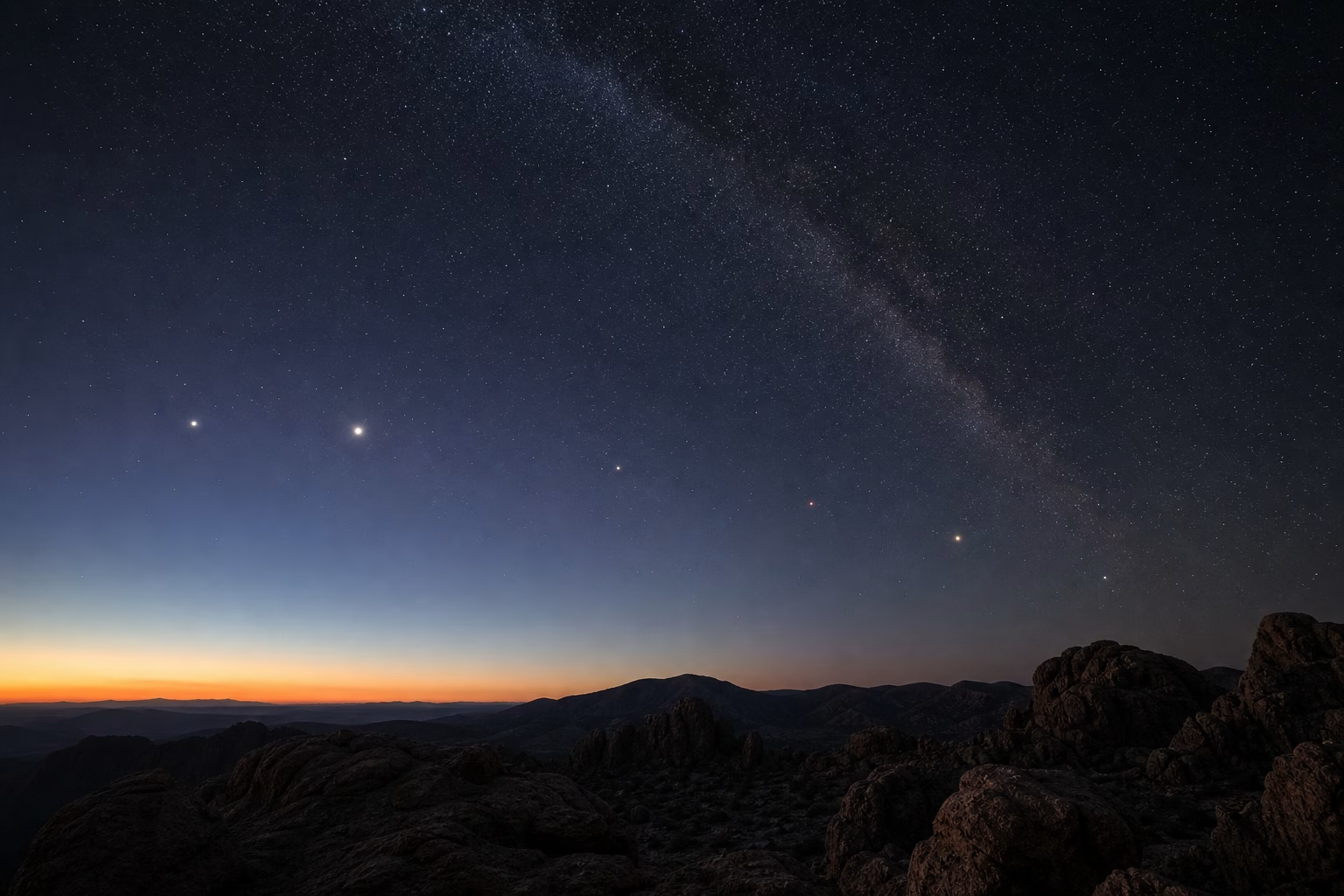
Before sunrise in mid-August 2026, six planets occupied the same broad stage. Mercury and Jupiter hovered low in the dawn glow, Mars and Saturn were easier to pick out, while Uranus and Neptune waited for observers with binoculars or a telescope. From one horizon to the other, the Solar System seemed to have arranged itself for a group photograph.
The sight was widely called a six-planet parade. It was beautiful, real and worth getting up early for. It was not, however, a straight line of worlds in space—and it did not place Earth under an unusual gravitational strain.
That gap between appearance and reality is what makes planetary alignments so interesting. They reveal both the flat architecture of our Solar System and the stories humans have projected onto the sky for thousands of years.
What could actually be seen
The lineup was visible on mornings around 11–13 August, with the best date and time depending on location, horizon and weather. “Planet parade” is a popular skywatching term rather than a formal astronomical category. It simply means that several planets appear in the sky at the same time.
Four of the six could in principle be seen with the unaided eye. Jupiter was the brightest planetary point. Mars carried a warmer, reddish tone, Saturn looked steadier and more subdued, and Mercury was the hardest naked-eye target because it remained close to the brightening eastern horizon.
Uranus and Neptune were different. Neither was an obvious naked-eye object. Uranus required a dark sky and usually binoculars or a telescope; Neptune required optical aid and an accurate finder chart. Photographs that show all six as equally bright dots are therefore illustrations, composites or long exposures—not a faithful impression of what an unaided observer saw.
Why the planets seemed to form a line
The planets orbit the Sun within a relatively thin, flattened region. They did not all follow exactly the same plane, but their orbital tilts are small compared with the size of the sky. From Earth, their paths cluster around an imaginary band called the ecliptic.
That is why the Sun, Moon and planets usually appear along the same broad arc. The August parade was not the result of six worlds suddenly snapping into formation. It was our line of sight through a disk-shaped planetary system.
Seen from above the Solar System, the planets were scattered around their separate orbits. Some were on the far side of the Sun, others on our side, and the distances between them were enormous. The “alignment” existed mainly on Earth’s sky, like distant streetlights appearing to follow the same road.
Was the parade exceptionally rare?
Six named planets in one predawn sky makes a memorable event, but the phrase “incredibly rare” needs context. Because every planet remains close to the ecliptic, multi-planet lineups happen periodically. Gatherings of four or five naked-eye planets occur every few years. Adding Uranus and Neptune makes the count larger, but it also relies on telescopic objects that are often present without being noticed.
The specific arrangement, spacing and viewing conditions of August 2026 will not repeat exactly. No sky does. What was special was the combination of six planets, summer observing conditions and the proximity of the 12 August total solar eclipse—not a once-in-civilisation gravitational configuration.
Did six planets combine their gravity?
Every mass attracts every other mass, so the planets did exert gravity on Earth. They do that every day. The important question is not whether the force existed, but whether their apparent lineup made it meaningfully stronger.
It did not. Gravity depends on actual distance and mass, not on how objects line up in our sky. More importantly for tides and stresses inside Earth, the relevant effect falls roughly with the cube of distance. A massive but remote planet produces a very small tidal influence.
Jupiter is the largest planet, yet at a representative distance its tidal effect on Earth is only a few millionths of the Moon’s. The other planets contribute still less. The Sun produces a substantial tide—about 46 percent of the lunar tidal effect—but it does that whether or not several planets share the same dawn sky.
Adding the planetary contributions cannot trigger earthquakes, volcanoes, extreme tides or changes in human biology. Even a visually tighter alignment would remain far below the daily tidal changes caused by the Moon and Sun.
Why gravitational myths survive
Planetary parades look intentional. Bright points occupy the same arc, the arrangement changes from night to night, and unusual events often coincide by chance with events on Earth. The human mind is extremely good at turning patterns into causes.
The word “alignment” also sounds mechanical, as though a row of planets were pulling in the same direction. But a two-dimensional sky chart hides their true distances and positions. It compresses billions of kilometres into a flat picture. Once that depth is restored, the imagined cosmic lever disappears.
This does not make the sky culturally empty. It means historical interpretations tell us more about human societies than about planetary forces.
Planets as messages in ancient Mesopotamia
Babylonian and Assyrian scholars kept systematic records of planetary movements, eclipses and weather. Their work combined careful observation with omen interpretation. A planet appearing in a particular region of the sky might be read as a sign concerning a king, a harvest, war or political stability.
These observers were not simply guessing. They built long records, recognised cycles and developed mathematical techniques that helped shape later astronomy. Yet the physical distinction between a celestial event and a supernatural message had not been drawn in the modern way.
A gathering of planets could therefore become both data and warning: an event to calculate and a pattern to interpret.
The flood panic of 1524
One of Europe’s best-known alignment scares grew around a series of conjunctions expected in February 1524, many in the zodiacal sign Pisces. Because Pisces was associated with water, astrologers and pamphleteers connected the configuration with flood imagery. Predictions circulated widely in the new world of print.
The episode is often simplified into a story that everyone expected a second biblical flood. The historical reality was more complicated. Scholars debated the prediction, some warned of change rather than literal inundation, and sceptics tried to calm public fears. Ironically, rebuttals also helped spread the alarming claim.
No planetary deluge arrived. But the episode showed how a technical astronomical calculation could become mass media when it met familiar symbols, religious anxiety and a new communication technology.
Modern myths use modern language
Today, planetary fears are more likely to use words such as resonance, energy field or gravitational amplification. The vocabulary sounds scientific, but the structure is ancient: an unusual sky pattern is treated as a warning about events on Earth.
A useful test is to ask for scale. How large is the claimed force? How does it compare with the Moon, the Sun or the gravity of a nearby mountain? Is the “alignment” real in three-dimensional space, or only apparent from Earth? Claims usually collapse when those numbers are supplied.
What the parade genuinely revealed
The August 2026 sky did not need hidden forces to be profound. It offered a naked-eye diagram of the Solar System’s shared plane. Watching Mercury near the horizon and the outer planets higher along the arc made orbital geometry visible in a way a textbook rarely can.
It also connected different eras of skywatching. The same bright wanderers studied by ancient omen readers are now visited by spacecraft, measured by spectroscopy and predicted to arcsecond precision. Our stories changed; the planets continued moving.
Just one day later, the August 2026 total solar eclipse created another map-based illusion near the Arctic. Both events rewarded wonder, but both became more impressive—not less—when the geometry was understood.
Sources and further reading

latest video

news via inbox
Subscribe to our Cosmic newsletter to get notified when we have new articles.