The Silurian Hypothesis Re-examined: Could an Industrial Civilization Vanish?
Imagine an industrial civilisation rising on Earth 50 million years ago. It mines, burns fuel, manufactures complex chemicals and changes the climate. Then it disappears. Would geologists today find its cities, roads and machines—or only a strange line in a rock core?
That question is the heart of the Silurian Hypothesis. Despite its science-fiction name, it is not a claim that reptilian people once ruled Earth. It is a scientific thought experiment proposed by NASA climate scientist Gavin Schmidt and astrophysicist Adam Frank: if an earlier species had developed industry, what evidence could survive deep time?
The question has become more relevant as astrobiologists broaden the search for extraterrestrial intelligence. Radio signals are only one possible sign of technology. Industry changes atmospheres, oceans and sediments. Learning to recognise those changes on Earth helps researchers imagine what an industrial planet might look like from many light-years away.
Why cities would be the first evidence to disappear
Human civilisation looks permanent because we live inside it. On geological timescales, it is remarkably fragile. Buildings crumble, metals corrode and rivers move. Glaciers grind landscapes flat. Sediment buries some surfaces while erosion strips others away. Plate tectonics continually recycles ocean crust into Earth’s mantle.
Schmidt and Frank noted that the oldest large, exposed land surfaces are only a tiny fraction of Earth’s age. Ocean sediments older than roughly the Jurassic are particularly scarce because most ancient seafloor has already been subducted. Even dinosaur fossils represent only a minute sample of all the animals that lived.
A civilisation that lasted a few thousand years could therefore occupy an almost vanishingly thin interval in a rock sequence. Archaeological objects might survive in rare protected locations, but a global chemical disturbance could have a better chance of being detected.
This is where the idea connects with our earlier discussion of a possible pre-human intelligent species on Earth. Intelligence alone may leave little geological evidence. Large-scale industry is different because it moves carbon, nitrogen, metals and manufactured compounds across the planet.
The fingerprint of an industrial age
The modern Anthropocene provides a test case. Since industrialisation, humans have rapidly released fossil carbon depleted in carbon-13. That changes the ratio of carbon isotopes in the atmosphere, ocean and newly formed sediments. We have also altered the nitrogen cycle through fertiliser production, increased erosion, redistributed heavy metals and produced materials with no close natural equivalent.
A future geologist might not find New York or Rotterdam. The clearer marker could be a narrow sediment layer containing several unusual signals at once:
- a rapid negative shift in carbon isotopes linked to a large release of fossil carbon;
- a sharp warming episode and changes in ocean oxygen levels;
- unusual nitrogen-isotope patterns from industrial fertiliser;
- spikes in lead, chromium, nickel or rare-earth elements;
- persistent synthetic molecules or their breakdown products;
- microplastics, fly ash and manufactured particles;
- long-lived artificial radionuclides or isotope ratios that are difficult to produce naturally;
- a sudden biological turnover, including extinctions and the global spread of favoured species.
No single item would be decisive. Volcanism can release metals and greenhouse gases. Asteroid impacts can produce abrupt layers. Natural climate feedbacks can shift carbon isotopes. The powerful evidence would be a combination whose timing, chemistry and global distribution are difficult to explain with one natural event.
Synthetic chemicals: the strongest clue?
Astrobiologists now treat some industrial pollutants as possible technosignatures. NASA-supported research has examined nitrogen dioxide in exoplanet atmospheres. NO2 is produced by combustion, although lightning, biology and volcanoes create natural background levels. An excess beyond plausible natural sources could be suggestive, not conclusive.
Manufactured gases such as chlorofluorocarbons are more intriguing because known biology does not make them. Recent modelling has expanded the list to artificial greenhouse gases such as CF4, C2F6, C3F8, SF6 and NF3. Some are long-lived and strongly absorb infrared light, making them potential atmospheric signals of industry or deliberate climate engineering on another world.
That does not mean the same gases would remain intact in a 100-million-year-old terrestrial rock. Many compounds degrade, react or escape. Geologists would instead search for durable residues, reaction products or an improbable family of fluorinated compounds preserved in exceptional sediments. The laboratory question is less “did we find a plastic bottle?” and more “does this molecular pattern have a credible natural pathway?”
Artificial isotope layers
Nuclear technology offers another category of marker. Human weapons tests left a global pulse of radionuclides, including plutonium isotopes, in soils, ice and marine sediment. Some decay too quickly to survive deep time, but others last much longer. Nuclear fission also creates distinctive isotope proportions and associated daughter products.
Nature complicates the story. Around two billion years ago, uranium deposits at Oklo in Gabon sustained natural nuclear fission reactors. Any ancient isotope anomaly must therefore be compared against known geochemistry. An artificial origin would require a pattern, concentration and context that natural reactors, meteorites and ordinary radioactive decay cannot reasonably reproduce.
This is the central discipline of technosignature research: do not ask whether a signal is unusual; ask whether all natural explanations have been seriously tested.
The PETM and other false positives
The Paleocene–Eocene Thermal Maximum, about 56 million years ago, is often mentioned because it included rapid warming, a large carbon-isotope excursion and changes in ocean chemistry. Superficially, parts of it resemble what industrial fossil-fuel use could leave behind.
There is no credible evidence that the PETM was industrial. Researchers have multiple natural mechanisms to investigate, including volcanic activity, methane release and carbon-cycle feedbacks. Schmidt and Frank explicitly warned against filling gaps with an imagined civilisation. The Silurian Hypothesis does not make an ancient industry likely simply because a geological event is complex.
Its value is methodological. It asks researchers to identify combinations that would separate an industrial event from known natural upheavals. A very rapid carbon release paired with synthetic residues, unnatural isotope ratios and geographically patterned metal extraction would be far more interesting than warming alone.
Are scientists actively searching ancient cores?
There is no major programme drilling Earth specifically to find a lost industrial civilisation. The relevant work is distributed across climate science, stratigraphy, organic geochemistry, nuclear forensics and astrobiology. Existing ocean cores, lake sediments and ancient rock formations are already analysed at extraordinary chemical resolution—but usually to reconstruct climate, volcanism and life, not technology.
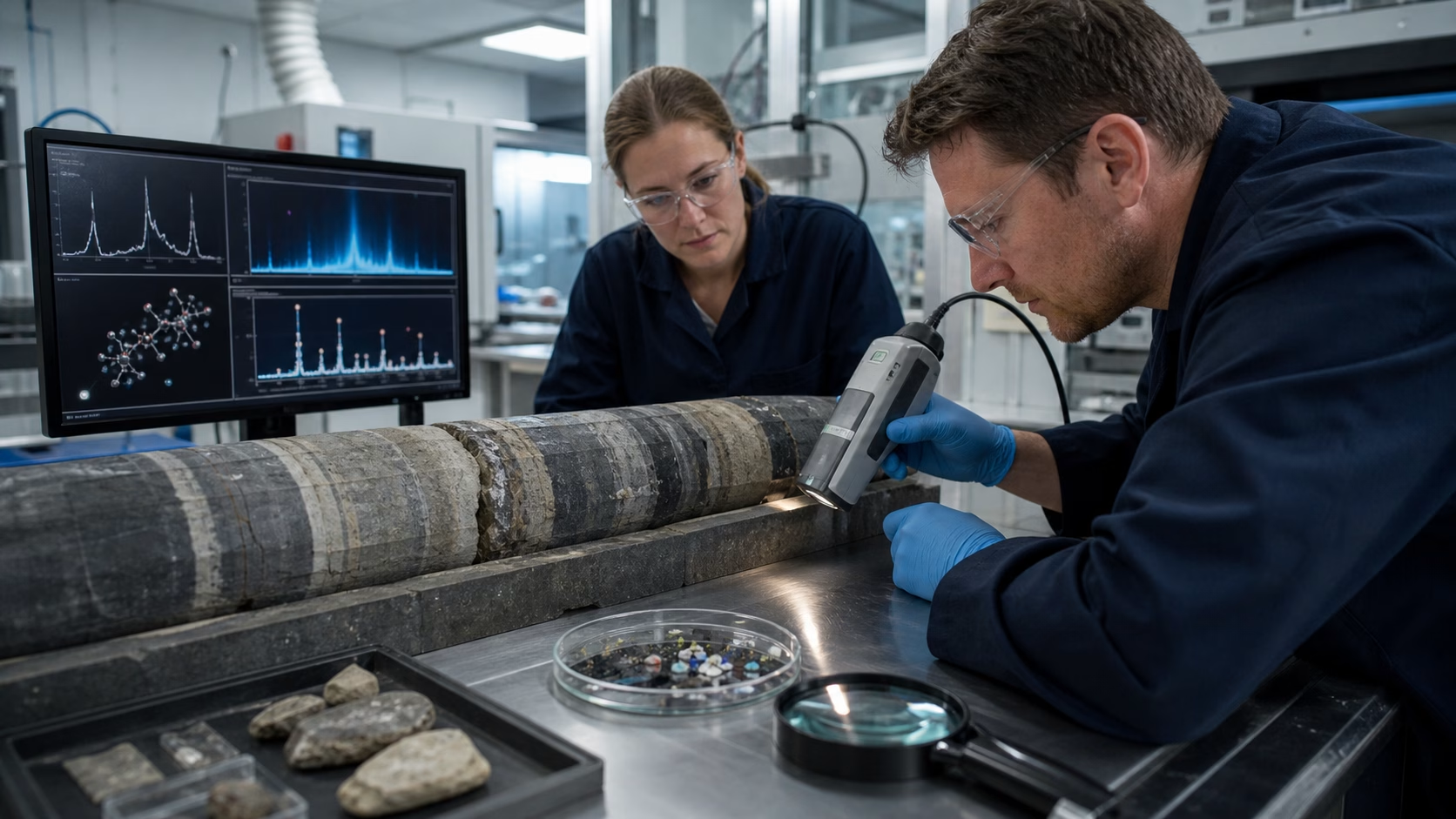
A serious search would begin with well-preserved, rapidly deposited sediments from unexplained abrupt events. Researchers would use mass spectrometry to measure isotope ratios, screen for persistent synthetic-like compounds and compare metal concentrations with surrounding strata. Results would need replication in samples from distant locations and strict contamination controls.
Machine learning may eventually help search large geochemical databases for combinations human researchers did not think to query. Yet an algorithmic anomaly would only be the beginning. The geological setting must still make sense.
Earth as a test for distant worlds
The Silurian thought experiment reverses the normal direction of astrobiology. Instead of asking what aliens would leave in space, it asks what we are leaving on Earth. That exercise helps define technosignatures for exoplanets: atmospheric pollution, waste heat, night-side illumination or chemical disequilibrium that biology alone cannot explain.
Future telescopes may detect such signals in an exoplanet atmosphere only during the civilisation’s active period. Geological technosignatures could last much longer, but are far harder to observe remotely. One day, robotic missions on Mars or Venus may examine ancient strata using lessons learned from Earth.
For more on atmospheric clues, see our guide to biosignatures and alien atmospheres. The same rule applies to both biosignatures and technosignatures: the strongest case comes from several independent lines of evidence.
A hypothesis that teaches humility
At present, no ancient industrial layer has been identified. The known fossil and archaeological record supports humans as Earth’s only demonstrated industrial civilisation. But the geological archive is incomplete enough that Schmidt and Frank’s question remains intellectually useful.
If another technological species existed tens of millions of years ago, its monuments might be gone. Its most durable legacy could be a thin, chemically peculiar horizon—a sudden planetary disturbance waiting inside a core box.
The Silurian Hypothesis is therefore not evidence of forgotten engineers. It is a better question: what evidence would be sufficient? By forcing science to define that threshold, the idea sharpens both the search through Earth’s past and the search for technology elsewhere in the cosmos.
Sources and further reading



latest video



news via inbox
Subscribe to our Cosmic newsletter to get notified when we have new articles.