LHCb Rare Decay: What the One-in-Ten-Billion Signal Shows
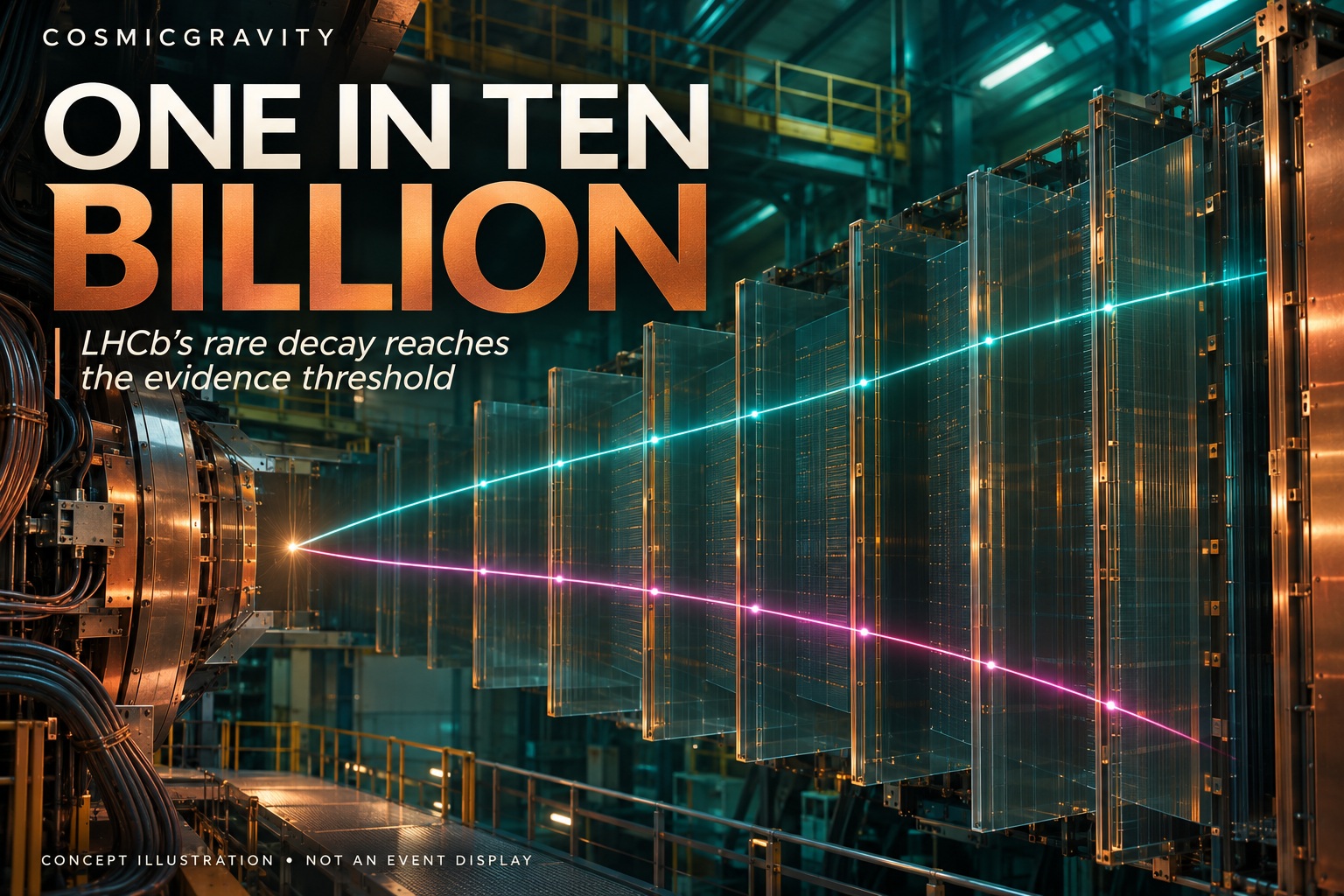
A new LHCb rare decay result has brought physicists closer to measuring a process expected in roughly one out of ten billion B⁰ decays. The particle transforms into a muon and an antimuon. It is an exceptionally difficult signal to separate from the much more ordinary activity in a collider.
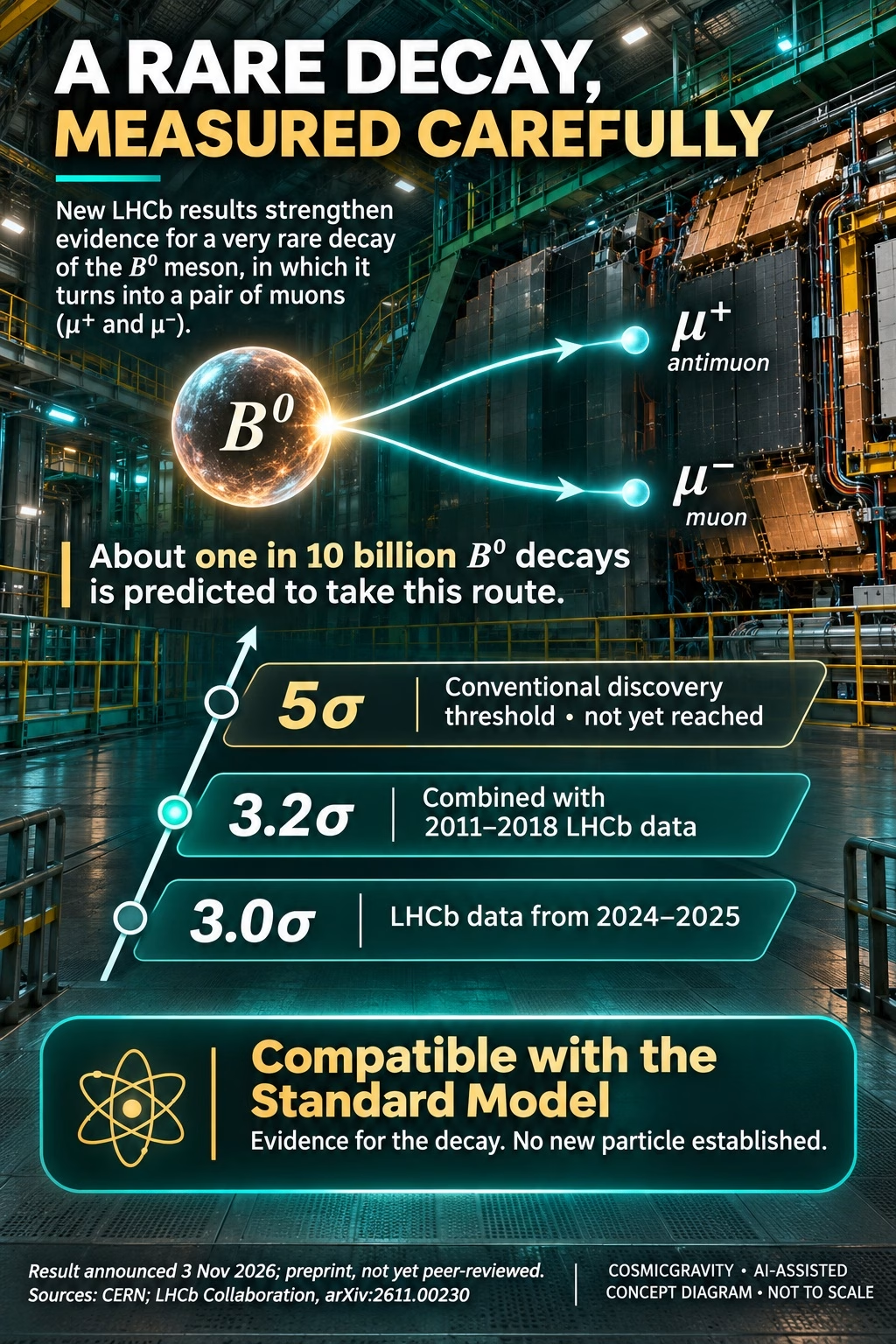
LHCb announced the result at CERN on 3 November 2026. Combining its newer data with earlier runs brings the significance to 3.2 sigma. That is evidence for the decay, below the conventional five-sigma discovery threshold. The measurement agrees with the Standard Model; it has not established a new particle or overturned the theory.
What is the LHCb rare decay?
The shorthand is B⁰ → μ⁺μ⁻. A neutral B meson, also called Bd in accounts of this result, disappears and leaves two oppositely charged particles. The negative one is a muon, a heavier relative of the electron. Its positive counterpart is the antimuon.
A B meson contains a beauty quark or antiquark paired with a lighter partner. The process under discussion involves the down-flavour version of the neutral meson and its charge-conjugate. Its cousin, Bs⁰, involves strange flavour and can also decay into two muons.
Those similar names matter. The Bs⁰ decay was already observed. This announcement concerns new single-experiment evidence for the still rarer B⁰ route, alongside more precise measurements of the Bs⁰ process. Mixing them together would erase the actual advance.
One in ten billion of what?
The denominator is B⁰ decays. It is not all proton collisions at the Large Hadron Collider, nor all particles passing through the detector. Most collisions do not supply a usable example of the exact parent particle and decay being studied.
The Standard Model predicts a probability close to 10−10 for this particular route. The LHCb preprint gives a prediction of 1.03 × 10⁻¹⁰, with a small theoretical uncertainty. “About one in ten billion” is a useful translation of that expectation.
Measuring it takes more than counting a handful of promising pairs. Therefore, researchers need to know how efficiently their detector finds the signal and how many relevant particles their data represent. They compare with better-populated decay channels to turn selected events into a probability, known as a branching fraction.
How LHCb rare decay searches separate signal from background
The new analysis uses LHCb Upgrade I data recorded in 2024 and 2025. The preprint describes 18 inverse femtobarns of proton-collision data at 13.6 teraelectronvolts. Those are measures of the dataset and collision energy, not the energy of a single outgoing muon.
The detector reconstructs tracks and identifies particles. Software then selects pairs that look as though they came from the same short-lived parent. Many unrelated processes can produce muons, so merely finding two of them is not enough.
The team uses a boosted decision tree, a machine-learning classifier, to reduce background. It also fits the pairs’ invariant-mass distribution: the combined energy and momentum reveal the mass that their parent could have had. The B⁰ and Bs⁰ contributions sit in different parts of that distribution.
Importantly, the researchers kept the central signal-mass region hidden until they had finalized the analysis methods. This form of blinding helps prevent an attractive-looking fluctuation from steering the selection rules. Calibration data, simulation and checks with other decays then help test the measurement.
Reading the LHCb rare decay evidence
The 2024–2025 data alone reach 3.0 sigma. Adding LHCb’s 2011–2018 results raises the significance to 3.2 sigma. CERN’s announcement describes this as the first single-experiment evidence for the decay.
Sigma expresses how strongly the data disfavor a background-only explanation within the statistical analysis. It is not the percentage probability that the whole scientific claim is true. Experimental assumptions and possible systematic effects still matter.
Particle physicists conventionally ask for five sigma before calling a new phenomenon an observation or discovery. More data and continued checks are needed to reach that level here. Crossing three sigma is a meaningful milestone, but the gap should remain visible in every headline about the result.
There is a useful historical warning. A joint LHCb–CMS analysis in 2015 reported evidence for this B⁰ decay, but later updates did not confirm that evidence. The collaboration’s new explanation states this history openly. The fresh single-experiment result should be judged on its own data and future tests.
Why agreement with the Standard Model still matters
A rare decay can act as a sensitive check for particles that a collider cannot produce directly. Quantum contributions from undiscovered particles could alter the probability of a familiar particle taking a particular decay route.
However, this measurement is compatible with the Standard Model. That narrows the room for some alternative theories; it does not show that a hidden particle has been found. A more precise agreement can be valuable even when it produces no dramatic anomaly.
The same analysis improves the Bs⁰ branching fraction and effective-lifetime measurements. Looking at both probability and timing gives physicists different ways to test proposed extensions of the theory. Future upgrades could provide larger samples, but those gains remain plans rather than results already achieved.
What does “zeptoverse” mean here?
The term appearing in coverage refers to extremely small length scales associated with high-energy physics. A zeptometre is 10−21 metres. It does not mean that the team has photographed another universe or opened a new physical realm.
Indirect measurements can constrain physics at scales beyond direct production. How far a particular result reaches depends on the model being tested. The exciting achievement here is a carefully extracted signal in an exceptionally rare channel.
For another route into fundamental physics, our report on the DUNE neutrino detector follows the engineering behind a very different experiment. Our dark matter guide explains one of the larger questions that the Standard Model leaves open. This LHCb result does not itself detect dark matter.
Research and publication status
The collaboration posted the paper to arXiv on 30 October 2026 and announced the result publicly on 3 November. At the time of this article it is a preprint submitted to Physical Review X, not a completed peer-reviewed journal publication.
LHCb Collaboration, arXiv:2611.00230 · CERN’s 3 November announcement · Collaboration account, plots and historical comparisons · University of Cambridge’s explanation.



latest video

news via inbox
Subscribe to our Cosmic newsletter to get notified when we have new articles.