How a Kibble balance weighs a kilogram with electricity
Take the mass off a Kibble balance and the instrument can make one of its most important measurements. With the pan unloaded, a coil moves through a magnetic field and produces a voltage. In a separate run, that same coil holds up a mass. Put the two readings together and a laboratory can work out how much matter sits on the pan, using a definition of the kilogram that any suitably equipped lab can reproduce. NIST’s illustrated guide to the instrument.
Why the kilogram needed a new reference
For more than a century the kilogram was defined by a particular platinum-iridium cylinder. Laboratories could compare a copy with another copy and ultimately with the international prototype. But if two standards slowly changed relative to one another, the comparison alone could never reveal which one had changed. The prototype’s mass was one kilogram by definition.
On November 16, 2018, delegates voted for a definition based on a constant of nature. It took effect on May 20, 2019. In the International System of Units the numerical value of the Planck constant is now exactly 6.62607015 × 10⁻³⁴ joule seconds. A joule contains a kilogram in its units. Once the metre and the second are established, fixing that value gives the kilogram a reference independent of the fate of any one cylinder. The international resolution and NIST’s account of the vote.
How a Kibble balance uses the same coil twice
In the first run, gravity pulls the test mass down. A current in a wire coil produces an upward force in a magnetic field. The operator adjusts the current until the forces balance. The current is measurable. The catch is that the force also depends on the strength of the field and the effective length of wire inside it. Measuring those separately to the required precision is an awkward proposition.
Enter the second run. The mass comes off, the applied current is switched off, and the coil moves through the field at a measured speed. The induced voltage depends on the same field and wire geometry as before. By combining the equations, that troublesome shared factor cancels. The resulting expression is m = UI/(gv). Here U is voltage, I is current, g is local gravitational acceleration and v is the coil’s speed.
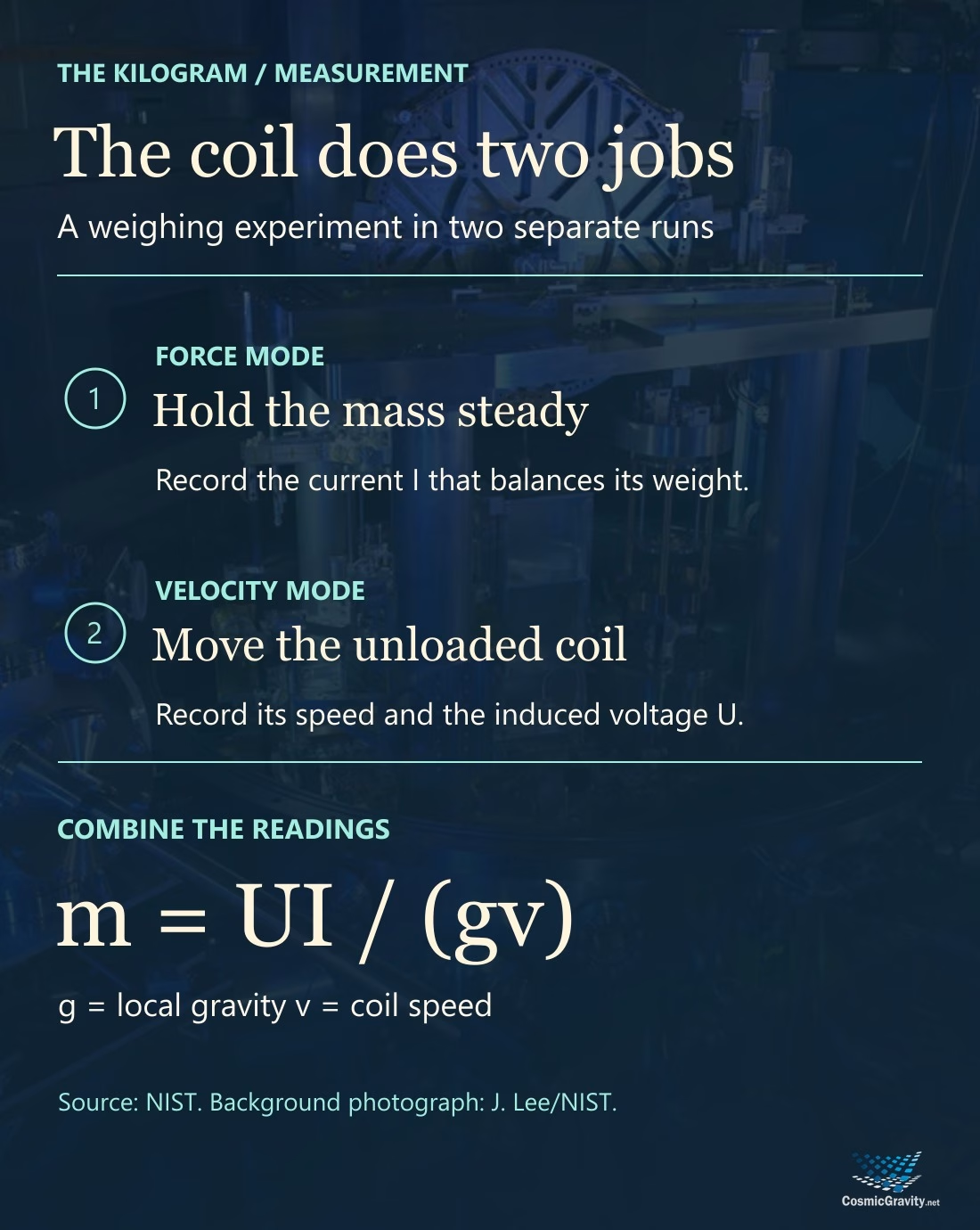
The older name “watt balance” points to the trick. Multiply voltage by current and you have electrical power. Multiply weight by speed and you have mechanical power. They have the same value in the combined equations, even though the current and the speed came from different runs. The machine can produce the comparison without lifting the test mass at that speed.
Where the Planck constant enters the weighing
It enters through the electrical measurements. A Josephson voltage standard relates voltage to frequency, and the quantum Hall effect supplies a reproducible resistance standard. Together those effects let the laboratory connect the coil’s electrical readings to the Planck constant. A laser tracks the coil’s motion. A separate instrument measures local gravity, because the same mass has a slightly different weight in different places.
An exact constant still leaves an experimental question. How well were the coil speed, the electrical readings and the local pull of gravity actually measured? That is why a laboratory reports an uncertainty alongside a mass. Ordinary balances can still be calibrated against physical weights. What changed in 2019 was where that chain of comparisons ends.
Frequency also connects laboratory instruments to definitions of time. For a look at how a clock can follow a signal inside an atomic nucleus, read about the feedback loop in a thorium nuclear clock.
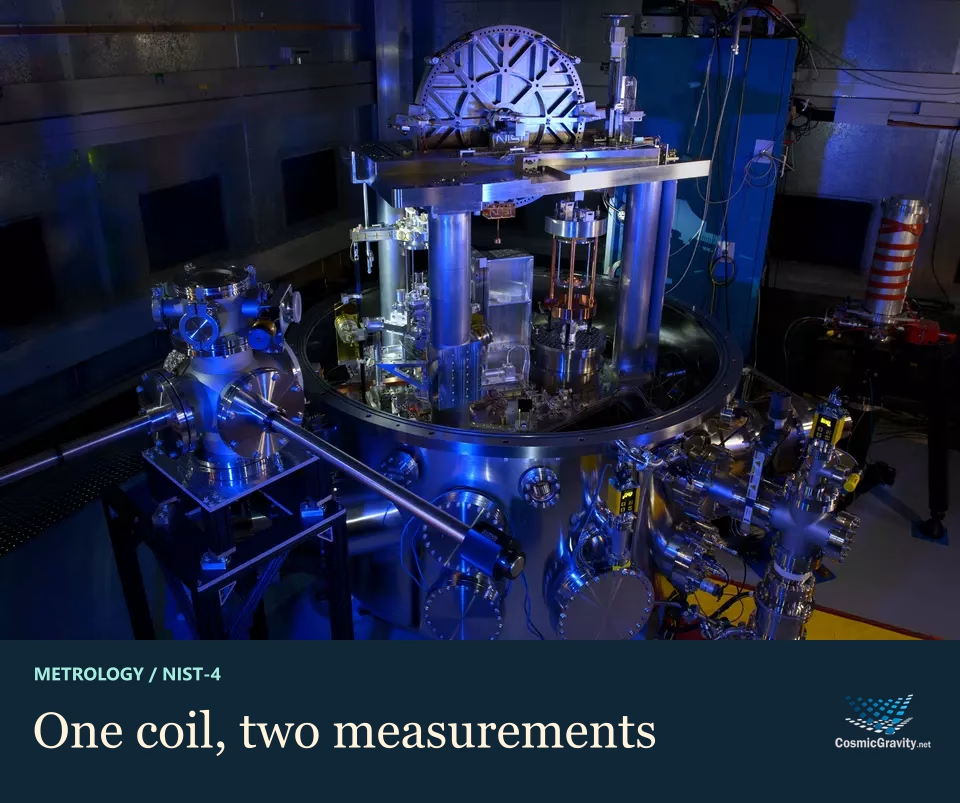
Feature image: The NIST-4 Kibble balance in the United States. Photograph by J. Lee/NIST. View the original.


latest video



news via inbox
Subscribe to our Cosmic newsletter to get notified when we have new articles.