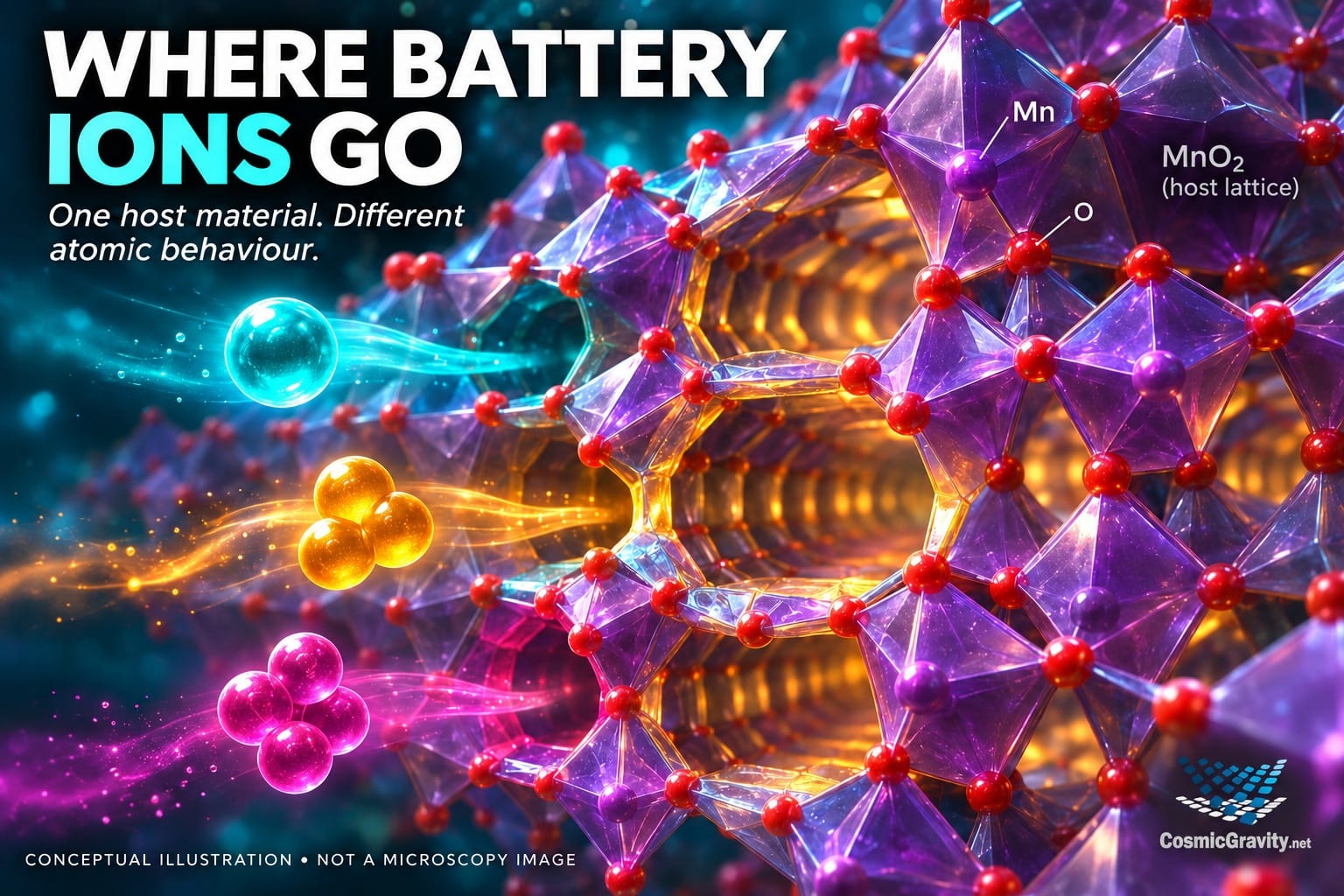
Battery Ion Insertion: Why Sodium, Magnesium and Calcium Behave Differently
A tunnel through an electrode crystal sounds like an obvious advantage for a rechargeable battery. Yet battery ion insertion depends on more than whether a tunnel exists. The ion’s preferred position, its distribution through a particle and the host’s response can change the outcome.
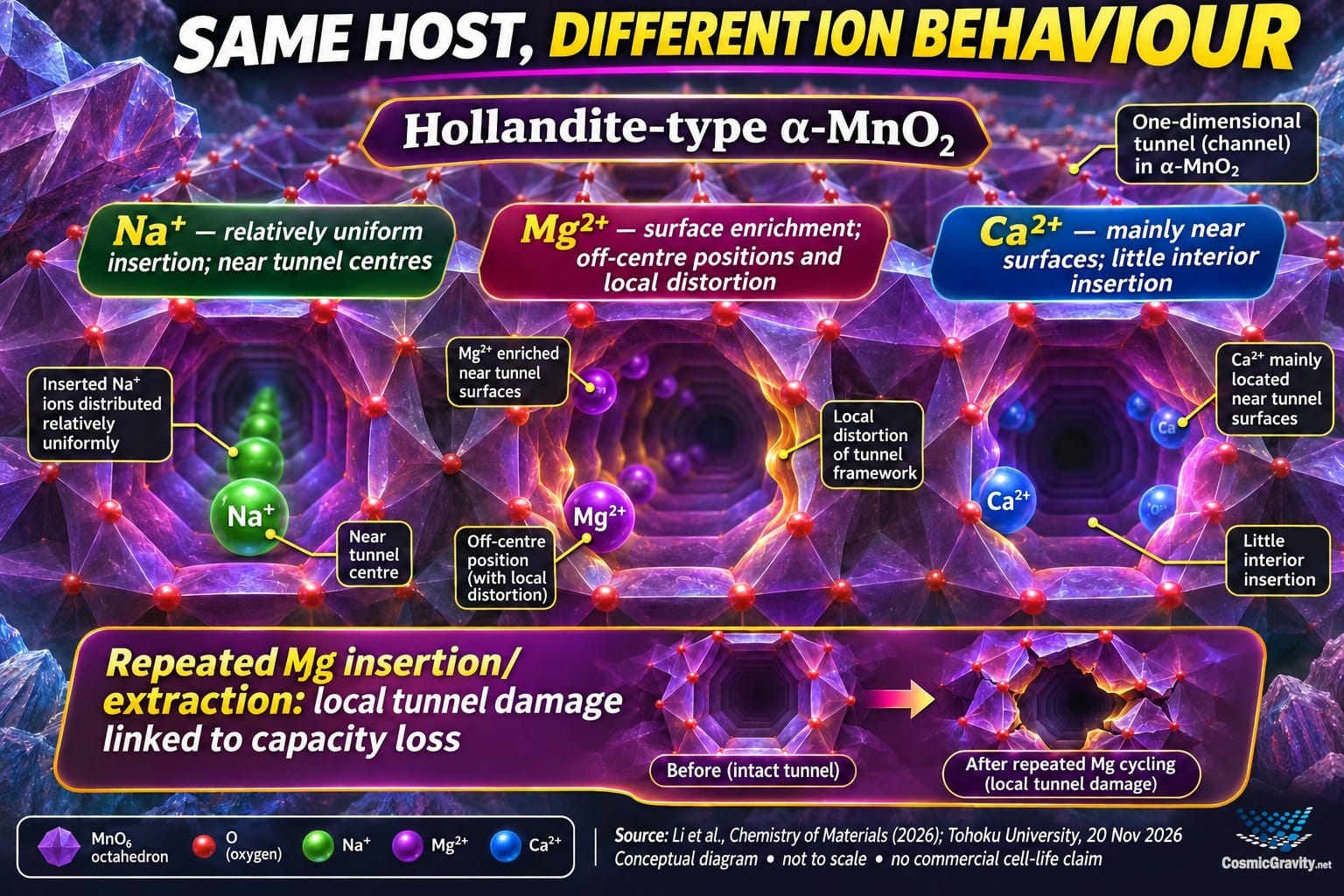
Tohoku University’s 20 November 2026 research account explains a study of sodium, magnesium and calcium in the same host: hollandite-type manganese dioxide, α-MnO₂. The university dates the Chemistry of Materials paper to 4 November. This is an atomic-scale investigation of electrode behaviour, rather than a new commercial cell announcement.
Three different patterns of battery ion insertion
The researchers found relatively uniform sodium insertion, with ions near tunnel centres. Magnesium occupied both central and off-centre sites, with pronounced enrichment near particle surfaces and local tunnel distortion. Calcium’s reaction was mainly confined to the near-surface region, without clearly detectable occupation of internal tunnel sites.
Repeated magnesium insertion and extraction was associated with local tunnel damage and capacity loss, even while the overall crystal structure remained largely intact. The contrast between local and overall structure is central to the finding.
Why a current curve cannot tell the whole story
The open original paper by Hongyi Li and colleagues combines electrochemical measurements, atomic-resolution scanning transmission electron microscopy and soft X-ray absorption spectroscopy. These methods examine different aspects of the same material.
Electrochemical analysis found substantial diffusion-controlled contributions for sodium and magnesium, while calcium’s behaviour was predominantly surface-controlled. Despite similarities in the broader kinetic contributions for sodium and magnesium, microscopy exposed different microscopic occupation patterns. Spectroscopy connected the structural picture with spatially uneven changes in manganese’s electronic state.
That combination illustrates an important experimental principle. Two samples can share a broad electrical signature without sharing an identical internal mechanism. A measurement that tells us charge is being stored does not automatically reveal every atomic location involved in storing it.
Battery ion insertion is also a local structural problem
For an intuitive comparison, imagine assessing a building from its overall outline while wear is concentrated around a few heavily used entrances. A recognizable exterior would not prove that every passage remained equally usable. This is an analogy, not a model used by the researchers.
Likewise, a statement about a material’s overall structure and a statement about a damaged surface region address different scales. Both can be true. Combining methods helps identify which scale is most relevant to a decline in performance.
The paper’s hollandite framework contains larger and smaller tunnel units. Not every opening is suitable for every guest ion. More generally, counting empty space is not equivalent to measuring a reversible pathway: the surrounding atoms and electronic states must also accommodate the reaction.
What the study does not rank
These observations should not be turned into a universal league table declaring sodium superior to magnesium or calcium in every battery. They concern a specified host, electrolytes and experimental conditions. Changing the electrode chemistry or interface changes the system being tested.
For the same reason, the work does not establish a guaranteed number of years for a home battery, an electric-vehicle range or a manufacturing cost. Those claims would require evidence at the relevant cell and product scale.
A more precise materials-design question
The useful design question is how to make a host accommodate the intended guest ion repeatedly, without damaging the pathways or losing active material. Atomic-scale measurements can help identify where that process begins to fail.
Our report on measuring local deformation in molybdenum examines a different material and technique, but offers a related lesson: local structure can matter greatly to overall performance. For batteries, the route to improvement begins with discovering what actually happens inside the electrode, rather than assuming all ions use the same tunnel in the same way.



latest video



news via inbox
Subscribe to our Cosmic newsletter to get notified when we have new articles.