
How Nanoindentation Changed Molybdenum at Room Temperature
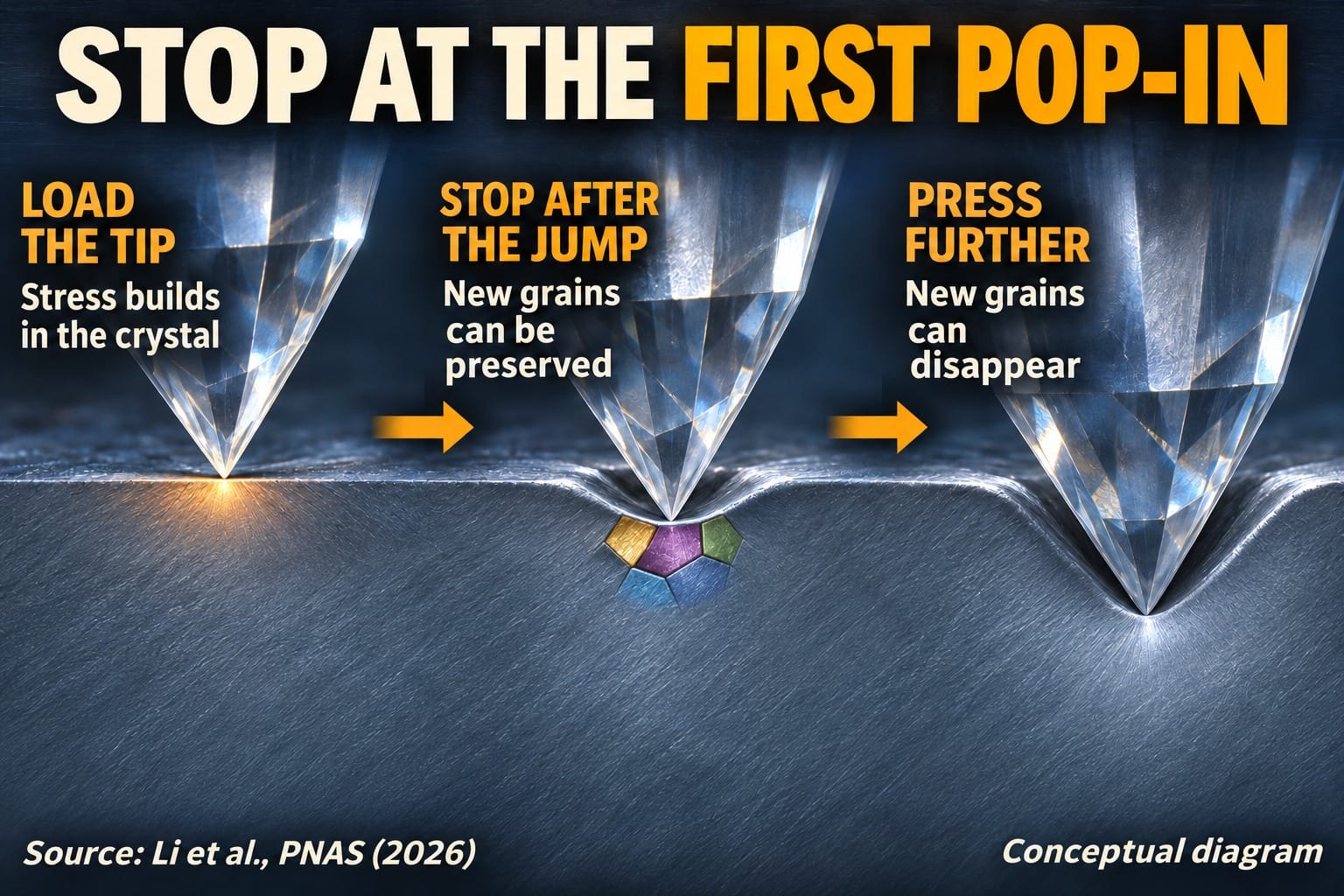
The most revealing moment in a test of molybdenum came just after a diamond tip jumped into the metal. Researchers stopped pressing, prepared the sample for microscopy and found small regions where the crystal pointed in new directions. When they pushed the tip farther in comparable tests, those regions could disappear. The result offers an explanation for how a change can occur at room temperature and escape notice in a test that looks at the material only after it has finished deforming. Li and colleagues in Proceedings of the National Academy of Sciences.
What is a pop-in during nanoindentation?
Nanoindentation applies a carefully controlled force with a very small tip and records how far the tip moves. At first a single crystal can deform elastically, storing energy as the tip bears down. Then the instrument can register a sudden jump in depth under a nearly unchanged load. Materials scientists call this a pop-in. The jump gives them a way to locate a burst of deformation on the instrument’s force and displacement record.
For the molybdenum nanoindentation tests, the team used single crystals with surfaces cut in different orientations. The researchers interrupted the load-controlled test just after the first jump. Examining the region under the indent at that stage revealed new grains whose crystal orientations differed sharply from the surrounding material. The same technique can leave a different picture if the tip keeps moving. Technion’s study record and abstract.
How the crystal changes at room temperature
A grain is a region in which the atomic lattice follows a common orientation. A grain boundary is where two such regions meet. Heating a deformed metal is a familiar way to help grains form and grow. In the Rochester and Technion experiments, intense local mechanical deformation was enough to produce new orientations in a tiny volume while the sample was at room temperature.
The team proposes two routes. Part of the crystal can first reorient through twinning, which creates a region related to its neighbour by a particular symmetry. Its boundaries can then evolve into boundaries between more strongly misaligned regions. In another route, large numbers of defects called dislocations build up and rearrange into new boundaries. The two routes give the researchers a way to explain why the material beneath a tiny indentation could contain several new orientations. Study abstract and publication details.
Why stopping the test matters
The researchers used simulations to examine how the defects move. In their model, a pre-existing boundary that blocked their movement could help new grains form. Without a barrier in that simulation, defects were able to move into the surrounding crystal. Experiments and simulations both showed that continued indentation can erase grains that formed during the jump. A finished indent is therefore a record of everything the tip did to that spot. It can lose the evidence of a short-lived stage.
The paper appeared online in October and in the November 3 issue of PNAS. Rochester’s November 9 account discusses why the finding interests engineers who work with heat-resistant metals. Possible applications remain questions for future experiments. The paper measures local structural changes in carefully prepared samples. Establishing whether the effect improves a larger part’s strength or makes a fabrication process practical would require different measurements. University of Rochester’s research account.
The next challenge is to see which metals and starting structures produce the same short-lived changes and how reproducibly those grains can be kept. Our coverage of a quantum gas microscope looks at a different experiment in which the method determines which small-scale patterns remain visible.



latest video



news via inbox
Subscribe to our Cosmic newsletter to get notified when we have new articles.