How Astronomers Identified Earth’s Temporary Mini-Moon 2026 QQ8
For weeks, the Minor Planet Center held off on naming a faint object whose motion looked like that of a temporary Earth satellite. A discarded piece of space hardware could have followed a similar path. Additional observations allowed astronomers to estimate how sunlight nudged the object. That helped them conclude it was most likely natural and give it the designation 2026 QQ8. The story shows how astronomers can learn something about a body too faint and small to see as anything more than a point of light. Minor Planet Center’s October account.
Why did 2026 QQ8 look like possible space debris?
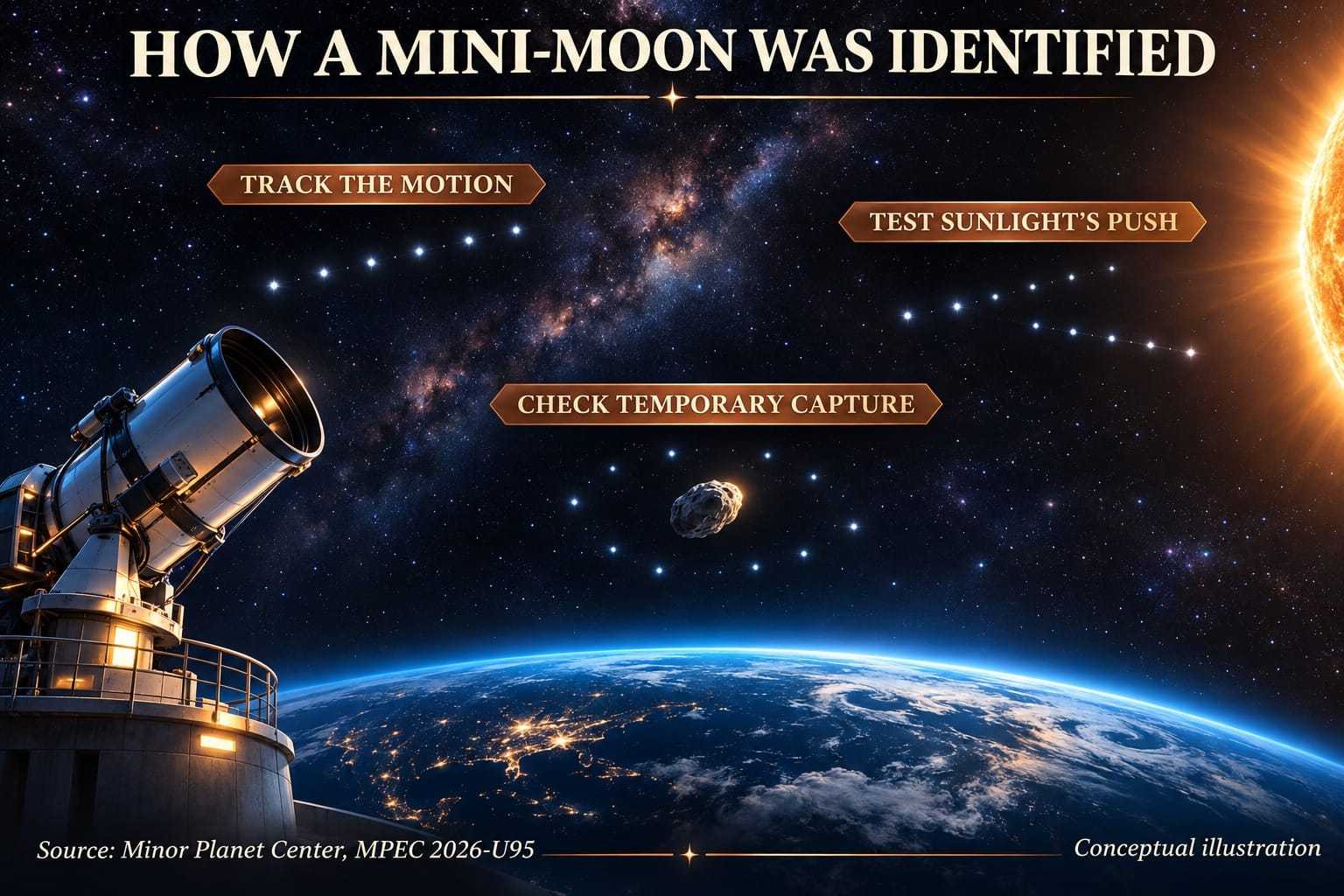
The object first circulated under the temporary label Sar2901. In September the Minor Planet Center said astronomers differed on whether it was a natural mini-moon or artificial. Its first few nights of positions made both possibilities plausible. A plotted track says where a dot appeared at particular times. To infer its path through space, astronomers have to fit a model to those positions. Extending the time between the earliest and latest measurements makes trajectories that initially look alike easier to tell apart. Minor Planet Center’s September note on Sar2901.
How did the push from sunlight help?
Sunlight carries momentum and exerts a small force on a surface. A thin, hollow piece of hardware can expose much more surface area per kilogram than a compact rock. All else being equal, sunlight will make a greater change to the motion of the object that presents more area relative to its mass. The effect can build up enough to matter when positions are measured accurately over weeks.
The centre credits follow-up by the Lowell Discovery Telescope and the University of Hawaiʻi 88-inch telescope with helping extend the record. In the circular issued on 29 October, the fitted effective area per kilogram was about 0.0008 square metres, with a one-standard-deviation uncertainty of around 0.00034. The centre also found no match with a known artificial object. Its assessment favours a natural body without identifying a particular source rock or measuring the object’s shape or surface material. Minor Planet Electronic Circular 2026-U95 · PDF copy of the circular.
What makes a mini-moon temporary?
The circular reports that calculations following 2026 QQ8’s motion through time show it is temporarily bound to Earth. A near-Earth asteroid can approach slowly enough relative to our planet to be captured for a while. The gravitational effects of the Sun and Moon help shape the path and can change whether the object stays bound. Researchers also distinguish captures that complete at least one revolution from briefly bound flybys. The circular establishes temporary capture and calls for more dynamical work. Research on temporary orbiters and temporarily captured flybys.
These calculations answer a separate question from the one about sunlight. An object can follow a temporarily bound trajectory whether it is natural or human-made. Classifying it therefore required evidence about both the path and the small forces acting on it.
For readers wondering whether they can see it, the circular’s follow-up records include several observations fainter than magnitude 23. That is well beyond naked-eye viewing. The small dot is useful precisely because its changing positions carry so much information. Our account of the dwarf-planet candidate 2026 ED138 looks at a different way to extend that kind of record, by searching older images for an object after it has been recognised.


latest video



news via inbox
Subscribe to our Cosmic newsletter to get notified when we have new articles.