Enceladus: The Ocean Moon Spraying Its Secrets Into Space
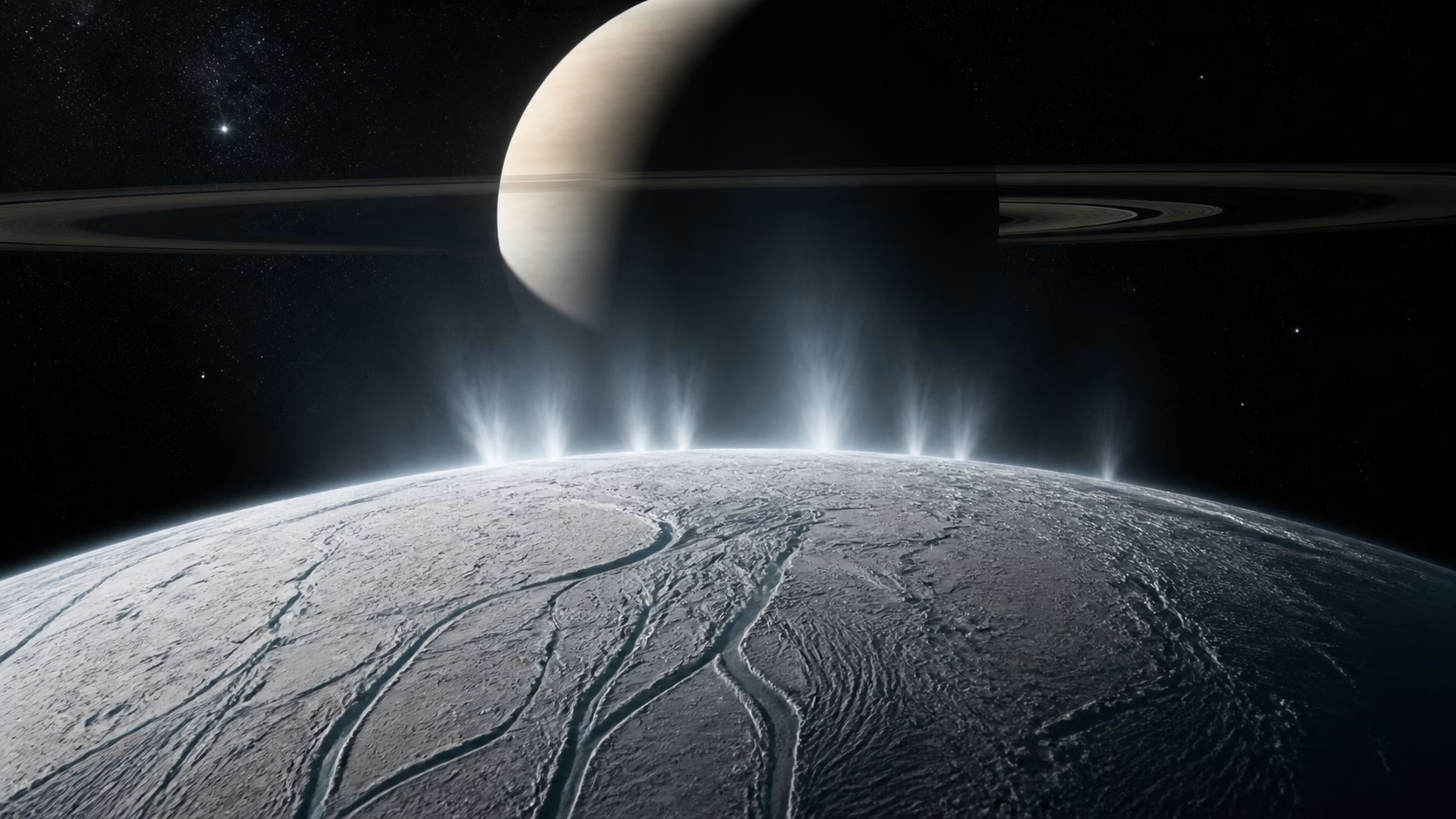
Enceladus should have been an unremarkable ball of ice. It is only about 500 kilometres wide, receives little sunlight and orbits in the cold Saturn system. Then the Cassini spacecraft saw material erupting from its south pole.
Those plumes changed the moon from a frozen curiosity into one of the most promising places to search for life beyond Earth. Beneath the crust lies a global saltwater ocean. Cracks known as tiger stripes vent water vapour, ice grains and chemicals directly into space.
For researchers interested in possible life on Enceladus, this is an extraordinary advantage. The moon is effectively delivering samples of its hidden ocean to any spacecraft that can fly through the spray.
The discovery Cassini was not built to expect
When Cassini arrived at Saturn in 2004, scientists knew Enceladus had a bright, relatively young surface. They did not expect a geologically active ocean world.
Measurements showed that something near the moon was disturbing Saturn’s magnetic field. Close images then revealed towering jets above the south pole. Cassini flew through the material several times, allowing its instruments to analyse particles and gas.
The plume contains water, salts, carbon dioxide, methane, ammonia and organic molecules. Tiny silica grains provided another clue. On Earth, grains of similar size can form when hot water interacts with rock at hydrothermal temperatures.
A global ocean under the ice
Early models allowed for a regional sea beneath the south pole. Later gravity and libration measurements indicated something larger: a global ocean separating the ice shell from the rocky interior.
Saturn’s gravity flexes the moon as it orbits, producing internal heat. That energy helps keep the ocean liquid and drives activity along the tiger stripes.
The ocean is not a shallow pond. Models suggest tens of kilometres of water beneath an ice shell whose thickness varies by location. The south polar crust may be thinner, providing pathways for water and vapour to reach space.
Why hydrothermal activity matters
Life needs more than water. It requires usable energy and chemistry. If Enceladus has hydrothermal vents on its seafloor, water-rock reactions could produce hydrogen and other molecules that microbes can use.
Cassini detected molecular hydrogen in the plume. One possible source is serpentinisation, a reaction between water and certain rocks. On Earth, this process supports microorganisms in environments isolated from sunlight.
Phosphates have also been identified in ice grains associated with the plume. Phosphorus is essential to earthly biology, forming part of DNA, cell membranes and energy-transfer molecules.
These findings establish habitability, not habitation. The same chemistry can exist without organisms. But Enceladus appears to provide liquid water, organic material, essential elements and chemical energy in one accessible system.
Could methane be biological?
The amount and pattern of methane detected by Cassini have inspired biological models. Methane-producing microbes on Earth consume hydrogen and carbon dioxide, releasing methane as a waste product.
Non-biological processes can also produce methane. Hydrothermal chemistry, primordial material and reactions deep inside the moon are all possible. Cassini’s instruments were not designed to distinguish every pathway.
Calling the methane a biosignature would therefore be premature. It is better understood as a target: a measurable chemical whose origin future missions could investigate with more capable instruments.
How do ocean samples reach space?
The tiger stripes open and close slightly under tidal stress. Liquid water below the surface may boil into vapour as pressure falls, carrying ice particles upward through fractures.
The plume is not necessarily a pristine sample of the deep ocean. Material can freeze, separate and react while travelling through the ice. Some molecules may be destroyed or concentrated during ejection.
Researchers need models and laboratory experiments to reconstruct that journey. NASA scientists have even collected Antarctic seawater to study how biological and chemical signatures change when salty water is suddenly exposed to vacuum and freezes into grains.
What would count as evidence of life?
No single organic molecule would be enough. Organic chemistry is widespread in space. A stronger case might include complex distributions of amino acids, unusual isotope ratios, cell-like structures and multiple chemical patterns that are difficult to produce without biology.
The ideal mission would analyse many grains with several independent methods. Mass spectrometry could identify molecules, while microscopy could search for structures and movement. Results would need contamination controls and repeatable measurements.
NASA’s Ocean Worlds Life Surveyor concept combines chemical analysis and high-resolution imaging for exactly this purpose.
Why Enceladus may be easier than Europa
Europa has a larger ocean and remains a leading astrobiology target, but its surface lies inside an intense radiation environment. Accessing fresh ocean material may require locating an active plume or drilling through ice.
Enceladus places ocean-derived material above its surface continuously. A spacecraft can sample it without landing. Saturn’s greater distance makes missions long and expensive, but the sampling geometry is unusually favourable.
The two moons should not be treated as competitors. Europa Clipper can teach us how a large ocean world works; an Enceladus mission could search directly for chemical and microscopic signs of life.
A small moon with a large question
Enceladus demonstrates how quickly our picture of the Solar System can change. Before Cassini, a warm global ocean inside such a small moon seemed unlikely. Now its plumes are among the strongest evidence that potentially habitable environments exist beyond Earth.
The case for life on Enceladus remains open. The case for investigating it is overwhelming.
Somewhere beneath those brilliant fractures, water touches rock in permanent darkness. We already know the ocean is throwing pieces of itself into space. The next step is to read them properly.
Related reading


latest video

news via inbox
Subscribe to our Cosmic newsletter to get notified when we have new articles.