2026 ED138: The Dwarf-Planet Candidate Hidden in Old Images
The new dwarf-planet candidate 2026 ED138 has given astronomers an enticing problem: they can track a real object beyond Neptune, but they cannot yet say how large that world is. Its discovery is secure. Its promotion into the dwarf-planet club remains a question of measurement.
That distinction matters amid headlines about a new planet beyond Pluto. The announcement is exciting enough without upgrading a candidate into a confirmed classification. Better still, the story now reaches beyond the discovery images: another team has found the object hiding in years of space-telescope observations.
How Rubin discovered 2026 ED138
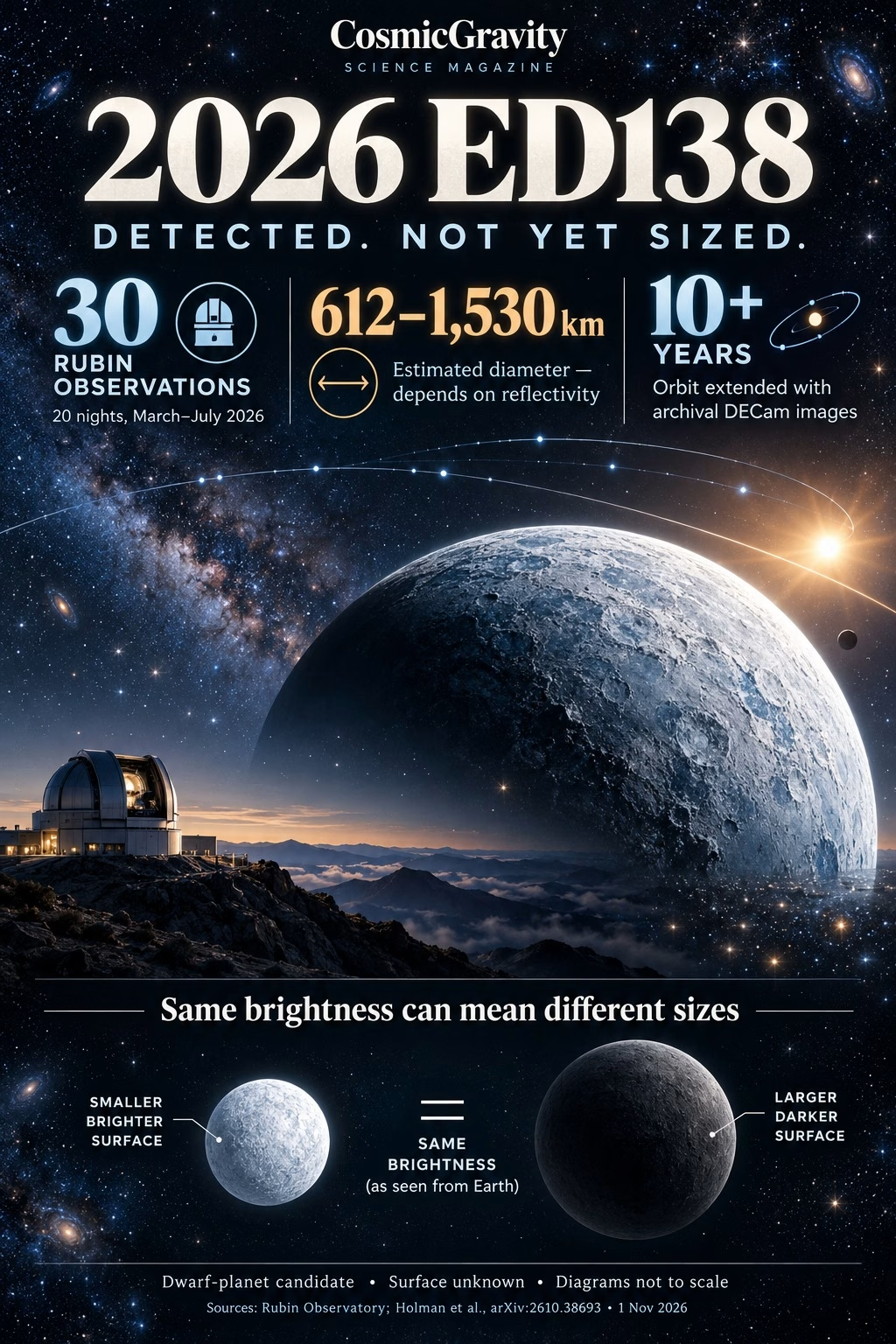
Rubin Observatory announced the find on 27 October 2026. Matthew Holman identified the object in early survey data, and the team checked that the detections belonged together. Rubin recorded it 30 times across 20 nights between March and July. Archival images from the Dark Energy Camera, or DECam, then extended the observational history back to 2016. See the observatory’s discovery announcement.
The object is currently roughly 46 times farther from the Sun than Earth. Astronomers call that 46 astronomical units, or AU. Its designation is provisional: 2026 ED138 is an identification label, not a newly assigned mythological name.
A moving point among background stars can contain a surprising amount of information. Repeated positions show which way it travels and how its apparent motion changes. A long observing history helps researchers distinguish between orbital solutions that could look almost identical over a few nights.
Why the size of 2026 ED138 remains uncertain
The discovery team’s 28 October preprint, submitted to the Astronomical Journal, estimates a diameter of about 612 to 1,530 kilometres under different assumptions about reflectivity. That is a range, not a direct measurement of the object’s edges.
A distant object looks bright for more than one reason. It might have a large surface reflecting relatively little sunlight. A smaller surface could produce the same brightness if it reflects a greater share of the light falling on it. Astronomers call that reflectivity its albedo.
Think of two objects photographed from far away, one coated in pale frost and the other in dark material. A brightness reading alone cannot tell you their relative dimensions. You need another constraint. That is why a precise-looking diameter in an early headline can be misleading: it may simply encode a chosen albedo.
The important question is therefore which future observation can separate size from reflectivity. Thermal measurements and an occultation, when an object passes in front of a background star, offer different ways to attack that problem. Neither should be described as already completed for this object without a published result.
What makes an object a dwarf planet?
Under the International Astronomical Union’s classification, a dwarf planet orbits the Sun, has enough self-gravity to become approximately round, has not gravitationally cleared its orbital neighbourhood, and is not a moon. The IAU’s explanation of Pluto and dwarf planets sets out that framework.
“Round” here concerns a physical balance. Gravity pulls material inward while the strength of rock and ice resists deformation. The relevant threshold depends on the material and its history; a single universal diameter does not settle every case.
That is also why “another planet” can conceal two different conversations. One concerns an object’s physical character as a world. The other concerns a formal category that includes its dynamical neighbourhood. A candidate can be scientifically valuable while its label remains unsettled.
This discovery is separate from the proposed large, unseen planet discussed in our guide to Planet Nine and the outer Solar System. Finding one trans-Neptunian object does not identify that hypothetical planet or establish its existence.
The quieter follow-up: finding it in TESS images
A second preprint, posted on 29 October, reports observations recovered from five month-long TESS observing sectors between 2019 and 2026. Four preceded the discovery. The researchers removed background stars and combined images along the object’s predicted path. They report a detection in every sector and positions consistent with its orbit.
This is called precovery: finding an object in data taken before anyone recognised it. It does not mean the telescope’s operators had already discovered and hidden a new world. The images existed; the knowledge needed to extract this particular moving signal came later.
There is a useful difference between collecting photons and recognising what they record. Archives preserve the first. New algorithms, a newly calculated path or a fresh scientific question can make the second possible years afterward.
The TESS work is a preprint, not a completed independent peer-review process. It supports the object’s observational history. It does not supply a resolved portrait or settle dwarf-planet status.
Why “missed before” is an interesting scientific result
The discovery team identifies crowded southern skies near the Milky Way as an important reason earlier surveys overlooked this object. Their analysis suggests more bright trans-Neptunian objects remain to be found, although the exact unseen population is an inference rather than a catalogue of discoveries.
A survey’s blank spaces are not all literal gaps between exposures. A region can be photographed yet remain difficult to search because foreground stars crowd together, observations are too shallow, or software cannot reliably link faint detections. Each of those limitations asks for a different improvement.
Rubin’s value lies partly in returning to the sky repeatedly. A single unusual dot is a puzzle. A sequence of positions can become an orbit. An orbit can turn a modern detection into a search instruction for older archives.
What to watch for next
The next substantial development would be a measurement that narrows the diameter, a better-characterised rotation or spectrum, or a reviewed analysis of the orbit and population. A new artist’s illustration would not do that work.
For now, the rewarding part of 2026 ED138 is that its uncertainty is explicit. Astronomers have located a real distant world and can explain what they still need to learn about it. That is a stronger story than a premature claim that the Solar System has acquired a fully measured new planet.
Research checked 1 November 2026. This report distinguishes the observatory announcement, research preprints and general astronomical explanation. For our approach to claims and corrections, see our editorial standards.



latest video



news via inbox
Subscribe to our Cosmic newsletter to get notified when we have new articles.