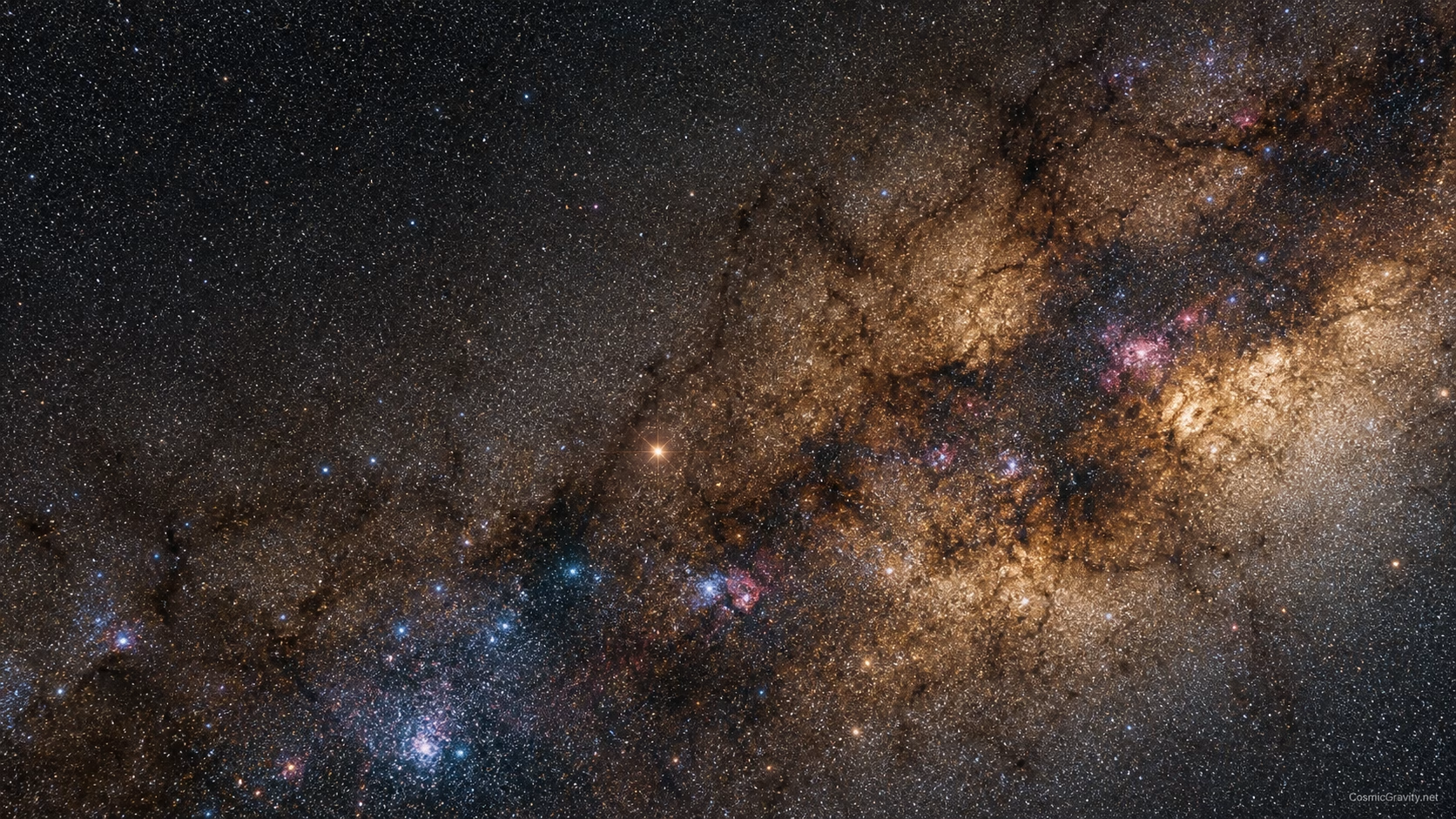
Euclid’s 60-Million-Star Map of the Milky Way Could Reveal Hidden Planets
The center of our galaxy is so crowded that ordinary images begin to look like static. ESA’s Euclid telescope has now turned that apparent chaos into a scientific map containing roughly sixty million stars—an extraordinary view designed not only to photograph the Milky Way’s heart, but to watch gravity briefly expose objects that are otherwise invisible.
The mosaic was assembled from nine pointings acquired on 23 March 2025 over about twenty-six hours. ESA describes it as the largest detailed visible-light image yet made of the galactic center. One Euclid field covers an area roughly 270 times larger than a Hubble image, giving researchers both detail and scale.
Why the Milky Way’s center is so difficult to map
Dust absorbs visible light, millions of stars overlap along the same line of sight, and brightness changes rapidly across the field. The region also contains the supermassive black hole Sagittarius A*, dense stellar clusters and a long history of star formation. Euclid was designed for cosmology, yet its wide field and sharp images make it unusually effective at surveying this complicated foreground.
How gravity can reveal a hidden planet
A planet near the galactic center is normally far too faint to see directly. But if it passes almost exactly in front of a more distant star, its gravity bends and magnifies the background starlight. This is gravitational microlensing. The alignment may last hours or days, never repeat, and still leave enough of a signal to estimate the lensing object’s mass.
Follow a microlensing event
- Baseline: a distant star shines at a steady brightness.
- Alignment: an unseen foreground object crosses the line of sight.
- Magnification: curved spacetime focuses extra light toward Earth.
- Planetary signature: a planet orbiting the foreground star adds a short bump or distortion.
- Model: astronomers compare the light curve with thousands of possible lens systems.
Microlensing is democratic: it can find planets that are cold, distant from their stars or even wandering through space without a host. Those worlds are underrepresented in transit surveys because they do not regularly cross a bright nearby star.
Could it expose rogue planets?
That is one of the most intriguing possibilities. A short, isolated lensing event may be caused by a free-floating planet, although separating such a planet from a small star or compact remnant requires careful modelling. Euclid’s wide field creates a statistical advantage. It can watch an enormous number of stars at once, increasing the chance of catching rare alignments.
Euclid is not working alone. Its measurements can complement NASA’s Nancy Grace Roman Space Telescope and ground-based surveys. Observing the same event from different locations may break degeneracies in the lens model and improve mass estimates.
A map that changes with time
The first image is a foundation, not the final result. When Euclid returns to the field, researchers can search for moving objects, variable stars and transient flashes. That time dimension turns a beautiful mosaic into a detector.
The project also connects the local galaxy with Euclid’s larger mission. The same gravitational principle that lets a planet magnify one star allows clusters to distort entire background galaxies. Read our explainer on Euclid’s dark-universe map for the cosmic-scale version of the technique.
Sources and further reading


latest video

news via inbox
Subscribe to our Cosmic newsletter to get notified when we have new articles.