
FLIP Exoplanet Imaging Reveals a Known Planet Hidden in Webb Data
FLIP exoplanet imaging has recovered a planet that was already in Webb’s pictures but hidden by leftover starlight. The planet is 51 Eridani b, a known giant world. The advance is a better way to extract its faint infrared signal from observations that conventional processing could not use to detect it at this wavelength.
That distinction makes the result more interesting than another planet announcement. A telescope can collect useful light and still leave astronomers unable to separate it from the instrument’s own glare. A study published in Nature on 4 November 2026 shows how a physical model of the telescope can help recover that information.
Why can’t Webb simply photograph every nearby planet?
Distance is only part of the problem. A planet sits close to a vastly brighter star on the sky. Even a young giant planet, still warm enough to shine in infrared light, can disappear beneath the star’s scattered light.
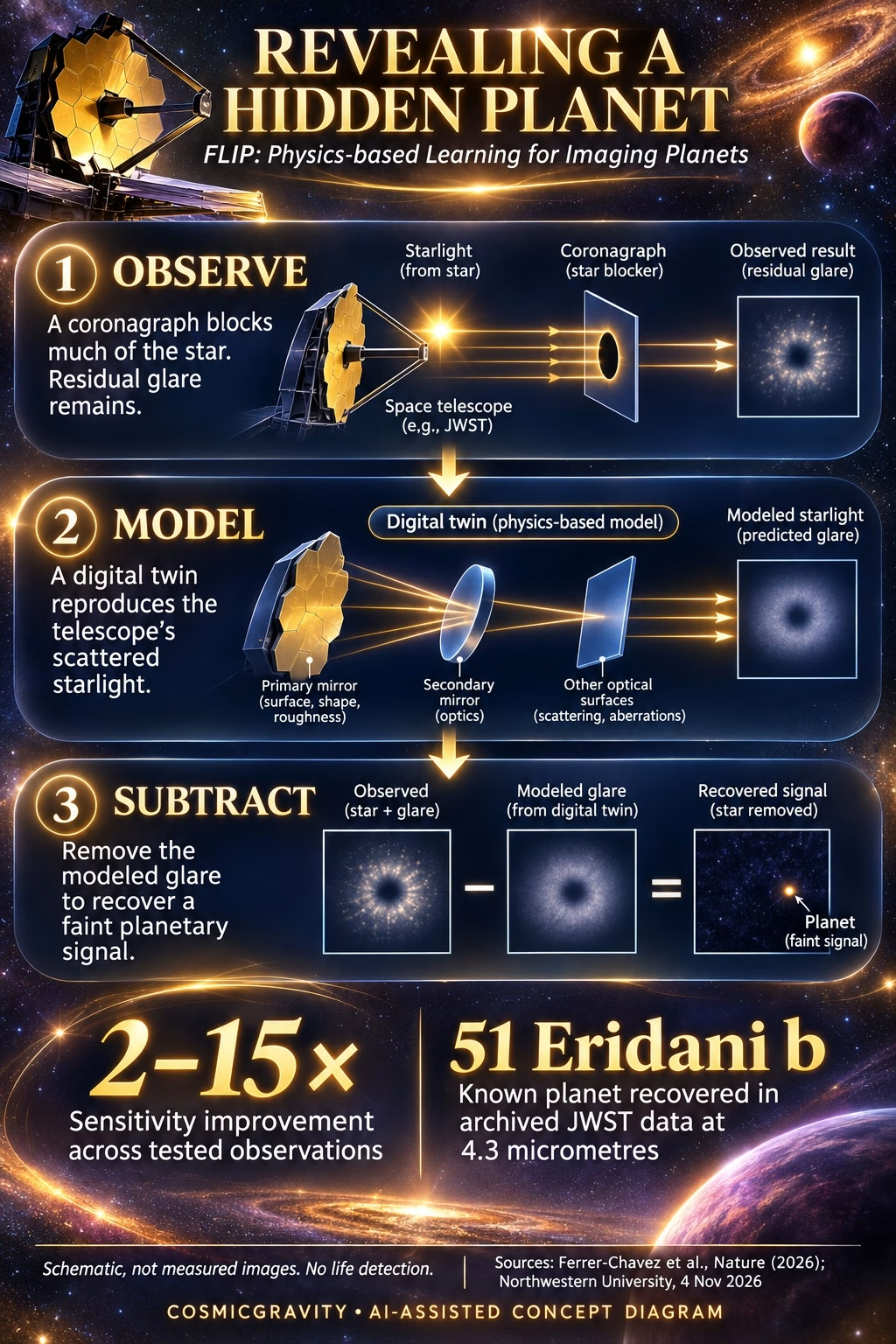
A coronagraph blocks much of the star. Image processing then has to remove what remains. Astronomers often build a reference from other observations, such as images of a different star, and subtract that reference from the science image.
However, the telescope changes slightly between exposures. Small pointing errors and thermal shifts alter the pattern of light reaching the detector. A reference that looks nearly right can still leave enough structure to bury a planet. Enlarging the picture does not remove that mismatch.
The new paper by Rodrigo Ferrer-Chavez and colleagues addresses this limit directly. It tests a method on actual observations from Webb’s Near-Infrared Camera, rather than demonstrating it only on ideal simulated images.
How FLIP exoplanet imaging models the glare
FLIP stands for Physics-based Learning for Imaging Planets. Its starting point is a model of how light travels through the telescope and reaches the detector. Researchers can adjust that model to account for imperfections in the real instrument.
Think of a slightly distorted shadow on a wall. Subtracting a photograph of yesterday’s shadow may leave a distracting edge. Reproducing the shape that casts today’s shadow gives you a better chance of removing it cleanly. In FLIP, the relevant shapes and light patterns follow optical physics.
The team first calibrates the instrument model using a reference observation. It then tunes the model against the science observation. This second step lets it compensate for differences between the two, instead of assuming the reference was a perfect match.
Efficient mathematical tools make it practical to adjust millions of parameters. These tools also appear in machine-learning research, but that does not mean a generative system has painted a planet into the picture. Northwestern’s explanation of the work stresses that the team uses a physical telescope model and optimization tools, rather than an AI system trained to recognize planets.
What FLIP exoplanet imaging adds at 51 Eridani b
The tests include the known planetary systems HIP 65426 and 51 Eridani, plus TYC 5899, a target without a previously known companion. Across the tested observations, FLIP improves sensitivity by a factor of two to fifteen over the standard comparisons.
The clearest example is 51 Eridani b at 4.3 micrometres. Earlier processing left a non-detection in that band. FLIP recovers the planet at the expected location. This is a new detection at a difficult wavelength, rather than the first discovery of the world itself.
That wavelength matters because carbon dioxide absorbs infrared light there. The planet can consequently be faint in a band that is useful for investigating atmospheric chemistry. Recovering the signal makes more of the original observation scientifically accessible.
For context, the 2015 discovery study reported 51 Eridani b using the ground-based Gemini Planet Imager. The new work answers a different question: how much planetary information can a better analysis extract from existing space-telescope data?
How do researchers avoid subtracting the planet too?
A flexible model brings a real risk. If it fits every bright patch too enthusiastically, it could treat genuine planetary light as unwanted structure and remove it.
The study therefore uses injection-and-recovery tests. Researchers insert artificial planetary signals into the science image, follow how well those signals survive the optimization, and use them to assess sensitivity and signal loss. These are controlled tests of the method, distinct from the real planet being measured.
There is no promise that every old exposure contains another world waiting to appear. Different stars, instrument settings and observing conditions produce different gains. A best-case fifteen-fold improvement should not become a claim that all Webb images are now fifteen times better.
What comes next for FLIP exoplanet imaging?
For now, archived observations are a practical place to apply the technique. Future work could extend it to other telescopes and instruments. Imaging an Earth-like planet beside a Sun-like star remains a much harder task; this study does not report one.
It also reports no evidence of life. A planet’s detection, its atmospheric composition and a convincing biological interpretation are separate steps. Our guide to exoplanet biosignatures explains why atmospheric clues need careful context.
The broader lesson fits the story behind many James Webb discoveries: collecting the light is only the beginning. In this case, a more faithful model of the instrument has opened a window that was already present in the data.
Read the research
Ferrer-Chavez et al., “Imaging exoplanets below the telescope stability limit,” Nature, 4 November 2026 · Northwestern University’s account and comparison images · Original 51 Eridani b discovery paper, 2015.



latest video



news via inbox
Subscribe to our Cosmic newsletter to get notified when we have new articles.