How lunar libration lets Earth see around the Moon’s edge
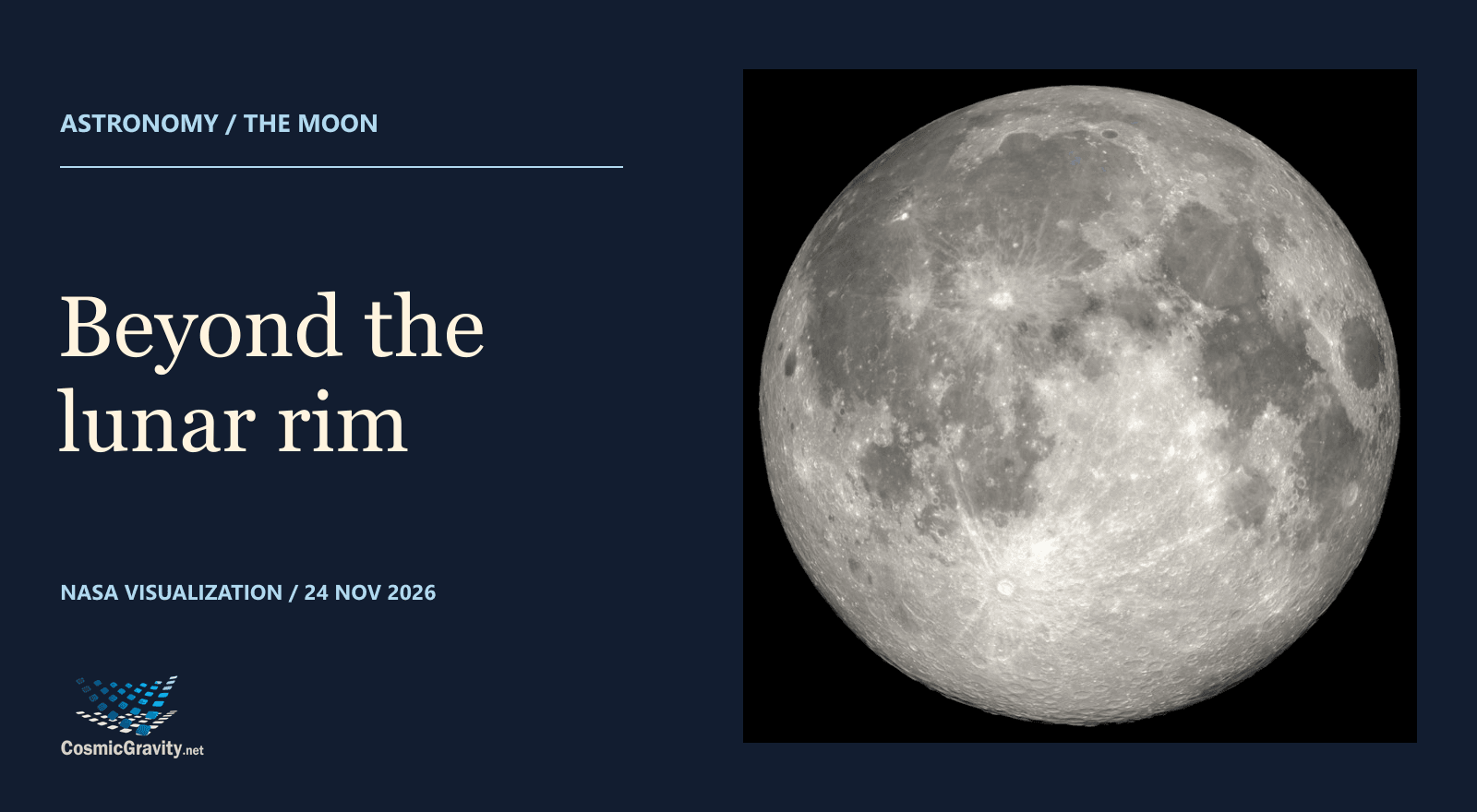
Look at NASA’s rendering of the nearly full Moon on November 24. The round dark patch near the right-hand edge is Mare Crisium, the Sea of Crises. Its distance from the rim looks different in images from other nights, even after you match the disks in size. That small shift is a way to see lunar libration for yourself. Over time it brings about 59 percent of the Moon’s surface within sight of Earth.
Feature image: The Moon on November 24, 2026 at 18:00 UTC, rendered from mission data. NASA’s Scientific Visualization Studio, Ernie Wright. North is up. View the original.
Why the Moon generally shows us one face
The Moon turns once on its axis in roughly the time it takes to orbit Earth once relative to the stars. Imagine walking around a table while keeping your face turned toward its centre. By the time you get back to your chair, you’ve faced every wall in the room. The Moon makes that same turn in about 27.3 days.
Gravity and the long history of tidal interactions brought the Moon into this synchronized rotation. But a synchronized month doesn’t guarantee an identical view each evening. The Moon follows an ellipse. It travels faster along the part nearest Earth and slower farther away, while its spin is much steadier. For a while the spin gets ahead of the line joining Earth and Moon. Later that line catches up. From Earth the difference exposes a little extra terrain around alternating eastern and western edges. NASA explains the changing geometry.
Lunar libration in three November views
The north and south rims trade places for another reason. The Moon’s equator is tilted by about 6.7 degrees to its orbital plane. At one point along the orbit we look slightly down on the lunar north. Around the other side we see a little farther south. NASA’s edge-on animation of libration in latitude shows why changing our vantage point is enough to produce that nod.
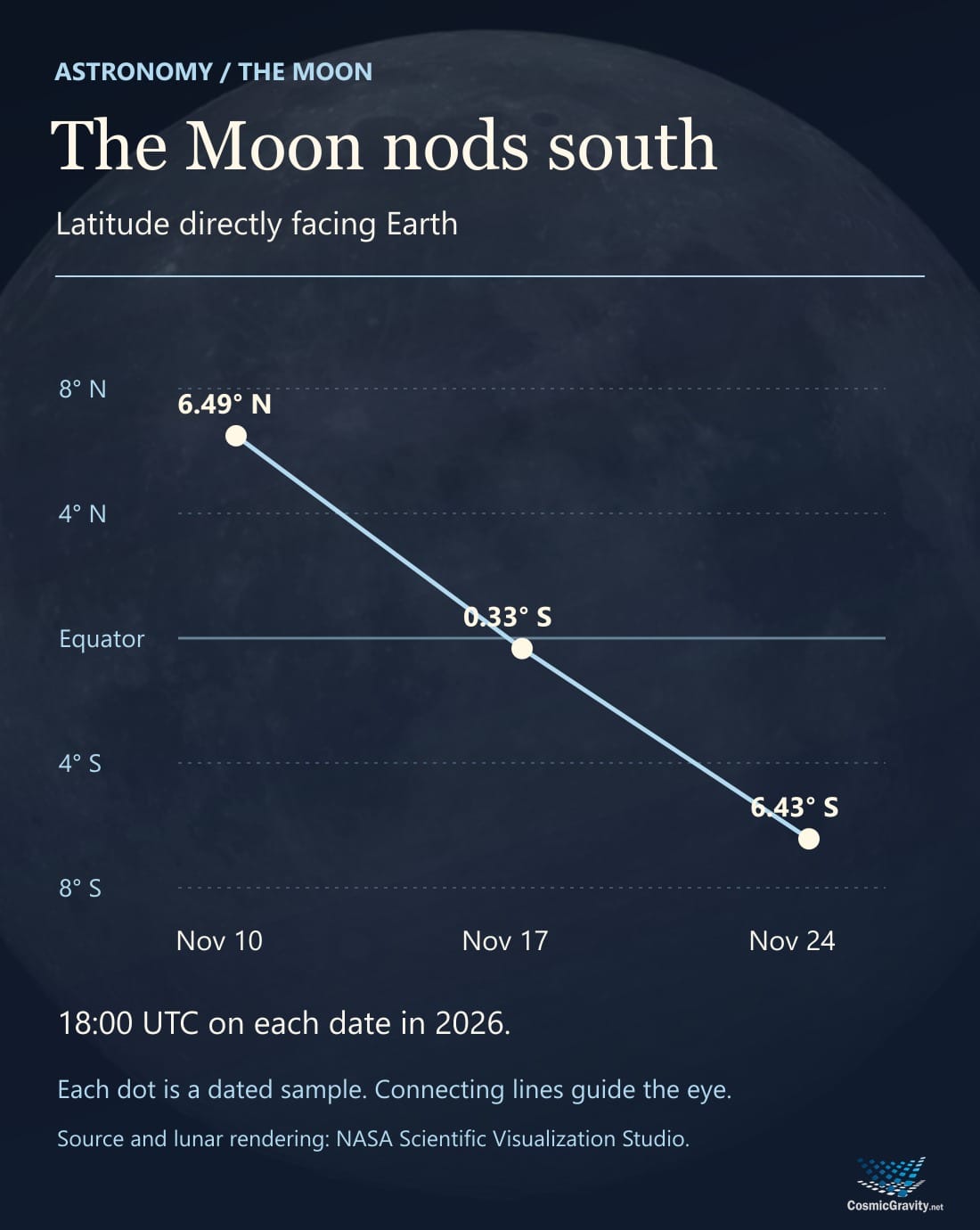
There’s a number you can use to check the effect. Picture an observer on the Moon with Earth directly overhead. The latitude of that observer is the sub-Earth latitude. In NASA’s north-up simulation, at 18:00 UTC on November 10 that point lay 6.49 degrees north of the equator. A week later it was 0.33 degrees south. By November 24 it was 6.43 degrees south. The nearly full disk that evening offered a particularly favourable look toward the south, although the low viewing angle flattens the terrain close to the rim.
How to spot lunar libration in your own photos
Open NASA’s 2026 Dial-A-Moon and pick two dates. Keep north up in both views and scale the disks to the same diameter. Use a fixed feature such as Mare Crisium as your landmark. First compare its position relative to the curved outer rim. Then compare it with the line dividing daylight from night. The rim tells you about viewing direction. The advancing or retreating daylight line tells you where the Sun is shining.
A single view still shows only about half of the sphere. The extra nine percentage points accumulate along the margins over many views. Most of the far side stays out of Earth’s line of sight, even when sunlight falls directly on it. And if you watch the Moon pass a star cluster, as in our Moon and Pleiades observing guide, the entire lunar disk moves against the stars. Libration is the quieter motion you can still see after holding the disk itself steady.


latest video

news via inbox
Subscribe to our Cosmic newsletter to get notified when we have new articles.