Could Turkey’s 4,500-Year-Old Cargo Be the World’s Oldest Shipwreck?
A cluster of storage jars off Turkey’s Mediterranean coast has revived a wonderfully simple question: how far back can we trace a shipwreck? The Kekova discovery is a candidate for the oldest shipwreck in Turkey—and, according to its excavators, perhaps the world.
The claim rests on cargo that survived after the ship itself disappeared. That makes the jars the centre of the story. It also makes the distinction between an ancient object, a wreck site and a precisely dated voyage worth keeping in view.
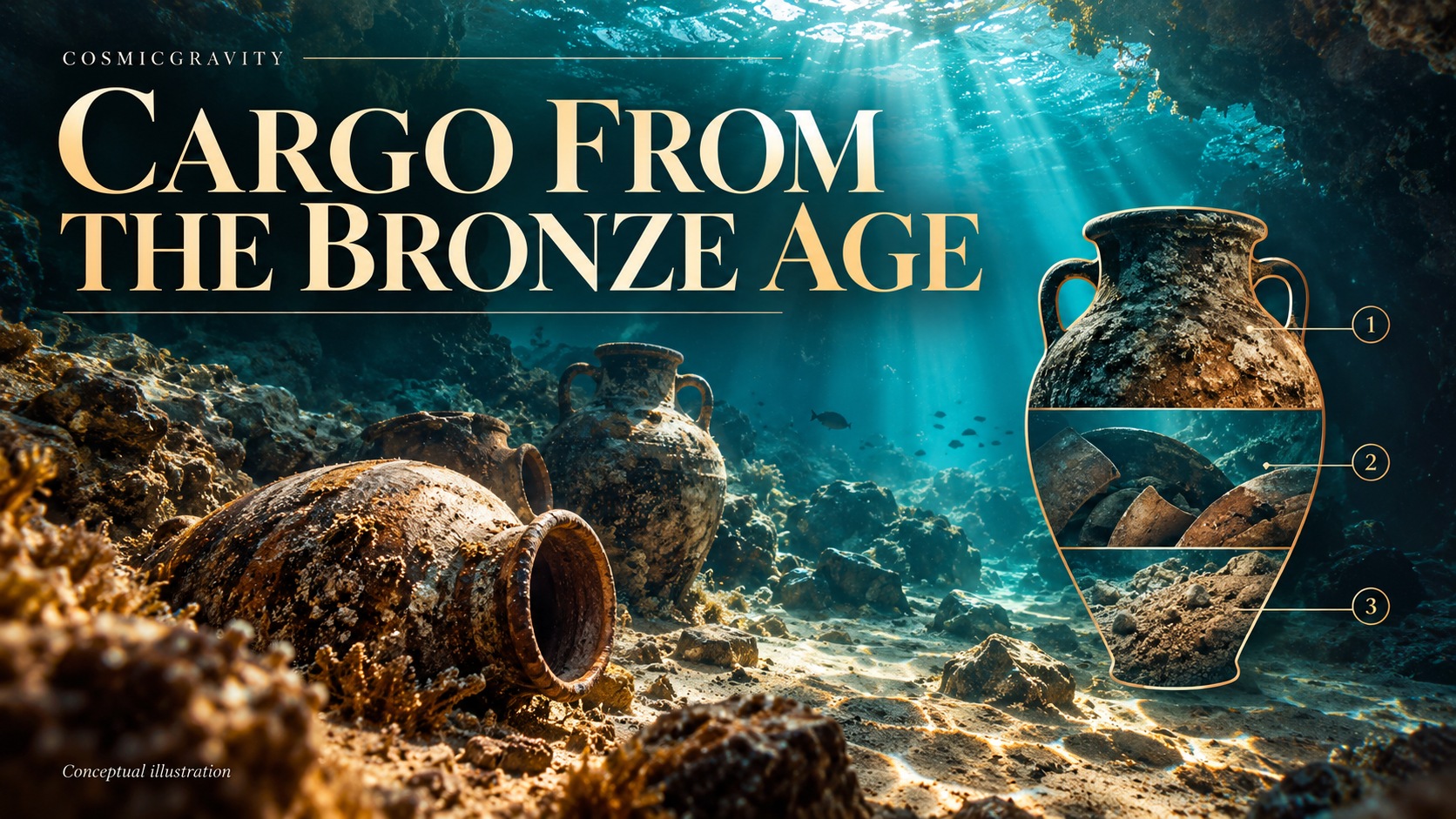
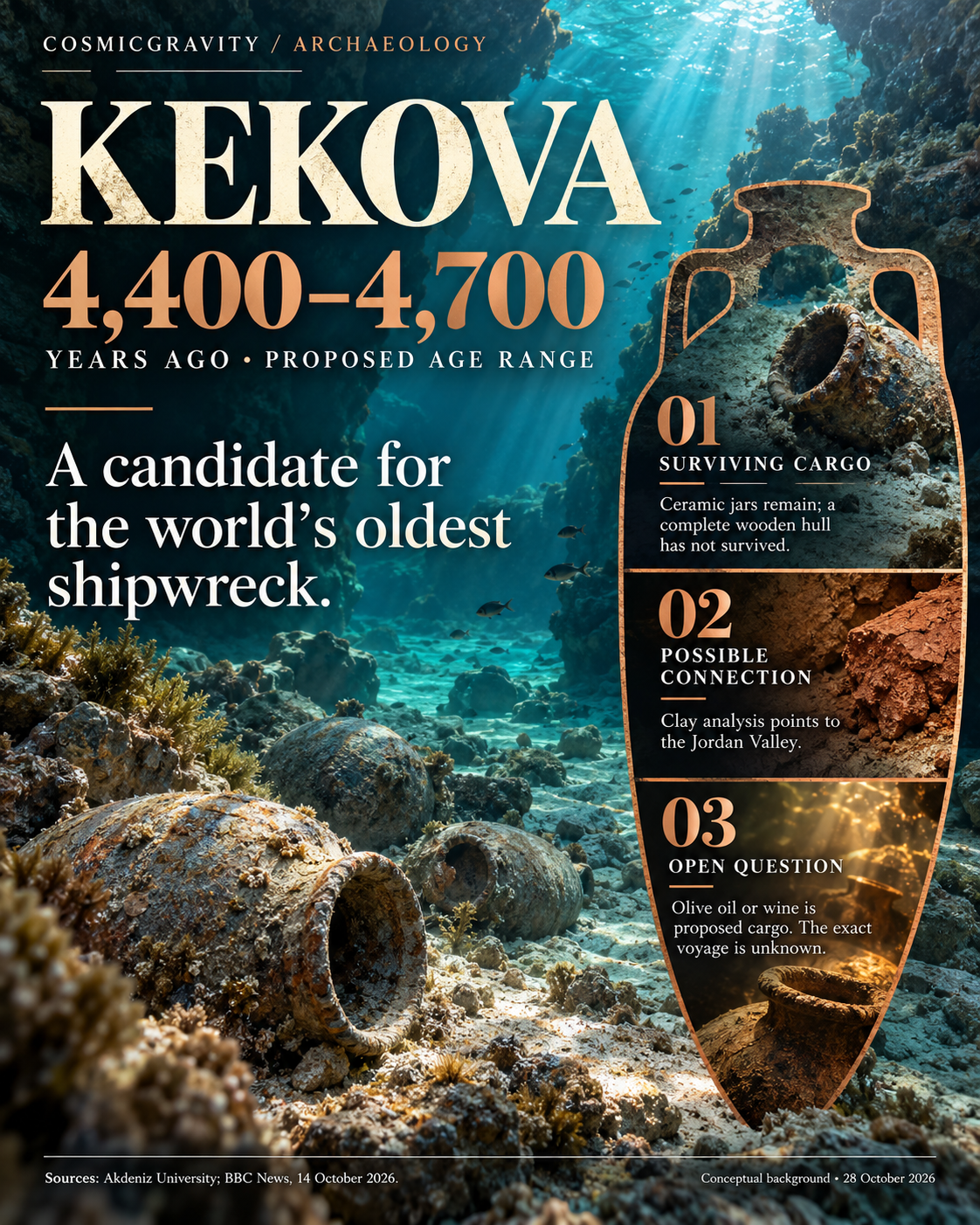
Original AI-assisted CosmicGravity magazine illustration. The scene and any inset imagery are conceptual; this is not a documentary photograph, an actual artefact or measured observational data.
Why Kekova could be the oldest shipwreck in Turkey
Akdeniz University’s announcement places the ceramic material at roughly 4,400–4,700 years old, in the Early Bronze Age. The research is led by Hakan Öniz, with the 2026 excavation conducted under Antalya Museum’s direction and the relevant ministry permissions.
The university says clay analysis points to workshops in the Jordan Valley. Similar jar forms occur at places including Giza, Saqqara, Troy and Crete. Those comparisons help place the material within a wider archaeological setting; they do not supply a complete itinerary for this particular vessel.
The cargo survives where the hull does not
In BBC News’s 14 October report, Öniz describes the site as a trading vessel. Its wooden structure has not survived, but ceramic storage pots remain on the seabed. Some preserve traces of their contents.
There is something striking about that reversal. The containers can outlast the thing that carried them. Yet a seabed photograph of jars cannot, by itself, answer every question about a vessel’s construction, final journey or sinking.
Olive oil or wine is proposed in the university announcement. That wording matters. A suggested cargo should remain a suggestion unless the analysis of a particular residue establishes more. Our illustration shows generic jars rather than inventing a scene of the vessel going down.
Why the date is a range
A date of about 4,500 years is a convenient way to describe the middle of the proposed period. It is not a recorded sailing date. The published announcement gives a span of several centuries, and that uncertainty belongs beside the headline.
The phrase “world’s oldest” also asks more than one question. Are researchers comparing a surviving hull, an associated cargo or another kind of underwater site? A persuasive comparison has to use equivalent evidence and explain how each site was dated.
TÜBİTAK’s science coverage likewise presents the age as a possibility. Readers can follow that distinction without losing the excitement of an unusually early maritime find.
A glimpse of trade before the famous wrecks
The most useful next details will be the excavation record, the dating argument and the cargo analyses. Those would help readers test the proposed connections rather than simply repeat a superlative.
Underwater finds often reveal the working side of ancient societies. The bronze seal-ring recovered in Alexandria offers another example on a smaller scale. At Kekova, ordinary storage jars may preserve an extraordinary early chapter of seaborne trade.



latest video



news via inbox
Subscribe to our Cosmic newsletter to get notified when we have new articles.