LOFAR radio map reveals the structure behind 63,000 sources
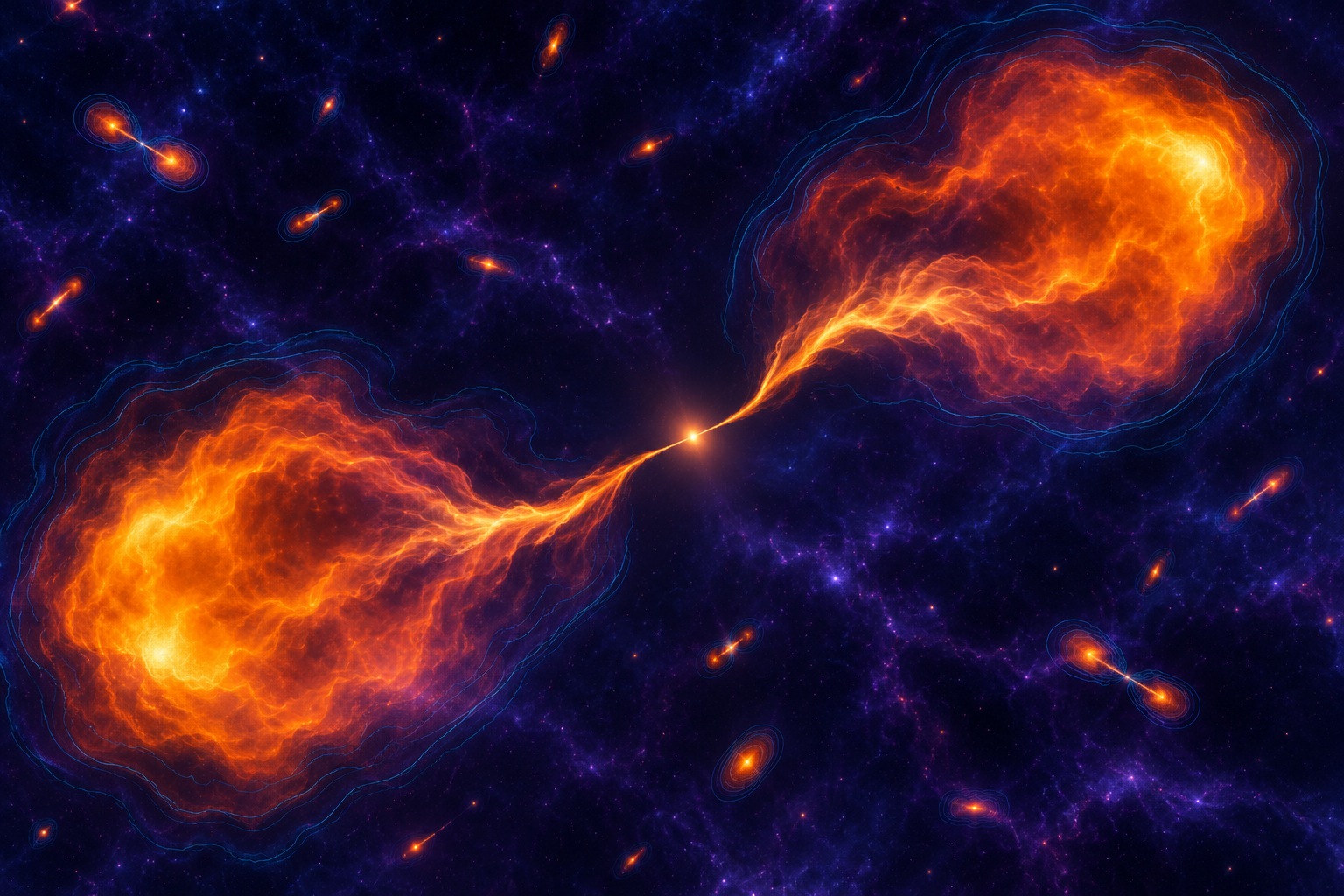
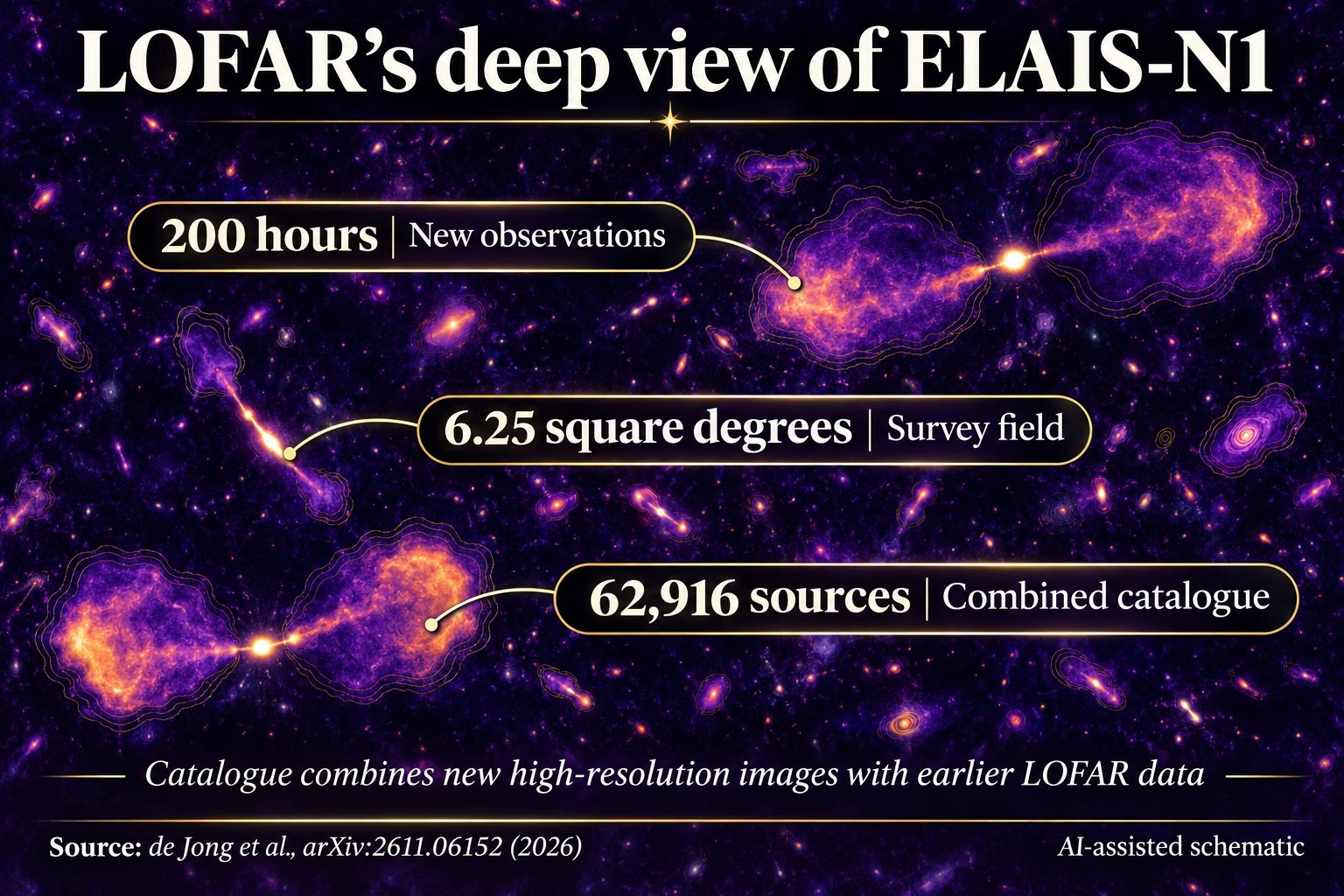
The new LOFAR radio map makes a small patch of the northern sky feel unexpectedly crowded. Its combined catalogue contains 62,916 radio sources, including galaxies where stars are forming and galaxies powered by active central black holes. The field covers 6.25 square degrees. Within that area, the new observations reveal structures that would blend together in a less detailed image. Durham University highlighted the result on 6 November, following the research team’s preprint on 4 November. The work has been accepted for publication in Astronomy & Astrophysics. Durham’s announcement.
The important advance lies in combining a deep exposure with fine detail across a substantial field. A faint source has to emerge from the background before astronomers can study it. Once it does, sharper imaging can help reveal whether it is compact, stretched into a jet or spread across a larger region.
What the LOFAR radio map contains
The team observed ELAIS-N1, a well-studied field, for 200 hours using LOFAR, the Low Frequency Array. They worked at frequencies between 115 and 168 megahertz. By linking stations over long distances and carefully calibrating their signals, they produced images with detail finer than one arcsecond, a tiny fraction of a degree. The central image has an angular resolution of about 0.33 by 0.39 arcseconds. The study’s observation and image measurements.
That resolution describes the separation of features the telescope can distinguish. By contrast, sensitivity describes how faint a source it can detect. They answer different questions. A particularly sharp image can still miss faint emission, while a very sensitive image can merge nearby features. This project brings those qualities together over a field measuring 2.5 degrees on each side.
The 62,916-source total needs a little care. The authors assembled it by combining their new images with earlier, deep LOFAR images at a coarser six-arcsecond resolution. It is the count in that combined catalogue. As a result, keeping the earlier data helps preserve a view of emission that can be easier to detect when it is gathered over a larger image element.
Why radio galaxies look so different
A radio view reveals a different part of a galaxy’s activity from the starlight that shapes a familiar optical photograph. Charged particles moving through magnetic fields can produce radio emission. Around an active galaxy, that emission may trace long jets and broad lobes extending away from the central region. Other radio sources are associated with star formation. Researchers use these features to investigate how galaxies and their central black holes evolve. Radboud University’s explanation of low-frequency radio astronomy.
The new field is therefore more than a collection of bright dots. A resolved jet or an extended region of emission gives a researcher additional clues about what powers a source. Those clues can guide comparisons with observations at other wavelengths, where a galaxy’s stars, gas or dust may be easier to study.
The computing behind a sharper sky
The observations generated roughly 400 terabytes of data. Turning them into a useful resource required both image processing and a reliable catalogue. Durham researcher Leah Morabito contributed the final scientific catalogue, which gives other astronomers a starting point for exploring the observations. The team has made the new observations publicly available. The catalogue and data release.
For someone using the LOFAR radio map, the catalogue is the bridge between admiring an image and asking a research question. It helps identify a source of interest and connect that source to measurements elsewhere. Astronomers can then inspect its structure and decide which further observations would be useful.
What comes next for the LOFAR radio map?
This release examines one carefully observed field. Wider surveys and deep fields serve complementary purposes: a broad survey supplies a large population, while a deep field lets researchers inspect fainter objects and finer structures within a smaller area. The authors describe their work as groundwork for future low-frequency imaging with upgraded facilities. Those future observations remain a programme to pursue.
Radio astronomy also studies events that change rapidly. Our guide to fast radio bursts follows that time-sensitive side of the subject. Here, the reward comes from patiently accumulating observations and making a crowded field clear enough for other researchers to explore.


latest video

news via inbox
Subscribe to our Cosmic newsletter to get notified when we have new articles.