Quantum Gravity: Where the Tiny and the Cosmic Collide
Modern physics rests on two spectacularly successful theories. Quantum mechanics describes atoms, particles and fields with extraordinary accuracy. General relativity explains gravity as the curvature of spacetime and predicts everything from gravitational waves to black holes. The trouble begins when nature demands both theories at once.
Quantum gravity is the search for a framework that can describe the microscopic quantum world and the massive cosmos without contradiction. No candidate has yet won experimental confirmation, but the subject is moving from pure mathematics toward observations and even laboratory tests.
Why do we need quantum gravity?
In most situations, physicists can keep the theories apart. Quantum field theory handles particles while gravity is so weak at small scales that it can be ignored. General relativity handles stars and galaxies, where the quantum behaviour of individual particles averages out.
That separation fails inside black holes and during the earliest moments of the universe. Relativity predicts singularities—places where density and spacetime curvature become infinite. Most physicists treat those infinities as warning signs that the theory has been pushed beyond its domain.
The natural scale of the problem is the Planck length, about 1.6 × 10⁻³⁵ metres. It is so far below the reach of particle accelerators that a direct image of “quantum spacetime” is not realistic with present technology.
String theory changes the basic ingredients
String theory replaces point-like elementary particles with tiny vibrating strings. Different vibration patterns appear as different particles, and one pattern behaves like a graviton—the hypothetical quantum carrier of gravity.
The framework naturally combines gravity with quantum mechanics and has produced important insights into black holes, dualities and the relationship between gravity and quantum field theories. Its best-known tool, holographic duality, suggests that a gravitational universe can sometimes be described by a lower-dimensional quantum theory without gravity.
The price is complexity. Most versions require extra dimensions, and the theory allows a vast range of possible low-energy universes. Researchers have not yet identified a unique experimentally verified route from the mathematics to our cosmos.
Loop quantum gravity quantises geometry
Loop quantum gravity begins with Einstein’s spacetime rather than adding strings. It rewrites geometry in quantum terms, producing networks whose links and nodes carry discrete units of area and volume.
In this picture, space is not infinitely divisible. At the smallest level it resembles a quantum weave. Related models of loop quantum cosmology can replace the Big Bang singularity with a “bounce,” although connecting such predictions to unique observations remains difficult.
Loop methods preserve background independence: spacetime is not a fixed stage on which physics happens, but a dynamical participant. That is conceptually close to general relativity, yet recovering familiar smooth spacetime and the full Standard Model remains a major challenge.
Other routes: safety, causality and emergence
Asymptotic safety asks whether gravity might remain a quantum field theory after all. Its calculations search for a high-energy fixed point that prevents interactions from becoming uncontrollable. If that fixed point exists with the right properties, gravity could stay predictive at arbitrarily high energies.
Causal-set theory proposes that spacetime is fundamentally a discrete collection of events ordered by cause and effect. Causal dynamical triangulations builds possible spacetimes from small geometric pieces and studies which large-scale universe emerges.
Other programmes treat spacetime and gravity as emergent, somewhat as temperature emerges from the motion of molecules. Holography, tensor networks and quantum-information ideas have strengthened the possibility that geometry is related to patterns of entanglement.
Can gravity create quantum entanglement?
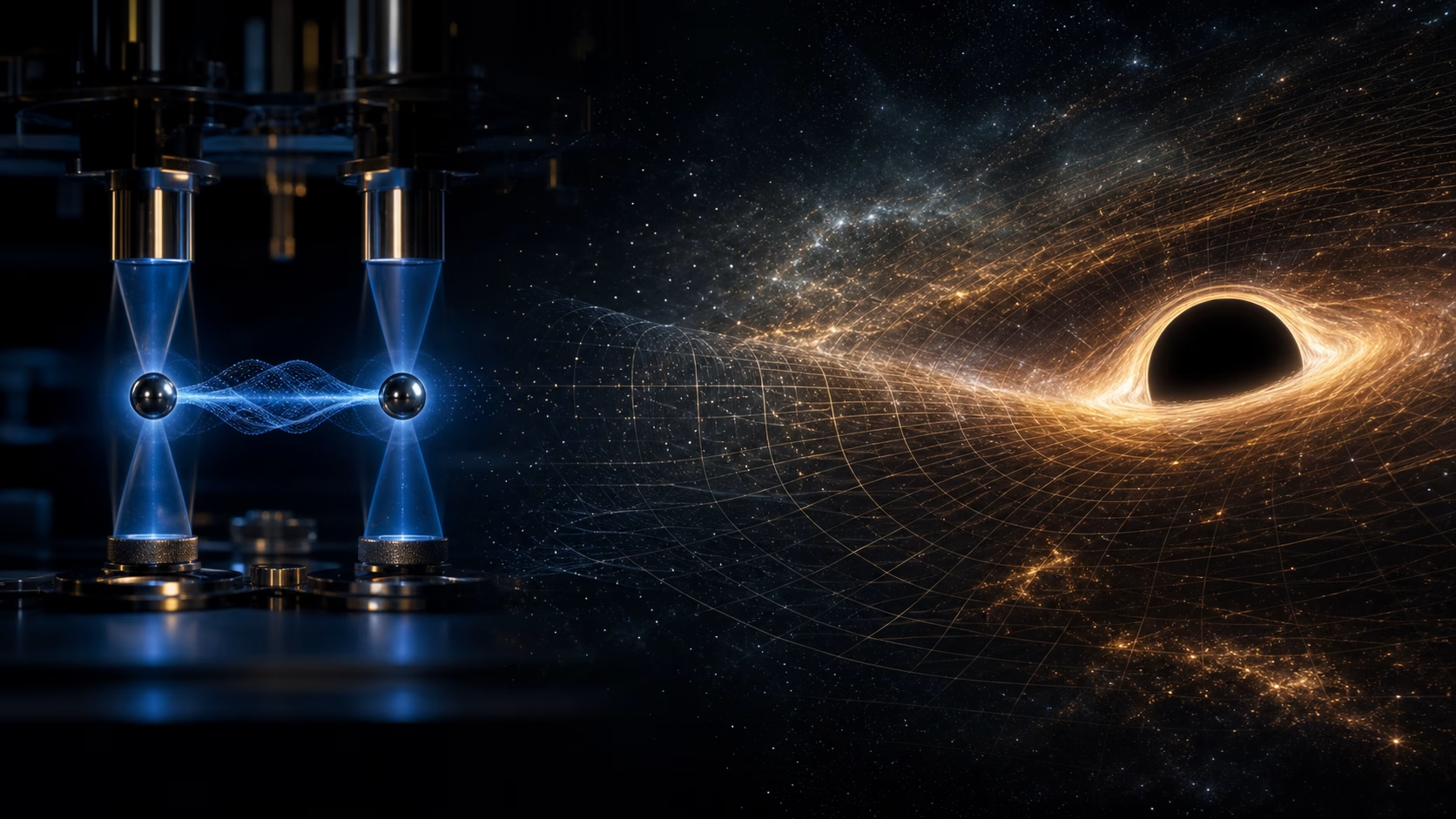
A new experimental strategy brings the question into the laboratory. Place two small masses in quantum superpositions and let their gravitational interaction create correlations. If the masses become entangled, the simplest interpretation is that the mediator carries quantum information.
A major 2025 review described how such tests could work. In July 2026, researchers also presented an atom-interferometry route that may reduce some experimental demands by using coherent atomic states.
However, the interpretation is still being sharpened. A 2025 Nature paper showed that certain models combining classical gravity with quantum field theory can also generate entanglement. That does not make the experiment useless; it means the signal’s size and detailed scaling must distinguish competing models rather than relying on a single yes-or-no observation.
The cosmos is already testing the extremes
Black-hole mergers, the cosmic microwave background and high-energy particles all probe environments where quantum-gravity effects might leave traces. So far, no observation requires one specific theory.
Black holes are especially important because they combine quantum information, thermodynamics and curved spacetime. Discoveries such as a wandering black hole revealed by a destroyed star test how these objects behave astrophysically, while the information paradox asks what happens at the deepest theoretical level.
Future surveys will add precision. The Roman Space Telescope will map dark matter and cosmic expansion across enormous areas, testing gravity on scales very different from laboratory experiments.
Why there is no winner yet
Each programme solves part of the puzzle. String theory offers unification and holography. Loop gravity quantises geometry without a fixed background. Asymptotic safety seeks a conservative quantum-field route. Causal and emergent models rethink what spacetime is.
The missing ingredient is decisive evidence. A beautiful mathematical structure is not enough, and a vague anomaly is not a theory test. Researchers need predictions that distinguish one framework from ordinary quantum physics and general relativity.
Quantum gravity may ultimately be found in black-hole observations, the infant universe or a carefully isolated tabletop experiment. The remarkable change is that all three routes are now being pursued together.
Sources: 2025 Review of Modern Physics on laboratory quantum-gravity tests, Nature: classical gravity and entanglement, and 2026 atom-interferometry proposal.


latest video

news via inbox
Subscribe to our Cosmic newsletter to get notified when we have new articles.