A Wandering Black Hole Was Caught Shredding a Star
A supermassive black hole is expected to sit in the centre of its galaxy. In July 2026, astronomers announced something far stranger: a wandering black hole revealed itself by tearing apart a star roughly 2,600 light-years from the centre of its host galaxy.
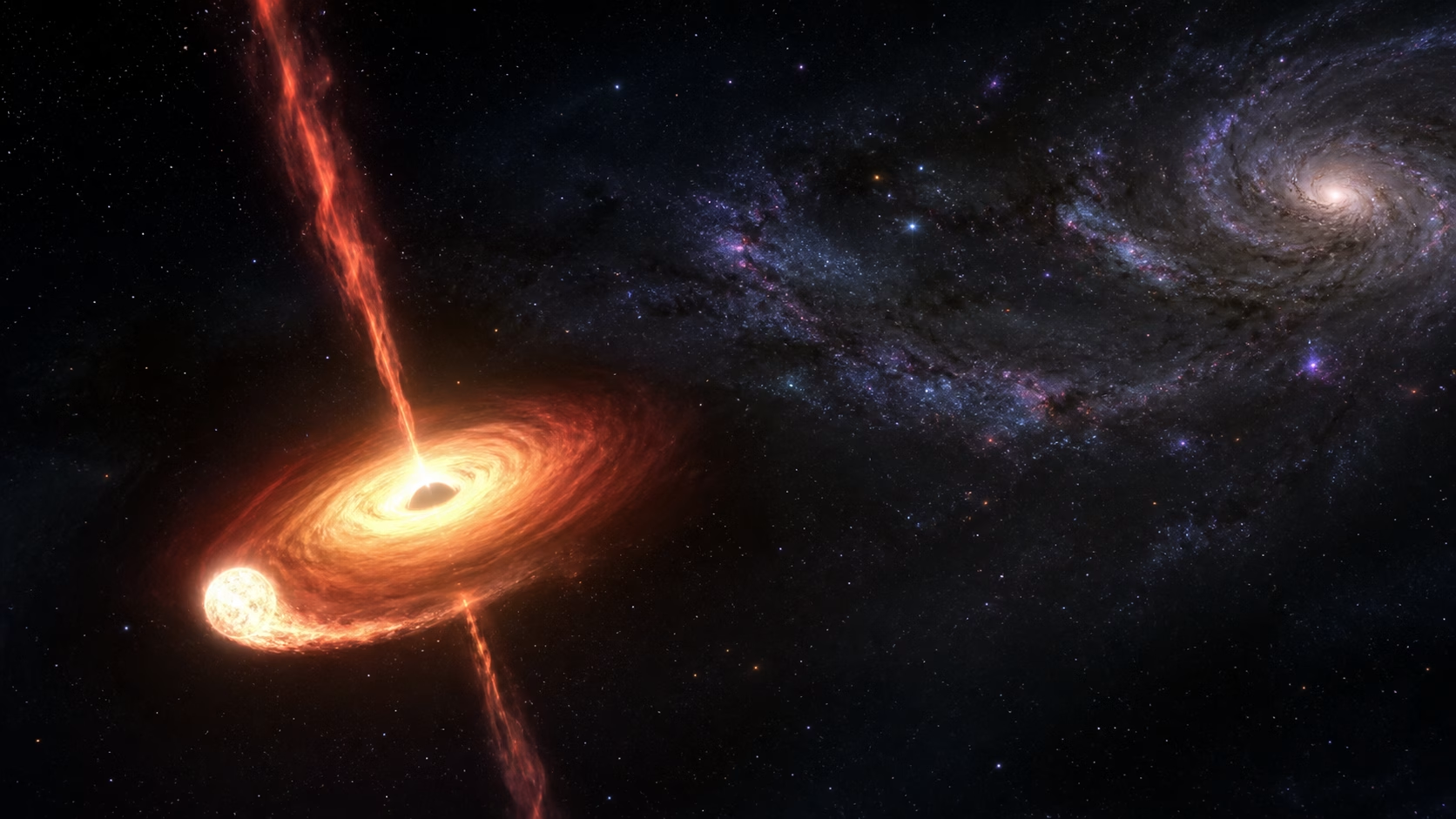
The event was detected as a brilliant flare about 750 million light-years away. NASA’s Neil Gehrels Swift Observatory helped confirm that this was a tidal disruption event—the violent death of a star that passed too close to a black hole roughly one million times the mass of the Sun.
A black hole that was almost invisible
Black holes emit no light of their own. Astronomers usually find them through their effects on nearby matter: the motion of stars, hot gas in an accretion disk or radiation released when material falls inward.
A dormant black hole wandering through a quiet region of a galaxy can therefore remain hidden for an extremely long time. This one announced its presence only when a star drifted across the boundary where gravity became fatal.
The near side of the star felt a stronger pull than the far side. That difference stretched the star into a stream and eventually tore it apart. Some debris escaped; some wrapped around the black hole, heated to enormous temperatures and produced a flare visible across hundreds of millions of light-years.
Why its location surprised astronomers
Most known tidal disruption events occur in galactic nuclei, where supermassive black holes normally live. This flare was well outside the centre. Another candidate has since been found more than 30,000 light-years from its galaxy’s core, suggesting that the first case may not be unique.
The leading explanation is a past galaxy merger. A smaller galaxy, carrying its own central black hole, may have collided with a larger one. Its stars were absorbed into the larger system while its black hole was left on a wide orbit or slowly sank inward.
There is another possibility in some systems. When black holes merge, gravitational waves can carry momentum unevenly and kick the remnant away from the centre. The details differ, but both routes turn a galaxy into a place where massive black holes may roam far beyond its nucleus.
Artificial intelligence found the unusual flare
The Zwicky Transient Facility scans the sky and detects roughly half a million changes every night. Most are variable stars, supernovae, moving objects or instrumental effects. An artificial-intelligence system flagged this flare in November 2025 because its changing brightness resembled a tidal disruption event even though its position was wrong for the usual pattern.
That is a useful example of what machine learning does best: it does not replace scientific judgment, but searches an overwhelming stream of observations for rare candidates. A similar strategy is transforming the search for possible alien signals, where the challenge is also separating a tiny number of unusual events from an ocean of ordinary data.
A new way to count hidden black holes
Galaxy mergers are common across cosmic history. If wandering black holes are a natural aftermath, galaxies may contain many more massive black holes than their bright central engines suggest. Most would be dark and difficult to find.
Tidal disruption events provide a temporary beacon. Future wide-field surveys can search beyond galaxy centres instead of automatically rejecting off-centre flares. That could reveal how frequently black holes are displaced, how quickly they return to galactic nuclei and how often galaxies have merged.
What the discovery does—and does not—show
The phrase “wandering black hole” can sound as if a cosmic monster is drifting freely toward us. That is not what the data imply. This object remains associated with a distant galaxy, and it poses no threat to Earth.
The real significance is historical. A black hole located far from the nucleus may preserve evidence of a merger long after the smaller galaxy’s original shape has disappeared. It is a compact fossil of galactic collision.
The result also connects to the puzzle of how black holes grew so quickly in the early universe. Observations of ancient quasars show that enormous black holes existed surprisingly early. Finding and counting displaced black holes in later galaxies can test how frequently mergers contributed to that growth.
The next survey could find many more
NASA’s Roman Space Telescope is designed to monitor vast areas of sky with Hubble-like sharpness. Its time-domain observations should detect large numbers of transient events, including stars torn apart by black holes. The July discovery proves that astronomers should look not only at galactic centres, but throughout their outskirts.
For a brief period, one unfortunate star illuminated an object that might otherwise have remained invisible. In doing so, it opened a new route to mapping a hidden population of black holes.
Source: NASA Swift: wandering mega black hole shredding a star.



latest video

news via inbox
Subscribe to our Cosmic newsletter to get notified when we have new articles.