How a GEIPAN UFO investigation turns a sighting into a case
A GEIPAN UFO investigation begins with a report that something in the sky looked unusual. What follows can be surprisingly practical. Where was the witness standing? Which way were they looking? Was the light moving against a fixed landmark, or did it only seem to move? France’s public aerospace observation archive is useful because it preserves that work alongside the original report. Its four main outcome labels also make a distinction that is easy to lose in a headline. An unexplained case can have too little information to assess, or it can remain unexplained after an investigation. GEIPAN’s description of its work.
GEIPAN is part of CNES, the French space agency. Its name refers to the study of unidentified aerospace phenomena, usually shortened in French to PAN. It collects accounts, investigates them and publishes case material while protecting witnesses’ identities. The service gives readers a way to follow the reasoning from a sighting to a conclusion. CNES’s GEIPAN project overview.
What a GEIPAN UFO investigation tries to establish
A witness describes an experience from one place, at one time and under particular conditions. An investigator tries to reconstruct those conditions closely enough to compare possible explanations. The exact date and time can make it possible to check aircraft movements, satellite passes or the positions of bright planets. The direction of view and the surrounding landscape help establish which part of the sky the witness actually saw.
A recording brings another set of questions. The original file may retain timing and camera information that a reposted clip has lost. A long view can show how a light moved relative to landmarks. A close crop might make the light easier to see while removing that reference. That is why the file and the witness’s account can each contribute something different to an inquiry.
GEIPAN describes its method as a comparison between the reported experience and known aerospace or natural phenomena. Depending on the case, that can involve expertise in atmospheric conditions, astronomy, optical effects or human perception. A strong explanation has to account for the circumstances of the observation. Resemblance to an example in a catalogue is only a starting point. CNES on how GEIPAN analyses reports.
What do the A, B, C and D labels mean?
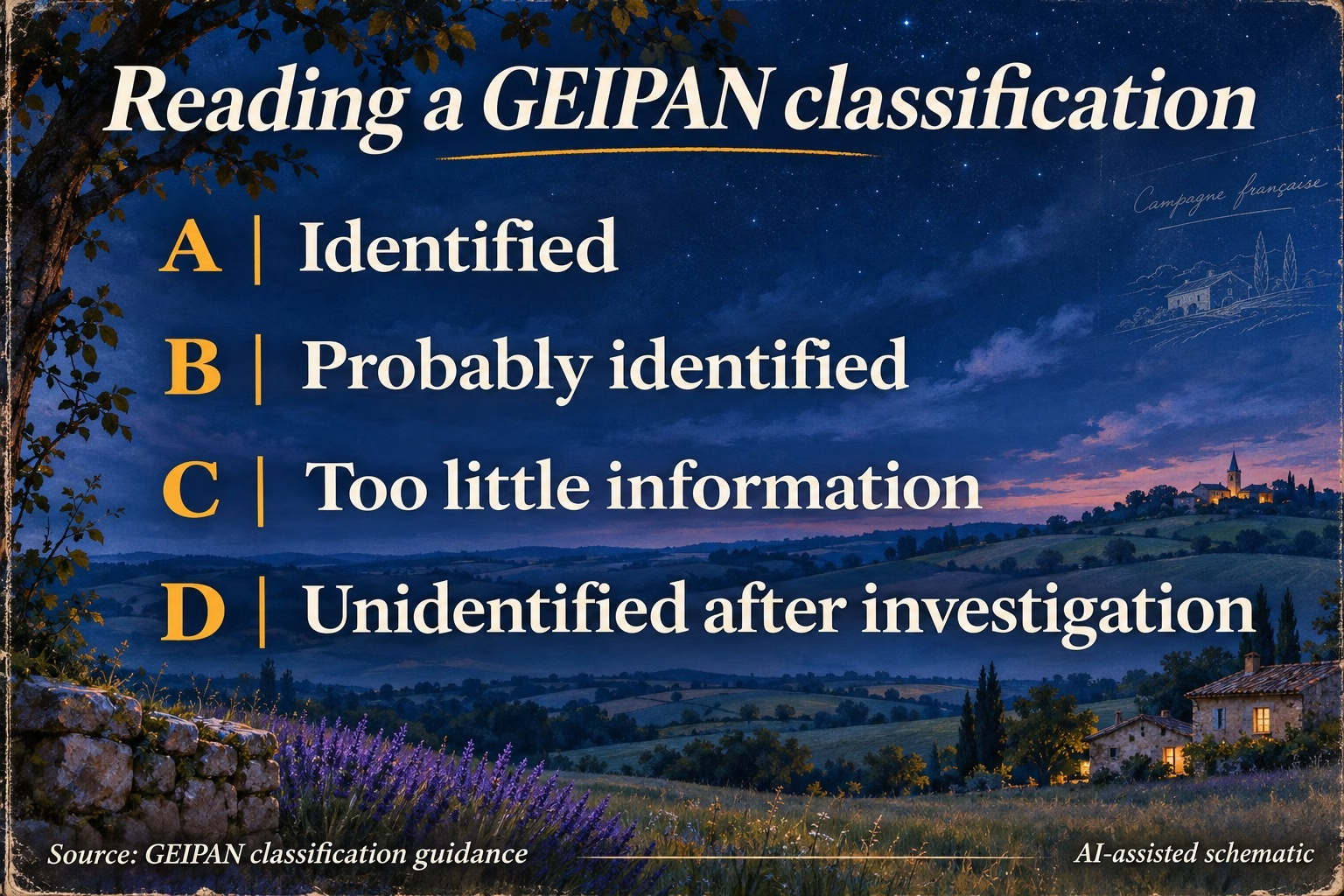
GEIPAN’s classification guidance defines A as an identification established by the inquiry and B as a probable identification. Those labels let the archive express how firmly the evidence supports an explanation. Class C covers cases where a lack of information prevents identification. Class D covers cases that remain unidentified after investigation. GEIPAN’s classification definitions.
The distinction between C and D is especially useful. Imagine a witness reports a white light but remembers neither the hour nor the direction. Investigators might have too little information to choose among several possibilities. A second case might include several accounts, photographs and a recorded location, yet still resist an explanation. Both can remain open questions, but the next useful step for each will differ. The first needs basic information. The second may need a fresh hypothesis or a new analysis of the evidence already collected.
GEIPAN assesses both the information in a case and the unusual features that remain after possible explanations have been tested. Several detailed accounts can improve a reconstruction, particularly when their perspectives and timing can be compared. At the same time, investigators need to understand which observations were independent and which descriptions may have influenced one another.
Can an investigation’s classification change?
Yes. GEIPAN says it can revisit a case when new information becomes available. That gives a classification a date and a context. Readers checking an old case should look for the inquiry’s conclusion and any later revision, as well as the witness’s initial description. A later explanation may depend on information that the first investigator could not obtain.
To follow a GEIPAN UFO investigation, start with its chain of reasoning. A proposed aircraft or astronomical explanation should fit the time, viewing direction and apparent movement. An unresolved conclusion should make clear which questions remain. Those details help another reader assess what further evidence could move the case forward. The same habit is useful when comparing the two federal accounts of the recent black triangle report, where different time estimates affect how the movement can be interpreted.


latest video

news via inbox
Subscribe to our Cosmic newsletter to get notified when we have new articles.