First Contact: How Earth Might Welcome Extraterrestrial Visitors
Updated August 2026. Humanity has imagined first contact for generations, usually as a dramatic landing in a capital city or a message that instantly changes everything. Reality would probably be slower, messier and far more cautious. The first convincing evidence of extraterrestrial intelligence may arrive as an unusual radio signal, a chemical fingerprint in an exoplanet atmosphere, or an artificial object detected somewhere in our own Solar System.
Reality check
Confirmed: scientists actively search for technosignatures and have developed verification principles for a possible detection. Possible: evidence could appear in several very different forms. Unknown: no extraterrestrial visitor, message or technological artifact has yet been independently confirmed.
So what would actually happen if the evidence survived scrutiny? This is not a prediction of an imminent arrival. It is a realistic thought experiment based on modern astronomy, international law and the procedures researchers have developed for handling an extraordinary claim.
First contact probably would not begin with a landing
A spacecraft touching down in front of cameras is the most cinematic scenario, but it is not the most likely. Space is enormous, interstellar travel is difficult and information can cross the distance much more easily than machines or living beings. A genuine first-contact event could begin quietly: a pattern in data that only a handful of researchers notice at first.
Four broad scenarios deserve serious consideration.
1. A distant artificial signal
A telescope might detect a narrow-band radio transmission, a sequence of optical pulses or another signal that appears engineered rather than natural. The first challenge would be repetition. A single anomaly is interesting; a signal independently observed by several facilities, coming from the same point in the sky and displaying structured information, would be far harder to dismiss.
2. A technosignature in an atmosphere
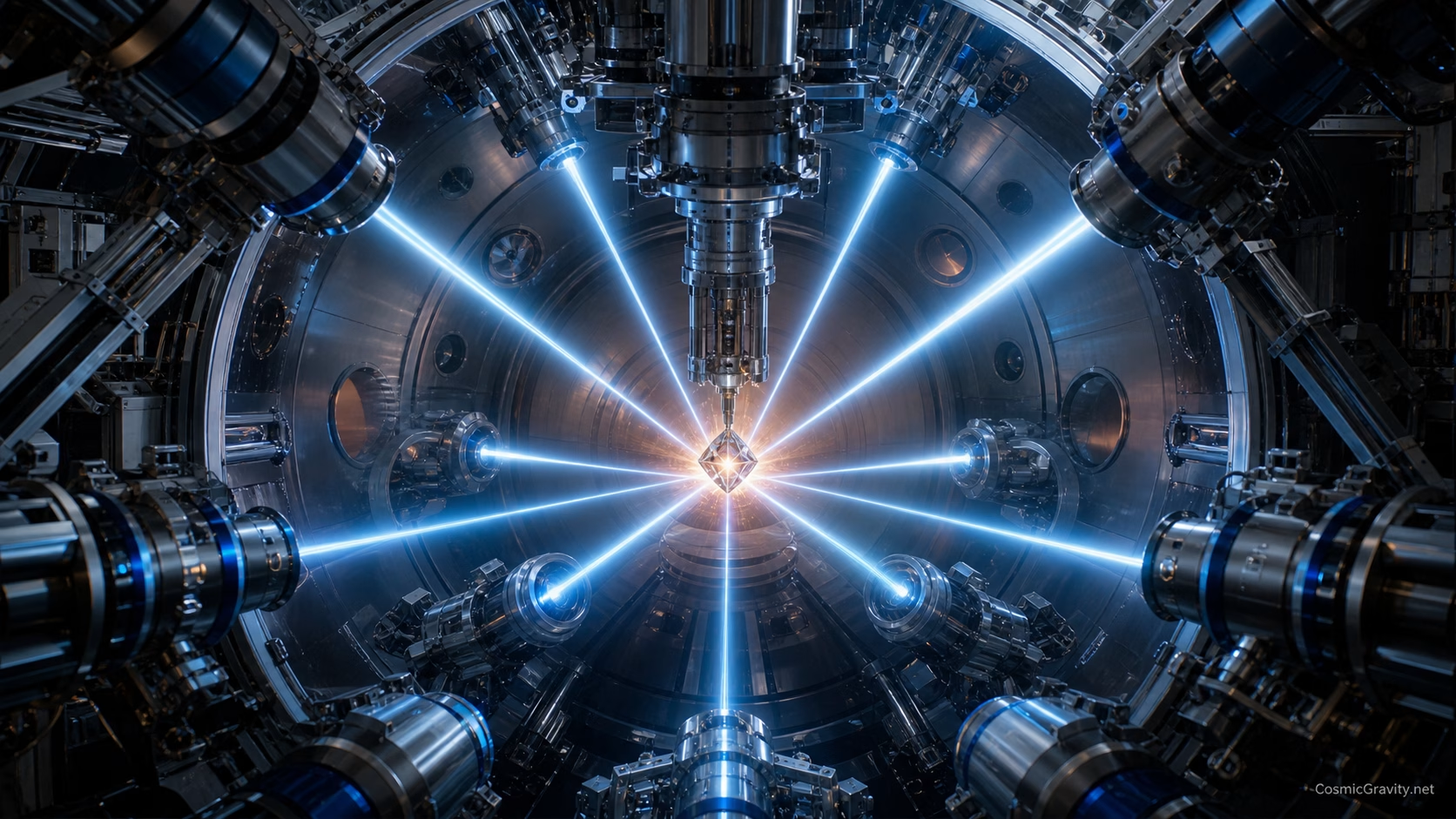
NASA describes technosignatures as observable evidence of technology. That could include unusual atmospheric chemicals, artificial light on a planet’s night side, waste heat or patterns that natural processes struggle to explain. Such evidence would not introduce us to individual beings, but it could tell us that technological life exists—or once existed—elsewhere.
3. An artifact or probe in the Solar System
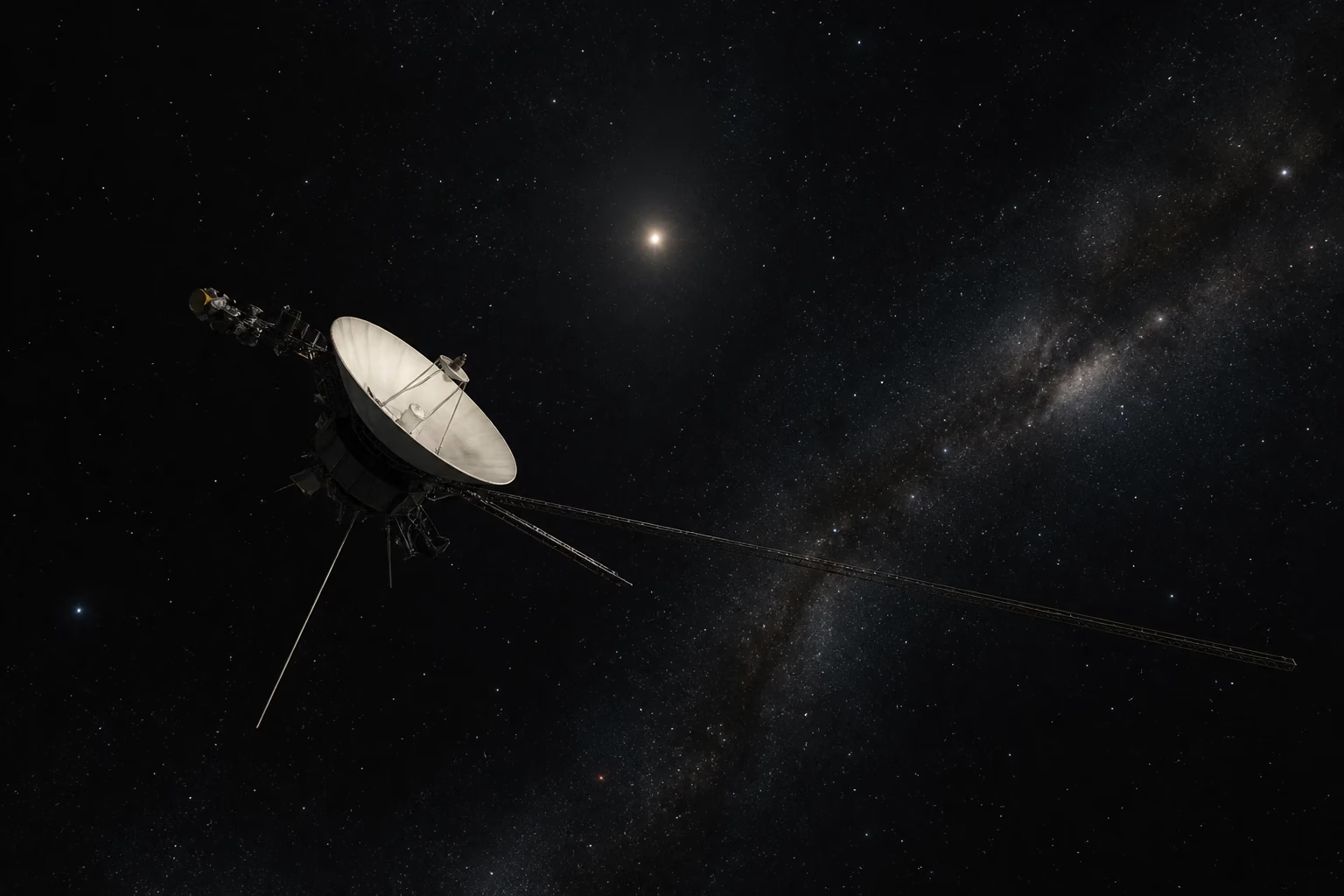
The discovery of an object with unmistakably artificial construction would produce an immediate global response. Before anyone approached it, scientists would want remote imaging, spectroscopy, radiation measurements and an independently documented chain of evidence. A probe could be active, dormant, ancient or simply impossible to interpret with our present knowledge.
4. Physical visitors near Earth
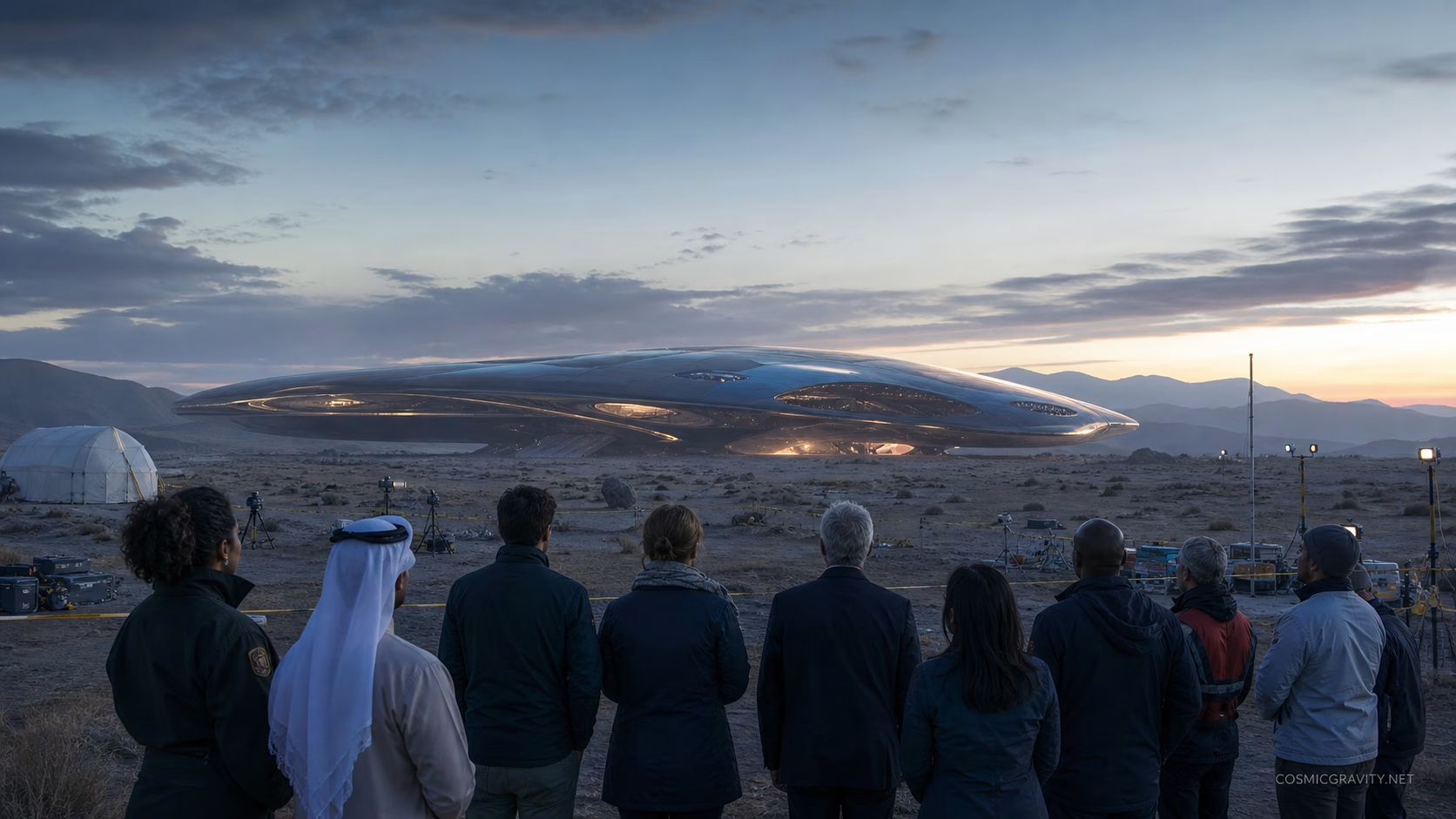
This is the least probable and most disruptive scenario. An unfamiliar craft performing controlled manoeuvres and communicating intelligently would move the issue from astronomy into diplomacy, security, biology and international law within minutes. Even then, the first sensible response would be observation rather than confrontation.
The first 24 hours: verification before celebration
The public may imagine an immediate presidential announcement, but researchers would first try to prove themselves wrong. Equipment faults, satellites, aircraft, software errors, deliberate hoaxes and unfamiliar natural phenomena all have to be eliminated. Independent confirmation is the difference between an exciting anomaly and a discovery that can withstand history.
Modern SETI principles call for prompt, open communication after credible verification. They also emphasise making data available so that other experts can analyse it. In practice, news might leak before the verification process is complete. Observatory staff, online tracking communities and social media could all notice unusual activity. Authorities would therefore have to communicate uncertainty honestly instead of leaving an information vacuum.
A responsible early statement might sound frustratingly restrained: an anomalous observation has been made; multiple facilities are examining it; no conclusion has yet been reached. That caution would not be secrecy. It would be science working at the speed demanded by an unprecedented claim.
How scientists would verify the impossible
The method would depend on the type of evidence, but several tests would apply in almost every case:
- Independent observation: Can other instruments in other countries detect the same phenomenon?
- Location: Does the signal or object consistently originate beyond Earth?
- Repeatability: Can it be observed again under documented conditions?
- Natural explanations: Have known astrophysical and atmospheric causes been tested?
- Human interference: Can satellites, military systems, transmitters, software or fraud explain it?
- Structured information: Does the evidence contain complexity that is difficult to produce naturally?
- Open data: Can qualified outside researchers inspect enough of the evidence to challenge the conclusion?
No single institution should be asked to authenticate such a discovery alone. A worldwide network of observatories and laboratories would offer both scientific resilience and public credibility.
Who would speak for Earth?
There is no elected spokesperson for humanity. A discovery could occur in one country, involve equipment funded by several countries and affect every person on the planet. National governments would have legitimate responsibilities, but no government could convincingly claim sole ownership of the event.
The United Nations would almost certainly become part of the discussion because it already provides the principal international framework for activities in outer space. The 1967 Outer Space Treaty establishes ideas such as peaceful use, international responsibility and avoiding harmful contamination. It does not, however, contain a detailed first-contact script.
A practical response would probably require several overlapping groups: scientists to evaluate the evidence, diplomats to coordinate governments, security experts to assess risk, linguists and mathematicians to study communication, ethicists to examine consequences and public representatives to challenge closed decision-making. The process would be imperfect, but broad participation would be more legitimate than a private reply composed behind one national flag.
Should humanity send a reply?
Receiving a message and answering it are different decisions. Current post-detection principles advise against transmitting a response before broad international consultation. The reason is simple: a reply would represent more than the research team that discovered the signal.
Even a harmless-looking message raises difficult questions. Should we reveal our biology, location, political divisions or technological level? Which languages and images would be included? Would silence appear cautious, unfriendly or irrelevant to a civilisation operating on a radically different timescale?
Distance may give humanity time. If a signal came from a star 100 light-years away, a conventional radio reply would require another century to arrive. A craft already near Earth would remove that breathing room. In either case, the first response should probably be minimal, factual and designed to avoid assumptions about intent.
The biological problem works both ways
Stories often focus on alien microbes threatening Earth. The danger would also run in the opposite direction: terrestrial organisms and chemicals could contaminate an unfamiliar ecosystem or destroy scientific evidence. Genuine visitors may not even use carbon-based biology, but uncertainty is exactly why caution matters.
Initial physical interaction would likely rely on distance, robotics and isolated environments. Researchers would monitor radiation, airborne particles, electromagnetic effects and chemical exchange before allowing direct contact. Quarantine would not imply hostility; it would protect both sides from risks neither understands.
How the world might react
There would be wonder, fear, humour, denial, opportunism and genuine confusion—often at the same time. Financial markets could become volatile, but daily life would not necessarily stop. Unless there were an immediate physical threat, most people would still wake up, care for their families and go to work while trying to understand what the discovery meant.
Religions would not automatically collapse. Many traditions already debate life beyond Earth and could adapt more easily than popular fiction assumes. Science would face a different challenge: a confirmed technological civilisation would answer one enormous question while opening thousands more. Where did it arise? How old is it? Is intelligence common? Has it observed us for long? Does it recognise individuals, nations or only a biosphere?
Misinformation would be one of the most immediate dangers. Old footage, synthetic images and unrelated UAP cases would be repackaged as proof. The best defence would be rapid access to original data, named experts, clear timelines and visible corrections when early interpretations change.
Five questions humanity should answer before contact
- What standard of evidence is sufficient? Public trust depends on explaining why a conclusion is stronger than a rumour.
- Who may authorise a response? A decision with planetary implications needs more legitimacy than a single government or company can provide.
- Which information should remain private at first? Openness matters, but precise operational or defensive information may require careful handling.
- How do we protect scientific independence? Researchers must be able to test official claims without political pressure.
- How will corrections be communicated? Early data will be incomplete. Changing an interpretation should be treated as responsible analysis, not evidence of a cover-up.
What welcoming extraterrestrial visitors should mean
A welcome does not require blind trust. It means approaching the unknown with curiosity, restraint and dignity. Humanity’s first impression would be shaped not only by what we say, but by how we treat one another while deciding what to say.
The smartest first-contact plan is therefore not a secret phrase or a military formation. It is a culture of verification, transparent communication and international cooperation built before the crisis arrives. That preparation is useful even if contact never occurs: the same habits help society handle ambiguous UAP reports, astronomical discoveries and fast-moving global misinformation today.
Recent debate about UAP disclosure, testimony and scientific transparency shows how quickly uncertainty can become political. First contact would amplify that pressure beyond anything we have experienced. The discovery may begin with a quiet data point, but our response would reveal something profound about Earth: whether we are able to act as one civilisation when the audience is larger than ourselves.
Sources and further reading
- SETI Institute: Principles for responding to a detection of extraterrestrial intelligence
- International Academy of Astronautics: SETI protocols
- NASA Science: Searching for technosignatures
- University of St Andrews: SETI Post-Detection Hub
- United Nations Office for Outer Space Affairs: Outer Space Treaty
Editorial note: This article is a science-based scenario, not a report of a confirmed extraterrestrial arrival. It was substantially revised and fact-checked in August 2026.

latest video

news via inbox
Subscribe to our Cosmic newsletter to get notified when we have new articles.