The Planet That Survived the Death of Its Star
Billions of years ago, a star much like the Sun reached the end of its ordinary life. It expanded into a red giant, shed its outer layers and left behind a hot core roughly the size of Earth. Any planet orbiting close to that star should have been destroyed.
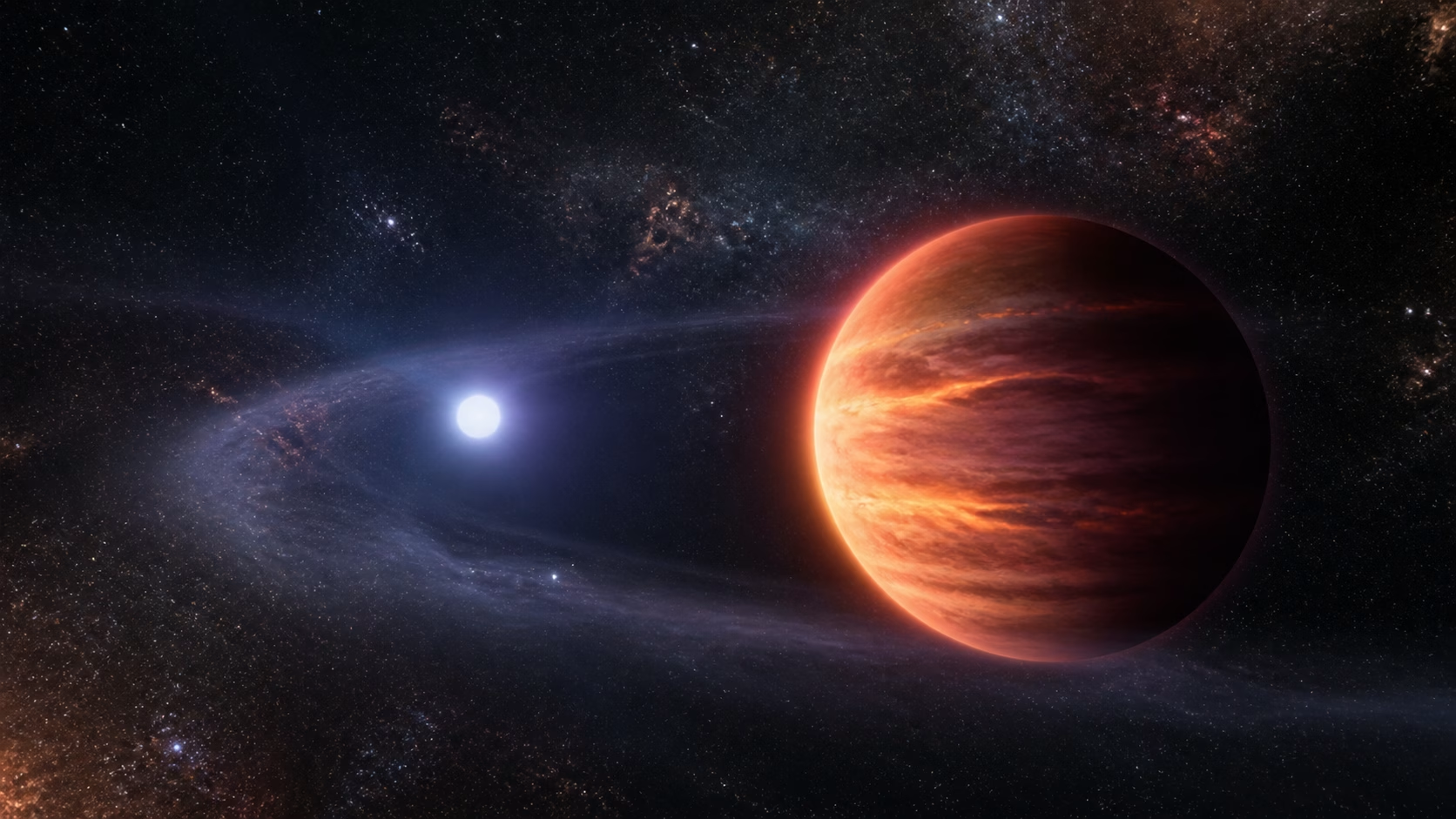
Yet a giant planet is there today. WD 1856 b, about the size of Jupiter, races around the white dwarf WD 1856+534 once every 34 hours. Its orbit is so tight that the distance between planet and star is about fifty times smaller than the distance between Earth and the Sun.
In July 2026, astronomers using the James Webb Space Telescope reported the most detailed measurements of this strange system so far. They detected the planet’s atmosphere, constrained its mass and found that it is much warmer than expected. That unexpected warmth helped explain how the planet may have survived the death of its star.
A planet larger than its star
A white dwarf is the compressed core left when a Sun-like star exhausts its fuel. It contains a large fraction of the original star’s mass inside a sphere similar in size to Earth. WD 1856 b is about seven times wider than the star it orbits.
The visual result would look almost backwards: a giant planet passing in front of a small stellar remnant. That dramatic size difference makes the transit especially useful. When the planet crosses the face of the white dwarf, it blocks a large portion of the starlight and allows telescopes to study subtle changes in the spectrum.
WD 1856 b was discovered in 2020 with observations from NASA’s TESS mission and the retired Spitzer Space Telescope. Its existence created an immediate puzzle. If the planet had always orbited where it does now, it would have been engulfed when the star became a red giant.
What Webb added
Webb watched the planet transit its star using the NIRSpec instrument. The measurements showed that WD 1856 b has between four and eleven times the mass of Jupiter. That confirms it is a planet rather than a small failed star, although it sits toward the heavy end of the planetary range.
The observations also detected an atmosphere and measured the planet’s thermal emission. Its temperature is about 126 degrees Celsius. That is far hotter than the present white dwarf’s light alone should produce at the planet’s location.
This was not merely an extra detail. Temperature preserves history. A massive gas giant cools slowly after it has been heated, and researchers can model how long that cooling should take.
The orbit could not have been permanent
The simplest conclusion is that WD 1856 b arrived in its tight orbit relatively recently on astronomical timescales. It must originally have lived farther from its star, safely beyond the reach of the red giant’s swollen atmosphere.
After the star became a white dwarf, gravitational interactions may have pushed the planet onto a highly elongated orbit. Each close passage near the stellar remnant would have raised tides inside the planet. The repeated flexing converted orbital energy into heat, gradually shrinking and circularizing the orbit.
That process explains two observations at once: why the planet is now so close and why it remains unusually warm. The heat is a fading memory of a violent migration.
What could have pushed it inward?
A single planet on a stable wide orbit would not normally plunge toward its star. Something had to disturb it. One candidate is another massive planet. As the host star lost mass, the gravitational balance of the system changed, potentially making previously stable orbits chaotic.
A distant companion star could also have slowly altered the planet’s orbit. WD 1856+534 belongs to a wider system that includes two small red stars. Over long periods, their gravity may have helped drive WD 1856 b into an eccentric path.
These scenarios are difficult to reconstruct because the decisive events happened long ago. Webb cannot replay the migration. It can measure the present orbit, atmosphere, mass and temperature, allowing researchers to test which histories are physically plausible.
A preview of the Solar System’s distant future
The Sun will eventually follow a similar path. In roughly five billion years, it will expand into a red giant. Mercury and Venus are expected to be engulfed; Earth’s fate is less certain. After the outer layers drift away, the Sun will become a white dwarf.
The outer planets may survive, although their orbits will widen as the Sun loses mass. Later gravitational encounters could rearrange the system. WD 1856 b demonstrates that a planet resembling Jupiter can survive stellar death and then migrate into a radically different orbit.
It is not a precise forecast for our Solar System, but it makes the abstract future tangible. Planetary systems do not simply stop when their stars die. They continue evolving for billions of years.
Could a white-dwarf system support life?
The discovery has also renewed interest in smaller planets around white dwarfs. A rocky world in a close orbit might receive enough energy for liquid water, but survival would be a major obstacle. It would either need to endure the red-giant phase or migrate inward afterward.
White dwarfs are small, making planetary transits deep and atmospheric signals comparatively strong. In principle, future telescopes could examine the atmosphere of an Earth-sized planet around one in unusual detail.
That does not mean such worlds are likely to be inhabited. They would face a complicated history of intense radiation, orbital migration and possible loss of water. Still, WD 1856 b proves that planets can occupy the right general region after stellar death.
An unlikely world that obeys real physics
WD 1856 b sounds impossible only if we imagine planetary systems as fixed clockwork. In reality, stars lose mass, orbits destabilize, planets scatter and tides reshape trajectories.
Webb’s measurements turned the planet from a curiosity into a story. Its atmosphere and temperature suggest a giant world displaced from its original home, heated during a dangerous inward journey and left circling the exposed core of a dead star.
It survived—but not unchanged.
Related reading


latest video



news via inbox
Subscribe to our Cosmic newsletter to get notified when we have new articles.