A red dwarf’s wobble gave away the third star in the Welopō‘ai system
Étienne Artigau and colleagues were looking for planets when a red dwarf about 28 light-years away gave them a much larger signal than they expected. Across 4.8 years of observations, its measured speed toward and away from us swung through roughly 16 kilometres per second from one extreme to the other. The explanation turned a familiar pair of stars into the Welopō‘ai triple star system. A faint white dwarf had been hiding close to the red one. A second white dwarf was already known farther out. The team’s November 19 study in Astronomy & Astrophysics.
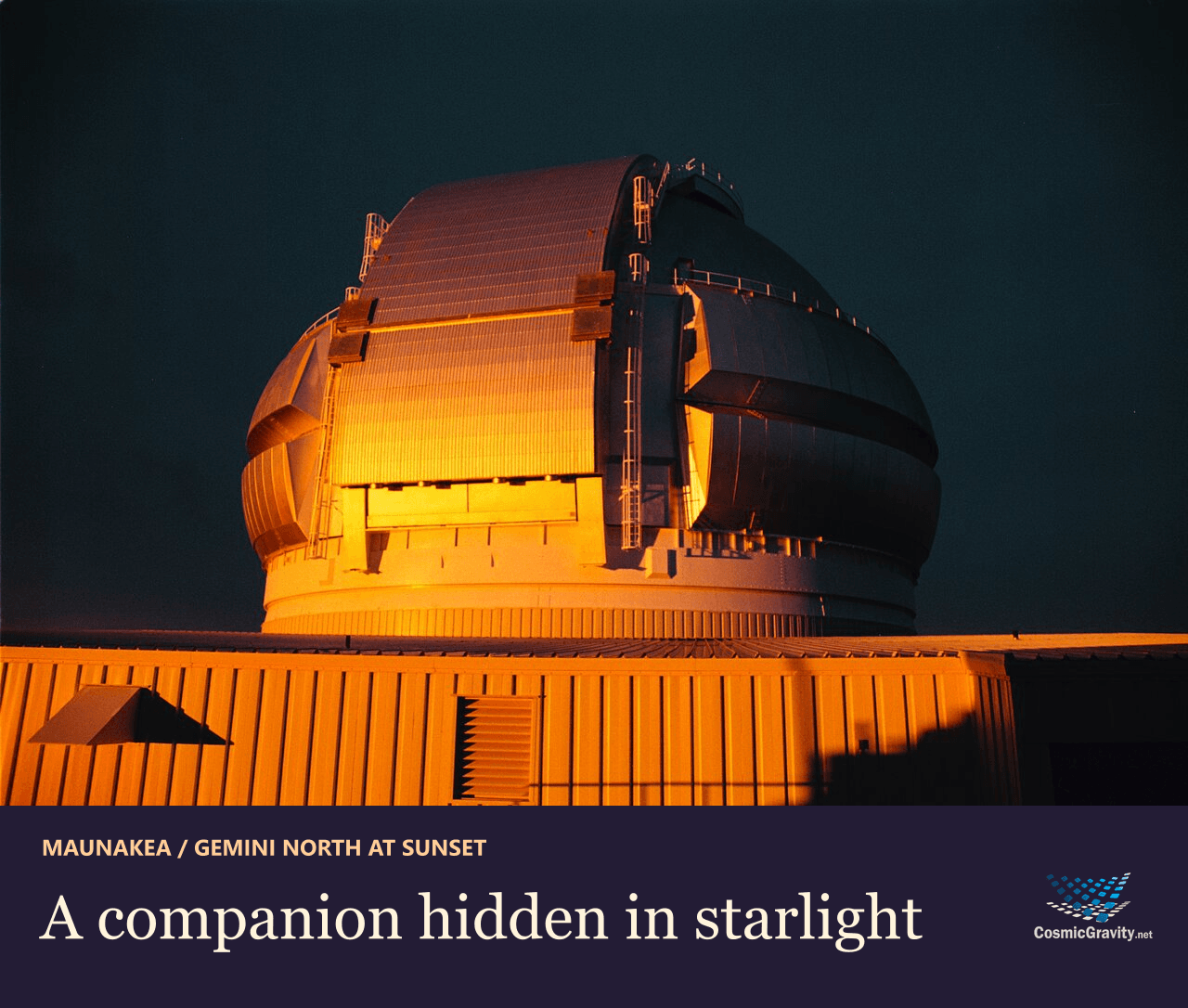
Feature image: Gemini North on Maunakea at sunset. The telescope resolved the faint inner companion. Photograph: International Gemini Observatory, CC BY 4.0. Editorial frame added. View the original. Licence.
How the Welopō‘ai triple star system gave itself away
SPIRou, an instrument on the Canada-France-Hawaiʻi Telescope, measures shifts in features in a star’s spectrum. An orbiting companion tugs on the visible star. As the star moves toward the telescope and then away, those features shift back and forth. A spectrum can betray a companion whose own light is too faint to stand out.
The size of the signal pointed away from a planetary companion, but the velocity record alone left room for interpretation. It measured motion along our line of sight and covered only part of an orbit. What the researchers wanted next was a position on the sky. Using the ‘Alopeke instrument at Gemini North, they separated a faint point of light from its brighter neighbour. Infrared observations supplied additional evidence about the companion. See the team’s wide view and close-up.
Two orbits and two different distances
Combined with position measurements, the velocities yield an inner orbit with a period of about 9.83 years. Its semimajor axis, the length scale astronomers use to describe the size of an elliptical orbit, is about 4.64 astronomical units. One astronomical unit is the average Earth–Sun distance. That puts the scale of the close pair’s orbit a little below that of Jupiter’s path around our Sun.
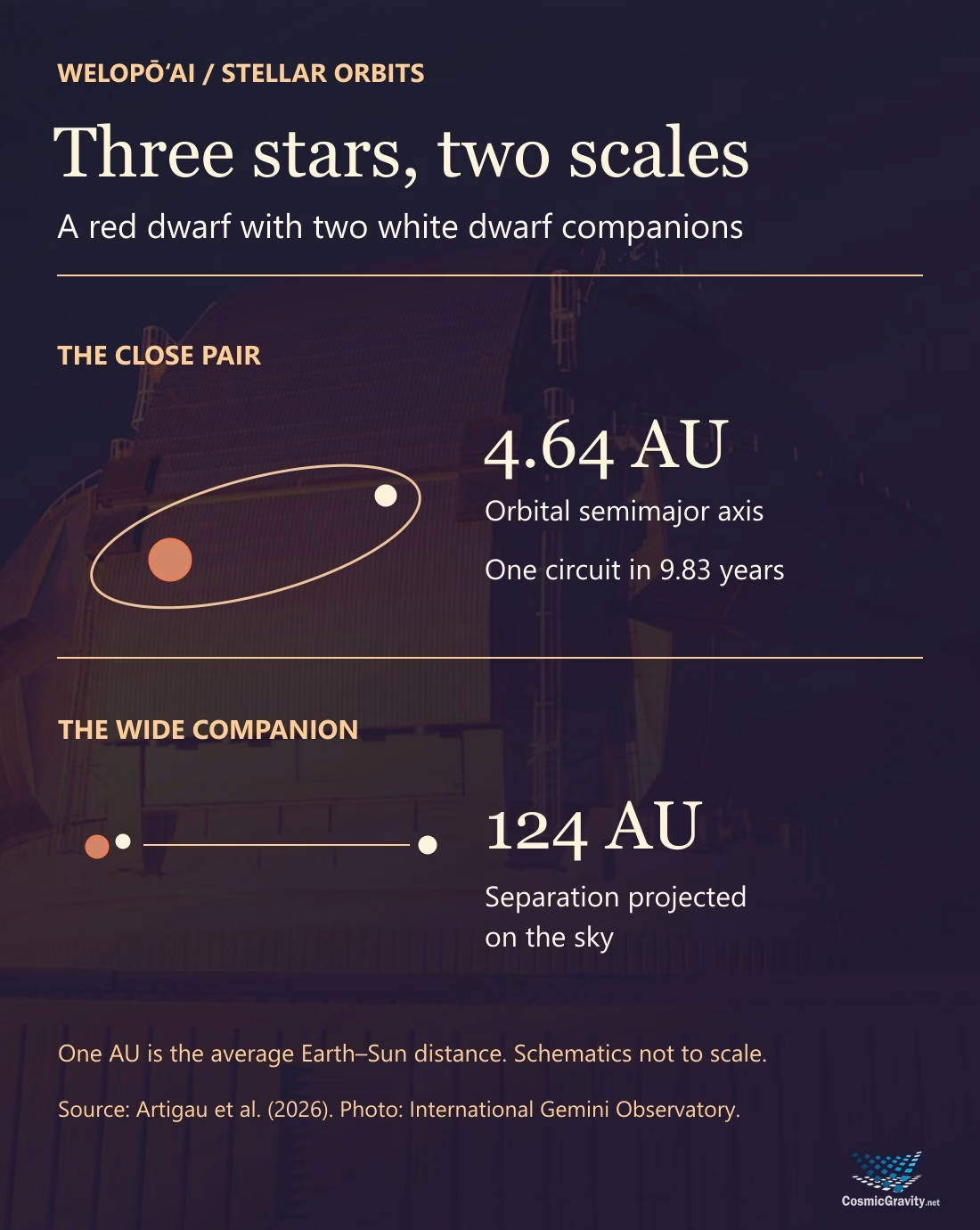
The distant white dwarf appears about 124 astronomical units from the inner pair in projection. Imagine measuring the separation of two lights on a photograph without knowing how far one lies behind the other. That is a different measurement from fitting the orbit of the close pair, and it is one reason the outer star’s circuit is much less tightly known.
The faint inner white dwarf actually outweighs its bright red companion. The team estimates about 0.618 solar masses for the white dwarf and 0.419 for the red dwarf. The uncertainty in the white dwarf’s dynamical mass is roughly 0.7 percent. Here “dynamical” means the researchers used gravity’s effect on the stars’ motion to weigh the companion. Its brightness alone would have given a much less direct answer. The authors’ freely available paper.
How did the close pair survive?
A white dwarf is the exposed remnant of a star that shed its outer layers. Its predecessor once occupied much more space. Working backward from a roughly ten-year orbit today, astronomers have to account for that expansion, the loss of mass and the gravitational influence of a third star. The system’s present geometry gives those calculations something unusually precise to reproduce.
The authors discuss whether the outer companion could have changed the shape and tilt of the inner orbit over long intervals. That is a proposed history. The separation measured in the Gemini images and the velocity changes recorded by SPIRou are observations. Welopō‘ai is especially valuable because several possible histories must now pass the same test: can they produce these particular stars, with these masses, in these orbits?
Another clue to a star’s history can survive in material left around its remnant. See the two debris rings around white dwarf J1328−1450.



latest video



news via inbox
Subscribe to our Cosmic newsletter to get notified when we have new articles.