Inside the Project Blue Book files behind 701 unidentified sightings
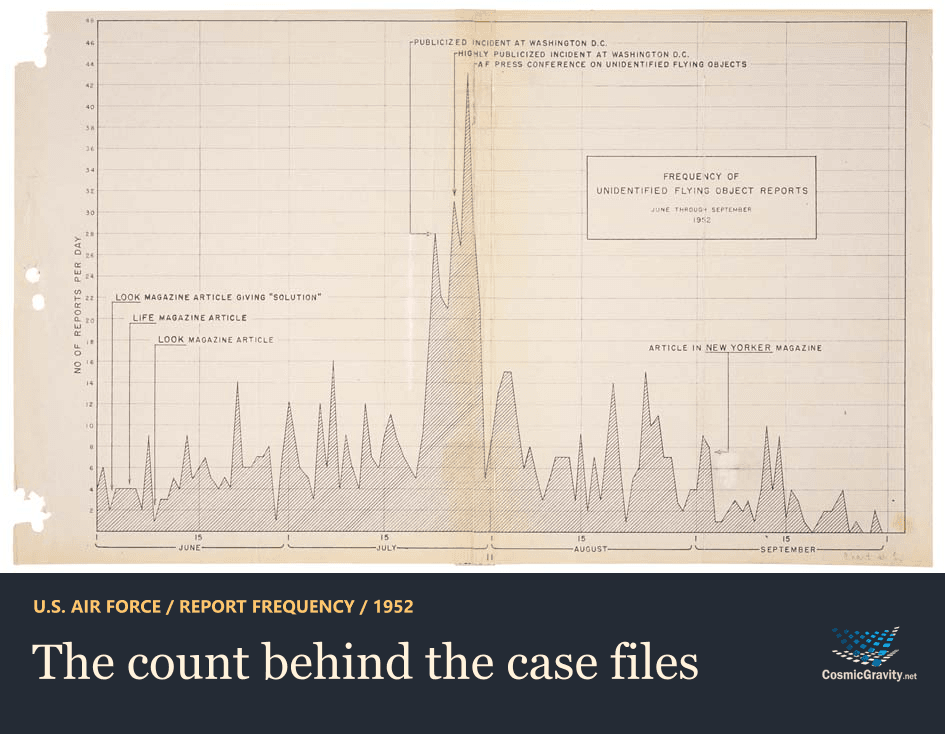
In the Project Blue Book files there is a chart that looks like a fever breaking. The line rises and falls through the summer of 1952. Before drawing conclusions from its peaks, read what the Air Force was counting. Each report began with someone who saw something, decided it was worth reporting and found a way to tell an investigator. A rise on the chart measures reports reaching the system. On its own it says little about what was in the sky. See the chart in the National Archives collection.
Feature image: Air Force chart of UFO report frequency from June through September 1952, Appendix I of Status Report No. 8. U.S. National Archives, Records of Headquarters U.S. Air Force. View the original.
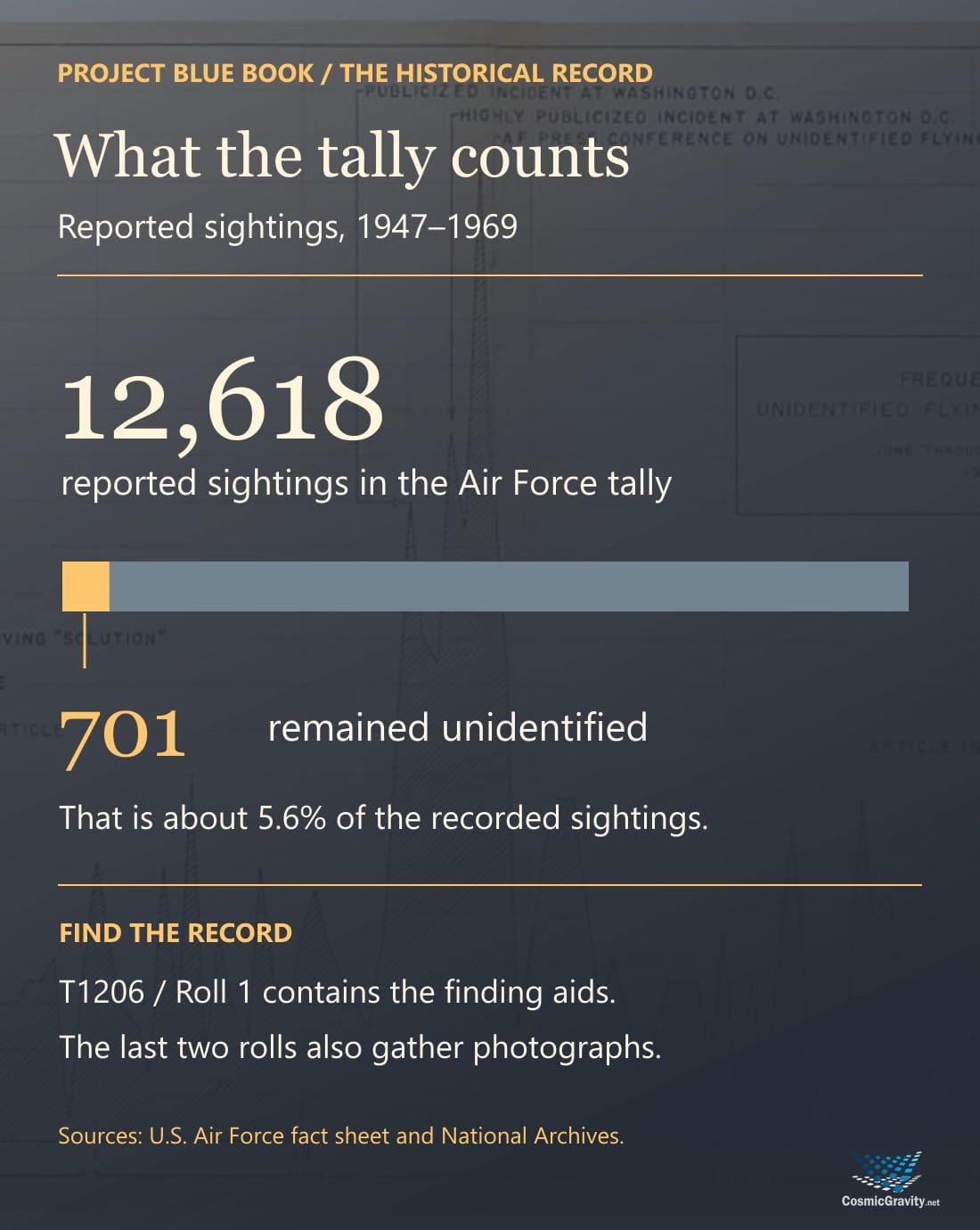
The same point matters for Blue Book’s most famous number. The Air Force counted 12,618 reported sightings in the records covering 1947 through 1969. At the end, 701 remained unidentified. That is about 5.6 percent. It answers a narrow historical question: how many reports still lacked an identification in that accounting?
Why the Project Blue Book files begin before Blue Book
Project Blue Book got its name in 1952. The investigation already had a history at Wright-Patterson Air Force Base in Ohio. Under Project Sign and its successor, Project Grudge, investigators had been collecting reports since the late 1940s. That succession explains how a 1947 sighting can appear in a collection popularly named for a later project. The termination order came on December 17, 1969. Operations wound down in January 1970. National Archives history of the three projects.
Follow one sighting through the paperwork
Start with the date and place. The Archives describes the individual case files as arranged chronologically. If you begin with a witness’s name, there is a catch: the publicly available textual case records omit the names of people involved in sightings. A newspaper date, a nearby town or a location mentioned in a letter can be a more practical starting point. National Archives finding guide.
Then look for the earliest account. A letter preserves what its author chose to mention. A questionnaire also preserves what investigators thought to ask. Time, duration and direction can be useful even when a witness has no name for the object. A later investigator’s summary adds another voice. If a detail shows up only in that summary, it is worth identifying who supplied it before using it to reconstruct the event. View the 1952 Air Force questionnaire.
There is a useful shortcut for readers tracing an image. The Archives lists the textual collection as 94 rolls of 35 mm microfilm under publication T1206. The first roll contains the finding aids. Photographs scattered through the paperwork were also filmed separately on the last two rolls. Motion pictures and sound recordings are held elsewhere in the Archives, so a text-file search can end before the surviving evidence does.
What the 701 can tell us
An unresolved report can preserve an honest observation while leaving crucial measurements out of reach. If a light moved across a witness’s field of view in ten seconds, its apparent motion might be recoverable. Its speed in miles per hour still depends on its distance. Counting that report as unidentified cannot supply the missing distance.
The Air Force concluded that the material it examined provided no evidence that the unidentified sightings were extraterrestrial vehicles. That is an institutional conclusion readers can examine alongside the individual files. The 701 do not carry a collective explanation of their own. Their value for research lies in working out, case by case, which questions the surviving evidence can still answer. For a modern example involving camera geometry, see the reconstruction of the Aguadilla video.



latest video


news via inbox
Subscribe to our Cosmic newsletter to get notified when we have new articles.