A Dead Star’s Double Rings Hint at Our Solar System’s Future
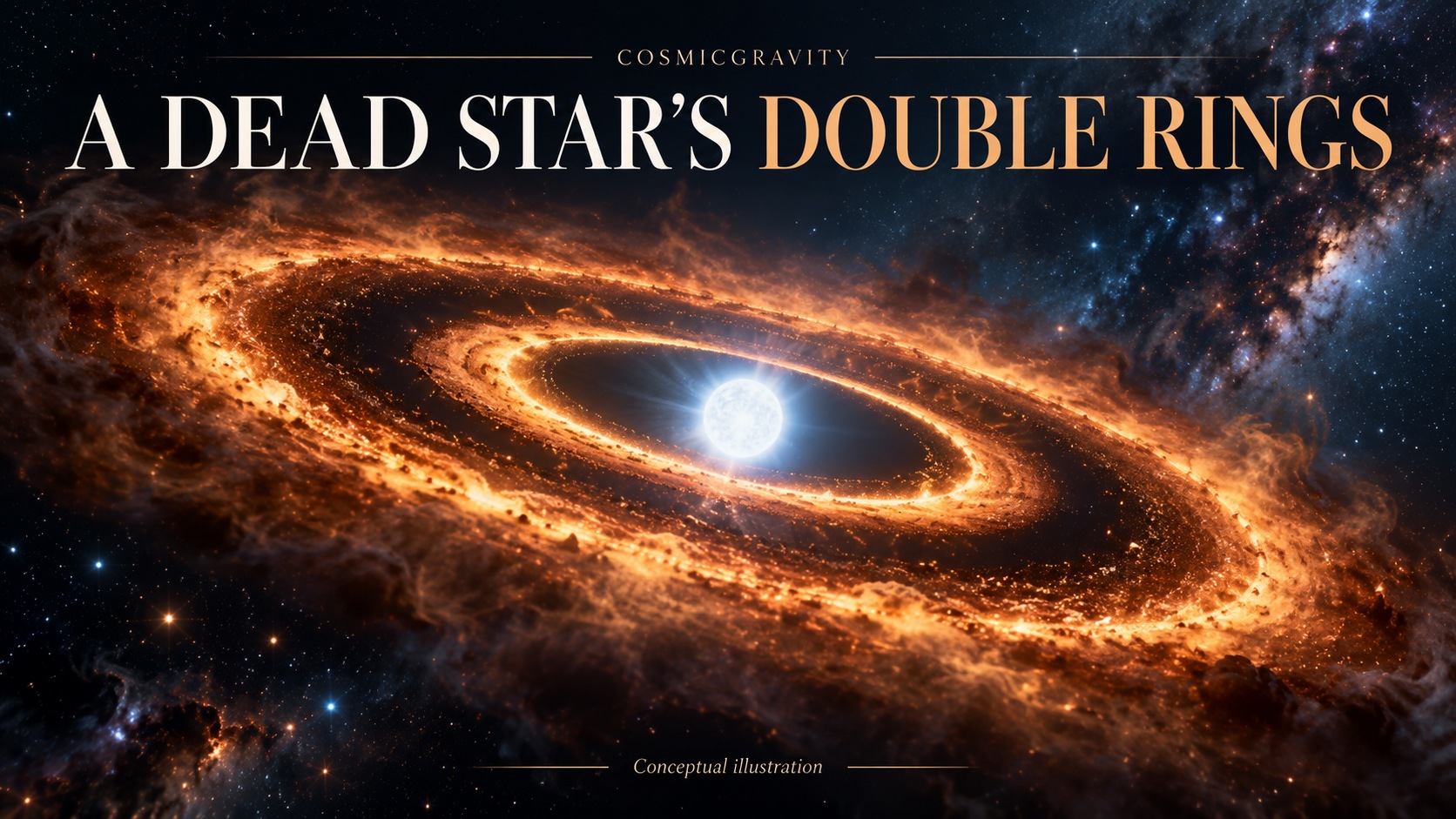
Two white dwarf debris rings have turned the remains of a distant planetary system into an unusually revealing laboratory. Around the dead star WD J1328–1450, astronomers have found evidence for two gas rings separated by a gap—a structure that raises questions about what can survive a star’s death.
The discovery, announced by the European Southern Observatory on 27 October, also offers a striking picture of planetary aftermath. The picture itself needs a caveat: astronomers inferred the rings from light, rather than resolving them in a photograph.
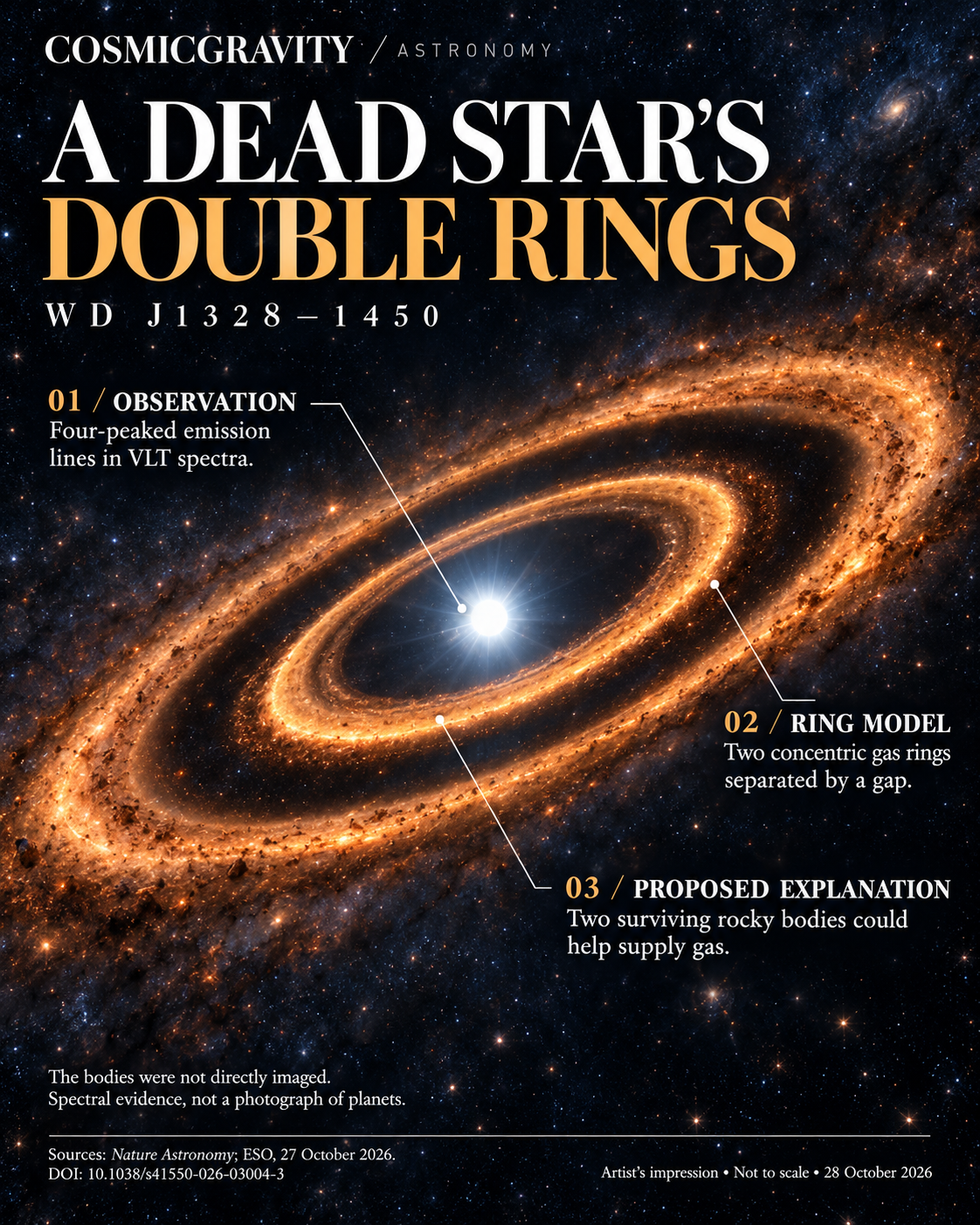
Original AI-assisted CosmicGravity magazine illustration. The scene and any inset imagery are conceptual; this is not a documentary photograph, an actual artefact or measured observational data.
How the white dwarf debris rings appeared in the data
The team used the Very Large Telescope’s X-shooter spectrograph. ESO’s announcement explains that the gas moves at two distinct speeds, producing an unusual pattern in the spectrum. The preferred interpretation is a pair of concentric rings.
A spectrum spreads light by wavelength. In this case, the pattern carries information about material moving around the star. A beautiful artist’s impression can help readers imagine the arrangement, but it should not be mistaken for the observation that established it.
Four peaks, and a gap worth explaining
In the Nature Astronomy paper, calcium and oxygen emission lines have four peaks, rather than the familiar double-peaked pattern of previously known systems. A model combining emission from two rings reproduces that shape.
The authors also discuss a single-disc shadowing alternative, while noting the lack of an existing physical model supporting that scenario. Their two-ring interpretation is strong evidence, but a model still carries assumptions that readers should be able to see.
There is a chemical puzzle as well. The outer gas ring is depleted in magnesium relative to the inner one. The material could come from different parent bodies or different layers of a body that once separated into distinct internal regions.
Are rocky survivors feeding the rings?
The researchers propose two surviving planetary bodies interacting with dust and supplying gas. As the University of Warwick’s account makes clear, those bodies were not directly detected. Their possible presence helps explain how such a system could maintain the observed structure.
That is the distinction to keep beside the most dramatic headlines. Evidence for rings is not a photograph of two planets. Nor is every object left in a planetary system large enough to deserve the everyday image that the word planet brings to mind.
Why it matters for our own distant future
A white dwarf is the compact remnant of a star that has exhausted its fuel. The Sun is expected to reach that stage billions of years from now. This is a comparison across stellar lifetimes, not a warning of an approaching event.
The rings show why a star’s death need not leave an empty neighbourhood. Material can remain, move and interact in ways that preserve clues to the former system. Understanding the arrangement is part of reconstructing that history.
Our Swift mission retrospective explores another side of studying a changing universe. Here, the crucial record is quieter: a distinctive pattern in starlight, pointing to a complicated planetary afterlife.
editor's pick


latest video



news via inbox
Subscribe to our Cosmic newsletter to get notified when we have new articles.