The 2025 AARO Report: 319 New Cases and 191 Still Unresolved
The latest Pentagon report on unidentified anomalous phenomena does not deliver the clean ending either side of the UAP debate wants. It does not reveal extraterrestrial technology. It does not make the unexplained cases disappear.
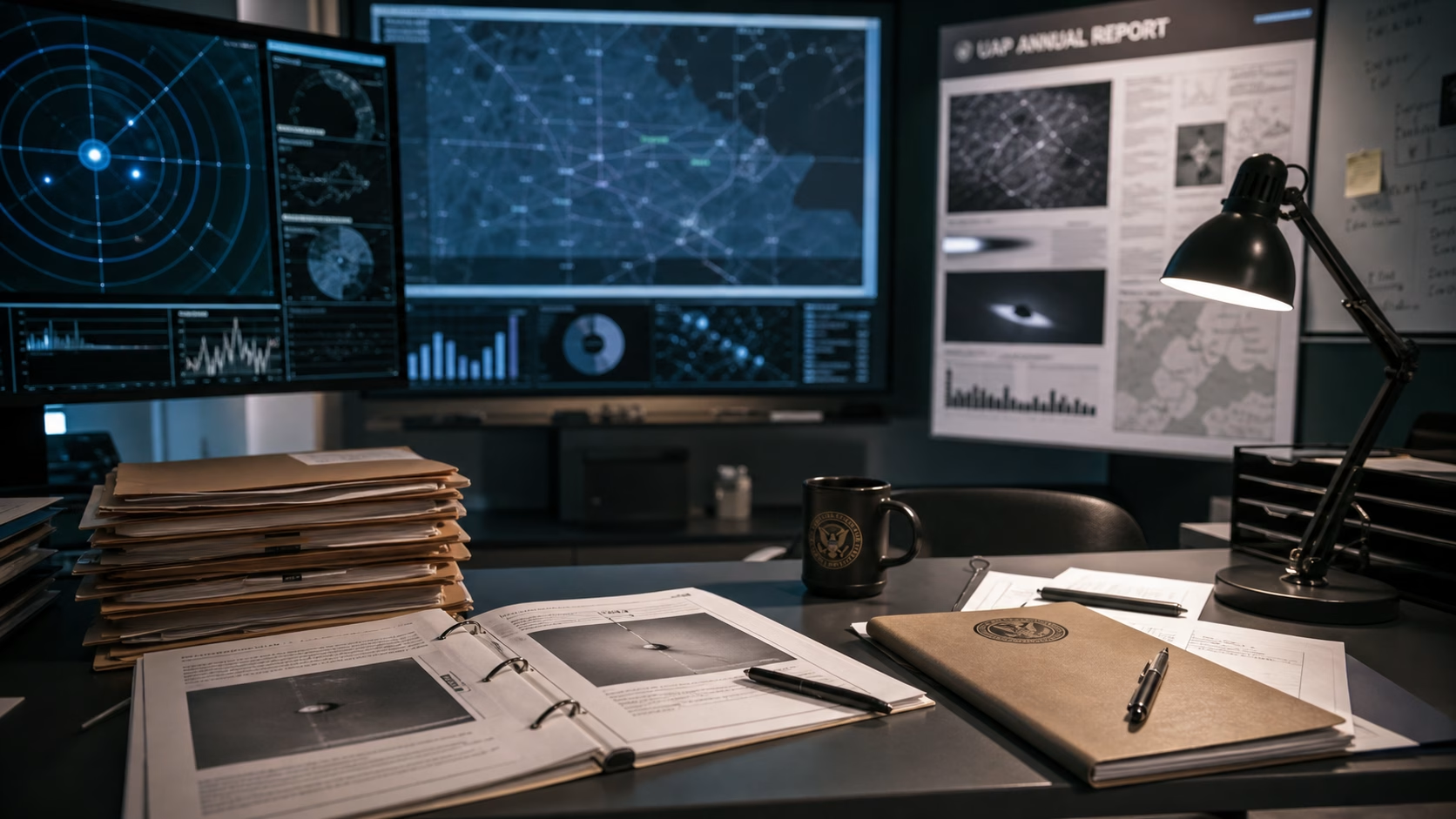
The 2025 AARO report, released publicly in July 2026, records 319 incoming reports. AARO closed 114 of them, while 191 entered its active archive because the available information could not support a firm conclusion. Nine more were referred to intelligence and scientific partners for additional analysis.
Those numbers need context. “Unresolved” does not mean alien, but it also does not mean disproven or unimportant. It means the evidence stopped short of an identification. In a field defined by partial data, that distinction is the heart of the story.
What period does the report cover?
Despite its 2026 publication date, the report is retrospective. Its main window runs from June 2, 2024 through May 30, 2025. Of the 319 reports received, 284 concerned events during that period and 35 described older incidents that had not appeared in a previous annual report.
AARO’s total holdings reached 1,870 cases by the cutoff date. The office is no longer handling a small collection of famous videos. It is managing a growing database that mixes pilot observations, military sensor reports, civilian aviation logs and incidents near sensitive infrastructure.
Most of the 319 reports concerned the air domain. Forty-four were classified as space-domain observations and one as maritime. A space-domain label does not necessarily mean a satellite recorded the event; many came from pilots or observers who estimated an object to be at extreme altitude.
What was actually identified?
Of the new reports closed during the cycle, balloons and satellites dominated. Sixty were attributed to balloons and 44 to satellites. A much smaller number involved aircraft, birds, unmanned aerial systems, a commercial rocket launch and a crewed jet pack.
This is not surprising. A bright object without reliable distance information can look stationary or impossibly fast. Balloons change shape, satellites flare in sunlight and aircraft lights can appear unusual when seen through haze or infrared sensors.
AARO also resolved 256 older cases, bringing the total number of resolutions during the cycle to 370. Three-dimensional satellite-flare modelling reportedly accounted for 238 resolutions across the wider backlog.
Solving ordinary cases is useful. It removes noise and improves future analysis. The danger comes when a conventional explanation for many reports is treated as an explanation for all reports.
The 191-case active archive
The largest group is not the solved cases but the 191 reports placed in the active archive. These cases lacked sufficient information for a confident judgment. Some may eventually prove ordinary. Others may remain unresolved permanently because the missing data can never be recovered.
This category frustrates everyone. Skeptics cannot use it as proof of misidentification, and believers cannot use it as proof of non-human technology. The evidence is incomplete.
Yet a large unresolved archive still matters. Patterns can emerge when cases are compared by location, sensor type, altitude, motion and observer. A single weak report may contribute to a stronger pattern if similar events recur under better observation.
The value of the archive depends on whether AARO preserves enough metadata and whether outside researchers eventually receive meaningful access.
Nine cases sent for deeper analysis
Nine incoming cases were forwarded to intelligence and science partners. That is a small number, but it represents the cases AARO considered worthy of work beyond routine identification.
The public report gives limited detail, so it would be wrong to assign extraordinary properties to all nine. Referral can happen because a case involves unusual behaviour, a sensitive location, possible foreign technology or simply data that requires specialist expertise.
This is where greater transparency would help. Releasing sanitized sensor information, geometry and analytical methods would allow independent experts to test conclusions without exposing operational capabilities.
The maritime case
The report’s single maritime-domain event is among its most curious entries. U.S. Navy assets off Virginia reportedly observed approximately 100 airborne objects and two likely uncrewed systems on the water’s surface. AARO says it is investigating the event with the reporting unit.
That description invites speculation, but the public information is too thin for a conclusion. The objects may have been drones operating with surface platforms, an exercise, a surveillance system or something not yet identified.
The scale makes the case operationally important regardless of origin. A coordinated group of unknown airborne objects near naval activity is a security and domain-awareness problem even if every object was built on Earth.
UAP and nuclear facilities
The report also records 50 incidents involving unmanned aircraft near nuclear infrastructure, weapons facilities or launch sites—a sharp increase from the previous reporting period. AARO classifies these as UAS incidents rather than unexplained UAP.
That distinction should not make them reassuring. An identified category is not the same as an identified operator. A conventional drone near a sensitive facility can still represent surveillance, interference or a serious security failure.
The long history of unusual reports near nuclear sites deserves careful examination, but modern drone incursions should not automatically be merged with older UAP testimony. Similar locations do not guarantee a common cause.
What the report says about recovered material
AARO again states that it has no verified evidence that government or private industry has captured or exploited material derived from UAP. It also reports no confirmed UAP-related health effects and no resolved case demonstrating breakthrough foreign aerospace technology.
Those are official findings, not proof that every whistleblower claim is false. Several witnesses have described alleged hidden programmes, while AARO disputes or says it has not verified those accounts. The disagreement cannot be settled by repeating either side’s conclusion.
What would settle it is evidence with provenance: documents that can be authenticated, physical material with a documented chain of custody, corroborated testimony and data that independent specialists can examine.
The deeper lesson is about data
The 2025 report reinforces an uncomfortable truth. Many UAP cases remain mysterious because sensors were not designed to answer the questions later asked of them. A five-second clip without range, calibration or surrounding footage may never reveal true size or speed.
This does not invalidate what trained observers report. Pilots know when something does not fit their experience. But human observation and isolated imagery become far stronger when radar, infrared, visible light, telemetry and location data converge.
The cumulative evidence behind the UAP subject is substantial: decades of testimony, official records, sensor encounters and recurring descriptions. The report adds to that history while showing exactly where the evidential gaps remain.
Its honest conclusion is neither “nothing to see” nor “alien craft confirmed.” It is that hundreds of reports can be reduced, modelled and compared—and a persistent remainder still demands better instruments, fuller disclosure and serious investigation.
Related reading


latest video


news via inbox
Subscribe to our Cosmic newsletter to get notified when we have new articles.