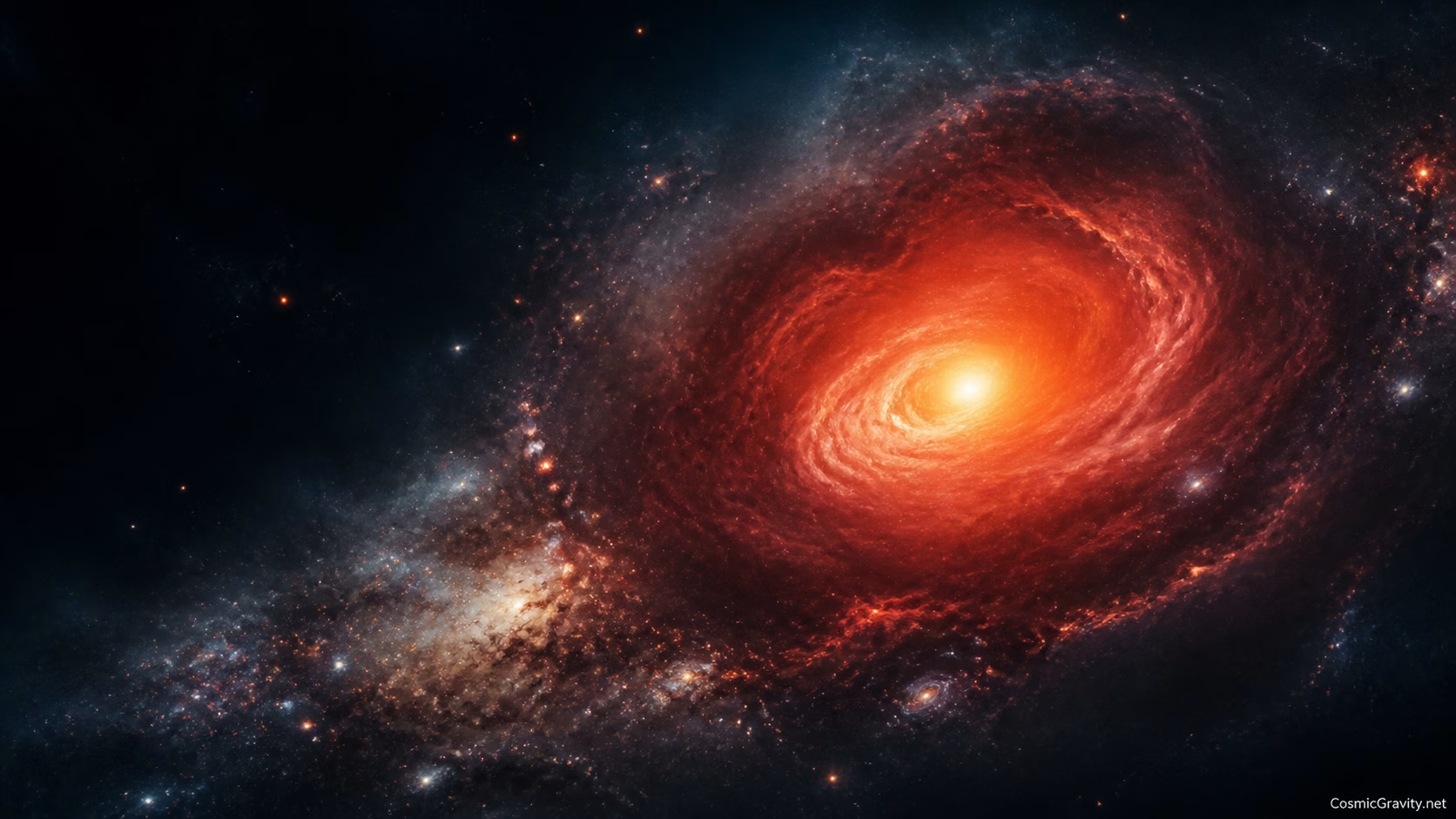
Webb’s “Black Hole Stars”: The Strange Objects That May Have Built the First Giants
Some objects look like stars only because the universe has not given us a better category for them yet. In June 2026, NASA reported that the James Webb Space Telescope had found its strongest evidence so far for a strange early-universe object sometimes called a “black hole star.” The name is dramatic, but the proposed object is stranger than the headline: not a normal star with a black hole hidden inside it, but a rapidly feeding black hole wrapped in a dense, hot cocoon of gas.
The leading candidate, GLIMPSE-17775, existed when the universe was still extremely young. Webb’s instruments separated its light into a spectrum and identified more than forty emission features. That unusually rich chemical fingerprint is why researchers are taking the idea seriously: the object is not merely a bright red dot in a deep-field image. It carries evidence of dense gas being heated under exceptional conditions.
What is a black hole star?
The label can be misleading. A conventional star shines because fusion in its core converts hydrogen into helium. In the black-hole-star model, most of the energy comes from matter falling toward a black hole. Gas piles up, heats to enormous temperatures and forms an extended luminous envelope. From far away, that envelope can resemble a giant star even though the engine is accretion rather than fusion.
This matters because astronomers have a timing problem. Webb has revealed active black holes only a few hundred million years after the Big Bang. Growing an ordinary stellar-remnant black hole to millions or billions of solar masses in that interval is difficult unless it feeds almost continuously, merges efficiently or begins from a much heavier seed.
Why GLIMPSE-17775 is unusual
According to NASA’s Webb team, the spectrum contains over forty lines and does not neatly match a normal galaxy or unobscured quasar. The favored interpretation is a black hole embedded in a hot, dense cocoon. That envelope could trap much of the energetic radiation close to the source and reradiate it in a form Webb can detect.
Interactive evidence check: how strong is the case?
- Direct observation: Webb detected the object and measured a detailed spectrum. That part is firm.
- Physical interpretation: Dense gas powered by accretion explains several observed features better than a normal stellar population.
- Open question: Other exotic combinations of stars, dust and an active galactic nucleus may still reproduce parts of the spectrum.
- Decisive next step: deeper spectroscopy, variability studies and searches for similar objects should show whether this is a class or an outlier.
Could these objects create the first supermassive black holes?
Possibly. A dense envelope can funnel material inward while shielding the growing black hole from some of the radiation pressure that normally limits feeding. In that scenario, the object becomes a remarkably efficient nursery for a massive black-hole seed. It would bridge the gap between collapsing primordial gas and the ancient quasars now being found by Euclid.
That is still a model, not a confirmed origin story. Early galaxies were chaotic places. Gas clouds collided, stars formed in dense clusters and black holes may have grown through several channels at once. Nature rarely promises a single route.
What would confirm a black hole star?
- A larger population with similar spectral fingerprints.
- Signs of accretion-driven variability rather than ordinary stellar behavior.
- Gas densities and temperatures consistent across independent models.
- A credible evolutionary path from these objects to later quasars.
The phrase “black hole star” will attract attention, but the real discovery is more precise and more interesting. Webb may be catching a previously unseen stage in the construction of the first cosmic giants. If that interpretation survives, the object will not rewrite the laws of physics. It will show how radically those laws can behave in an environment the modern universe no longer provides.
Sources and further reading


latest video

news via inbox
Subscribe to our Cosmic newsletter to get notified when we have new articles.