The Caracol Maya Tomb: How Archaeologists Put a Name to a Dynastic Founder
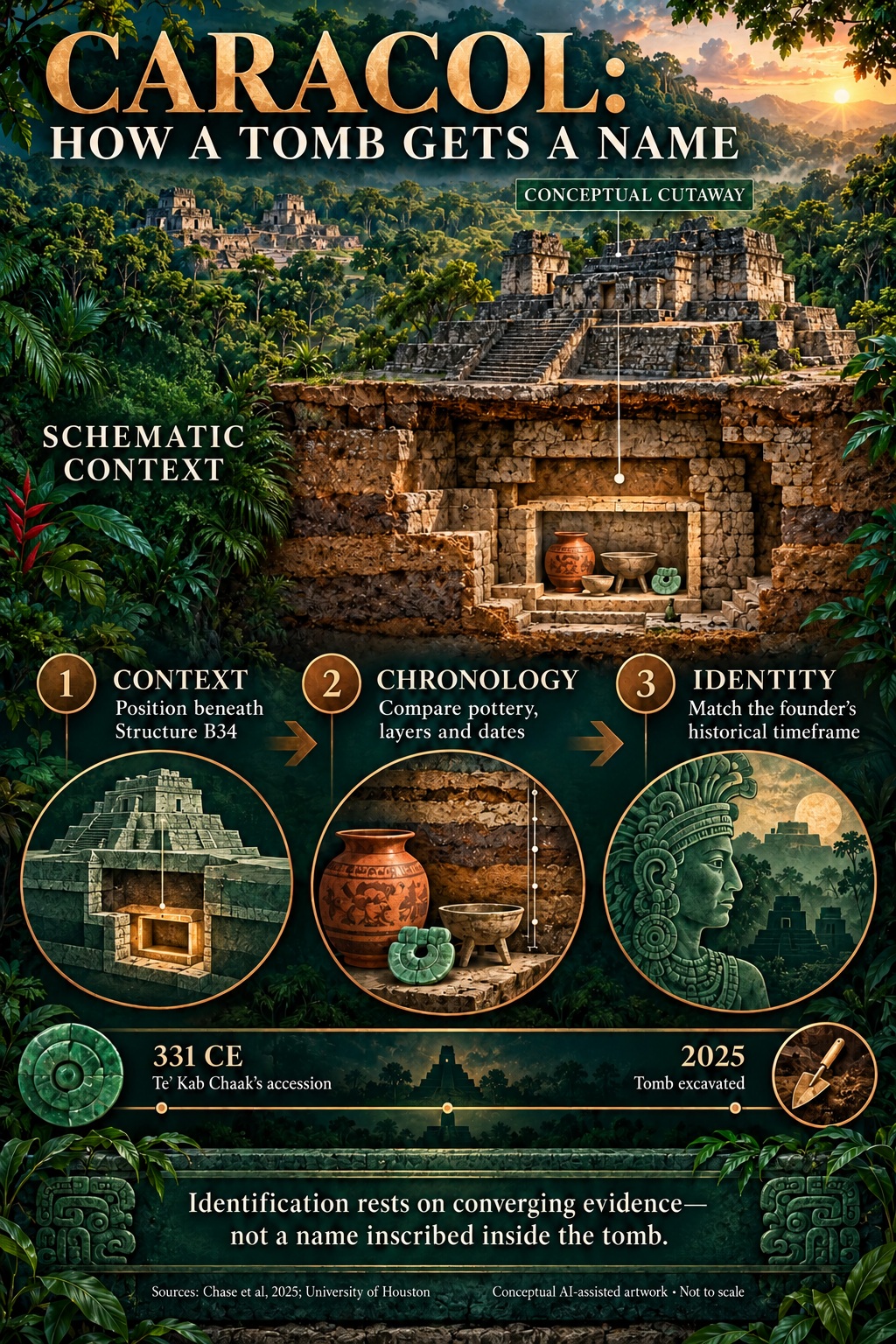
The striking discovery at Caracol is a tomb. The harder achievement is attaching a historical name to the person inside it. Archaeologists identify the Caracol Maya tomb excavated in 2025 with Te’ Kab Chaak, the founder of the city’s royal dynasty. Their argument rests on the burial’s context and chronology rather than a convenient inscription naming its occupant.
This is an evidence-led explainer of that discovery, announced in July 2025 and developed in the excavation team’s research report. It is not a claim that another royal tomb has been found this week.
What was found in the Caracol Maya tomb?
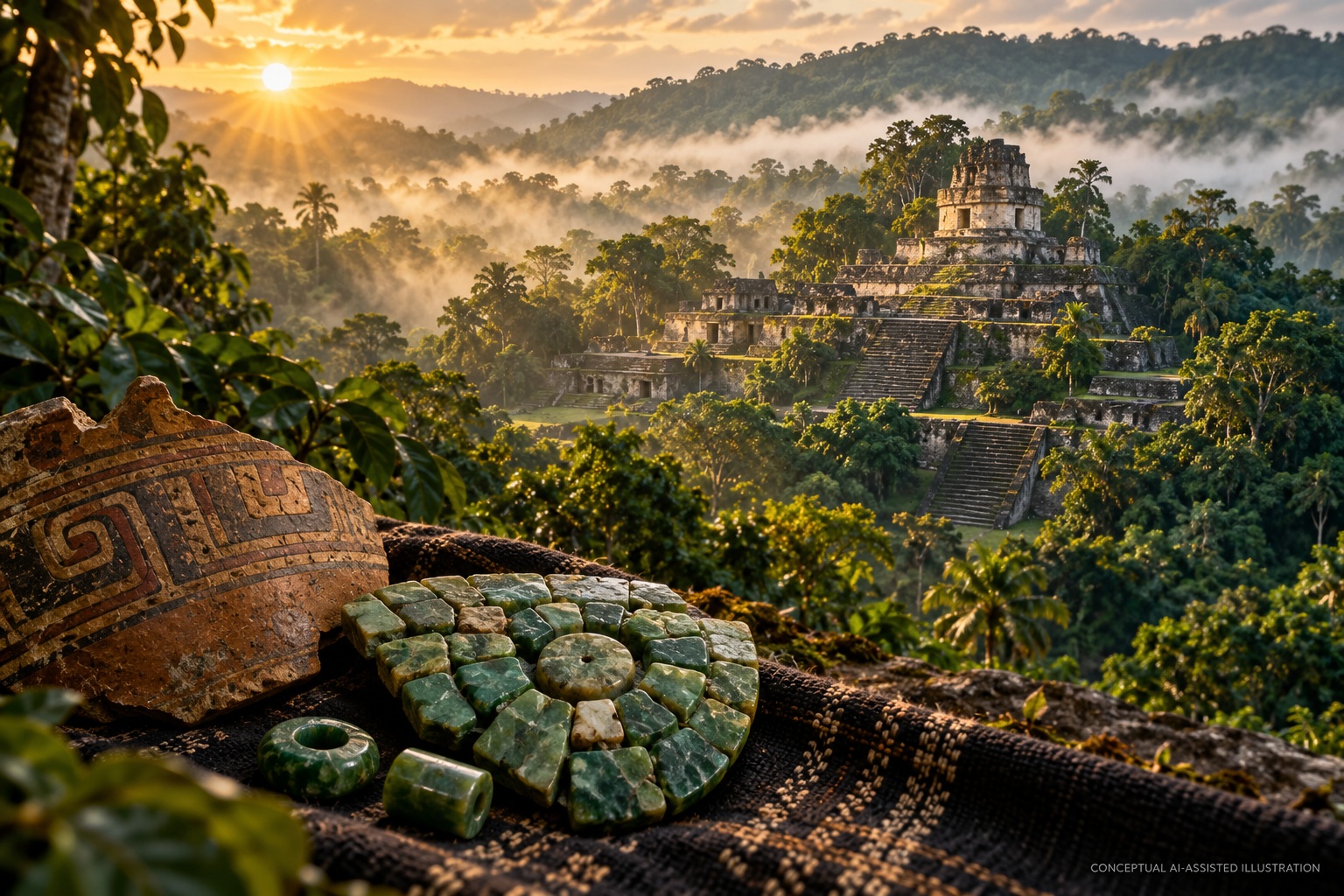
The University of Houston’s announcement describes a royal burial containing pottery, jadeite ornaments and a mosaic mask, among other materials. The team led by Arlen and Diane Chase links the discovery to a ruler whose accession is historically recorded in 331 CE.
The tomb lies in the Northeast Acropolis, east of Caana, Caracol’s central architectural complex. In their published excavation report, Chase and colleagues describe a chamber beneath the front stair of an Early Classic version of Structure B34. It held one individual and eleven ceramic vessels.
Those details do different jobs. Objects help characterise a burial; their arrangement and the surrounding construction place it within the history of a building. Together they provide more information than an impressive artefact photographed by itself.
How can archaeologists identify someone without a name label?
The report explicitly states that the identification is based on converging archaeological evidence, including stratigraphy, contextual relationships and dating. It also explains that no text inside this tomb directly names the individual. That qualification belongs beside the identification, not buried beneath a sensational headline.
Think of the argument as a set of overlapping constraints. A historical ruler belongs to a particular period. A chamber occupies a particular construction sequence. Its contents have chronological and social implications. A proposed identity becomes stronger when those independent lines fit together.
It is still useful to distinguish an attribution from reading a name on the person’s coffin. The former can be a well-supported archaeological conclusion. It simply has a different route from observation to identification.
Why an inscribed object would not automatically solve it
The excavation report makes a broader point that is easy to overlook: portable objects can be traded or given as gifts. A name on a vessel does not necessarily identify the person buried beside it. Objects have biographies of their own.
Imagine a modern grave containing a book with somebody else’s dedication. The inscription would be evidence, but interpreting it would require care. The archaeological question is similar in principle: what relationship links the named person, the object and its final location?
That is why an inscription, a pottery style and a construction layer cannot simply be treated as interchangeable labels. Each can constrain a different part of the story. Their value comes from the relationship between them.
What does a dynastic founder mean?
Calling Te’ Kab Chaak the founder of a dynasty does not mean he was the first person to govern any community at Caracol. The report distinguishes the beginning of a remembered sequence of rulers from the possibility of earlier forms of authority.
This matters because political histories are selective. A dynasty can organise its memory around an important founder without recording every earlier form of leadership. Archaeology and historical texts can therefore illuminate different parts of the same place’s past.
The discovery also opens questions about Caracol’s connections beyond the city. The researchers discuss its relationship with Teotihuacan in central Mexico. Such a relationship is a subject for examining material, chronology and context—not permission to collapse distinct societies into a single civilisation.
Why the Caracol Maya tomb remains worth reading about
Royal tombs attract attention because they promise a person behind the stone monuments. Here, the more rewarding story is how that connection is made. The research gives readers a chance to follow an identification argument rather than merely repeat its conclusion.
Our guide to monumental structures around the world provides a broader comparison of places and periods. For another example of an object changing meaning when its setting is considered, see the Lake Mezzano bronze sword.
The strongest reading of Caracol’s discovery preserves both parts of the achievement: an extraordinary burial and a reasoned, testable case for the name attached to it.


latest video



news via inbox
Subscribe to our Cosmic newsletter to get notified when we have new articles.