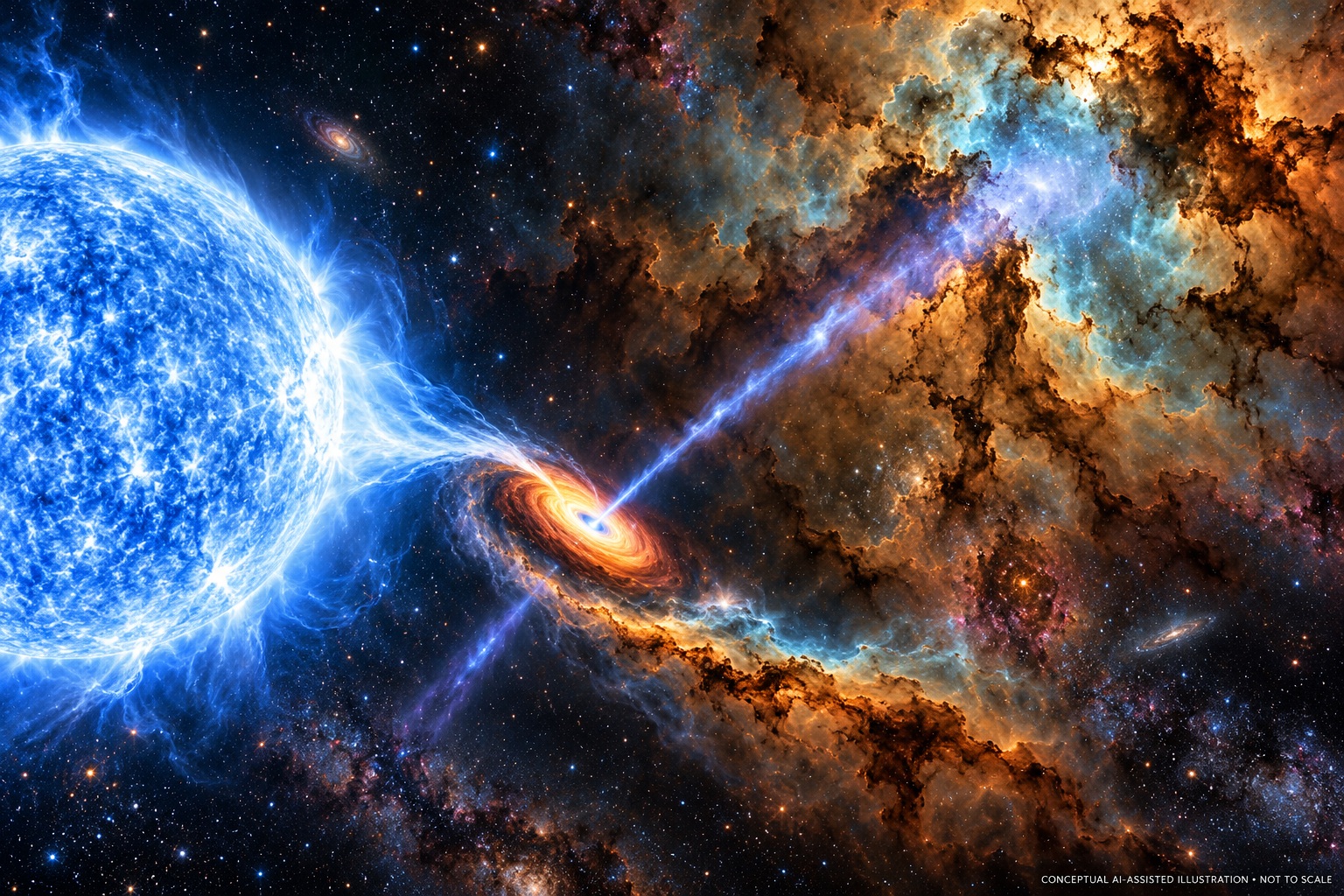
LMC P3’s Molecular Trail Offers a New Clue to a Cosmic Jet Engine
Sometimes the clue to an energetic object is the quieter material it has disturbed. Around the gamma-ray binary LMC P3, astronomers have found a narrow molecular-gas feature that may preserve the effect of a fast jet. The gas is not the jet itself, but it could reveal how the system releases its extraordinary energy.
A university research announcement issued on 30 October 2026 draws attention to the ALMA observations. The study, led by Yasuo Fukui and colleagues, connects the shape and temperature of the surrounding gas with a microquasar interpretation of the binary.
What is LMC P3?
LMC P3 is a binary in the Large Magellanic Cloud containing a massive star and a compact companion. Astronomers know it for powerful gamma-ray emission. The basic puzzle is how energy from the system becomes high-energy particles and radiation.
An earlier orbital study measured a period of approximately 10.3 days and found constraints that favoured a neutron star under its interpretation. The new work examines a different kind of evidence: the molecular environment around the system. Instead, these investigations provide complementary constraints. Neither reveals the companion’s surface in a photograph.
What ALMA observed around LMC P3
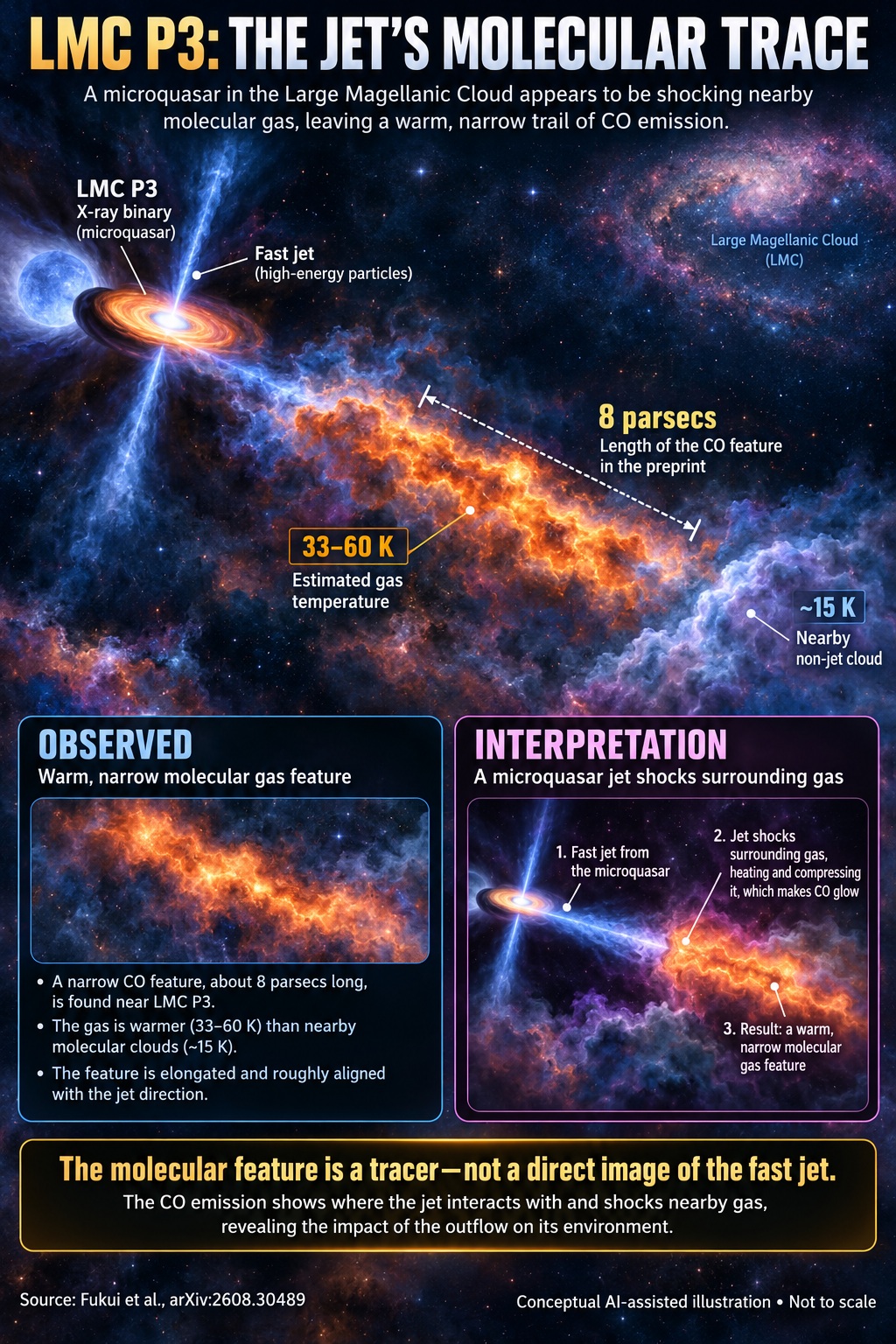
In the authors’ August 2026 preprint, accepted for publication in The Astrophysical Journal Letters, the main carbon-monoxide feature is described as about eight parsecs long and one parsec wide. It is aligned with the binary; a weaker possible feature has a somewhat different orientation.
In addition, the team estimates temperatures of 33–60 kelvin for the main feature, compared with around 15 kelvin in nearby non-jet gas. They interpret the warmer, elongated structure as material affected by shocks from a microquasar jet.
The 30 October release from Nagoya and Gifu universities gives the surrounding gas a useful role: it may record the effects of high-energy activity over much longer intervals than a brief change in bright radiation.
A molecular trace is different from the fast jet
The distinction is essential. A fast outflow from near a compact object can transfer energy and momentum to its environment. Gas affected by that interaction can become a tracer of the process without moving at the same speed as the original outflow.
For an everyday comparison, ripples can show where something passed through water without being the object that passed. The analogy is limited, but it captures why a visible consequence and its inferred cause should be labelled separately.
Here the direct observations concern molecular emission and its spatial structure. The microquasar explanation connects those measurements to a physical model. Presenting the ALMA image as a direct photograph of the relativistic jet would skip that inference.
Does the new result prove there is a black hole?
The university release discusses a black-hole interpretation as more plausible under the new geometrical constraints. However, the distinction between a neutron star and a black hole depends on how mass and orientation are inferred. A compelling jet argument should not be compressed into a claim that an event horizon was observed.
A microquasar interpretation concerns an accreting compact system and its outflows. It does not, by that word alone, identify the compact member. Keeping those questions separate makes it easier to understand what additional observations could change.
For that reason, comparing the older orbital result with the new environmental study is informative. The important issue is how the assumptions and constraints fit together, not which headline sounds most decisive.
Why cold-gas observations can reveal high-energy physics
Gamma rays show that a system reaches extreme energies. Molecular emission can help investigate what that activity does to surrounding material. Meanwhile, different wavelengths answer different questions about the same environment.
That approach has a practical advantage: evidence of an interaction may remain in the gas even when the central source changes brightness. However, the challenge is to distinguish that history from unrelated structures and heating processes. Alignment alone is suggestive; combining shape, temperature and physical modelling makes a richer argument.
Our report on debris rings around a dead star follows another case where material around a compact remnant carries the story. The fast radio burst explainer offers a comparison of how a measured signal can constrain several possible engines.
LMC P3’s new clue is a trail in its surroundings. Reading that trail carefully may help explain an engine that remains difficult to inspect directly.



latest video


news via inbox
Subscribe to our Cosmic newsletter to get notified when we have new articles.