Psyche Is Pushing Toward Its Asteroid—and Managing a Tiny Twist
Psyche electric propulsion is doing the patient work of moving a spacecraft across the Solar System. NASA’s 22 October update says the probe began a near-continuous thrusting phase on 28 September, following its Mars gravity assist. But the small forward push brings another effect: a tiny twist that engineers have to manage.
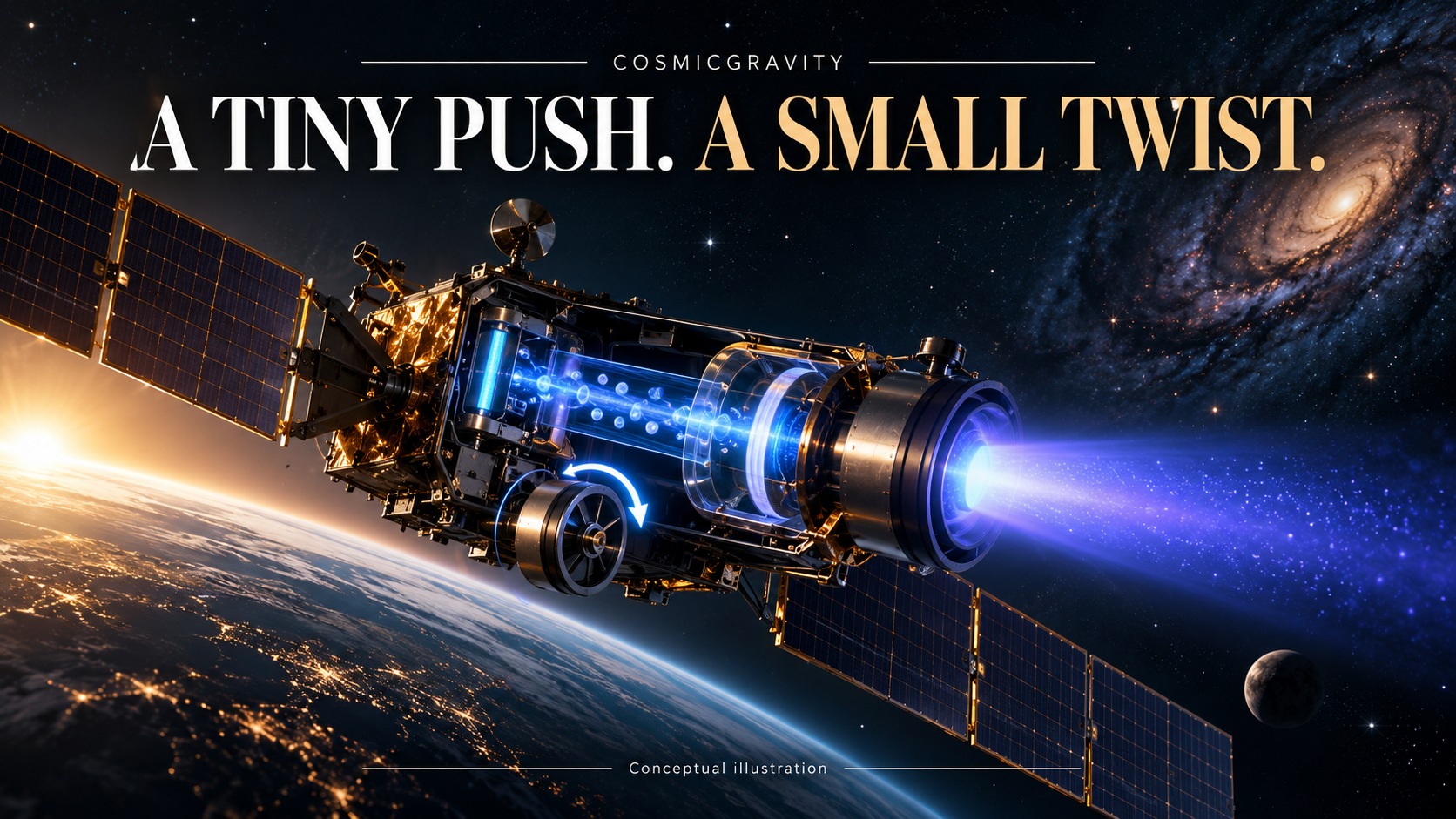
Original AI-assisted CosmicGravity magazine illustration. The scene and any inset imagery are conceptual; this is not a documentary photograph, an actual artefact or measured observational data.
It is a useful detail in a journey often reduced to a launch date and an arrival date. Between those milestones, the spacecraft must keep converting sunlight into motion while staying under control.
How Psyche electric propulsion works
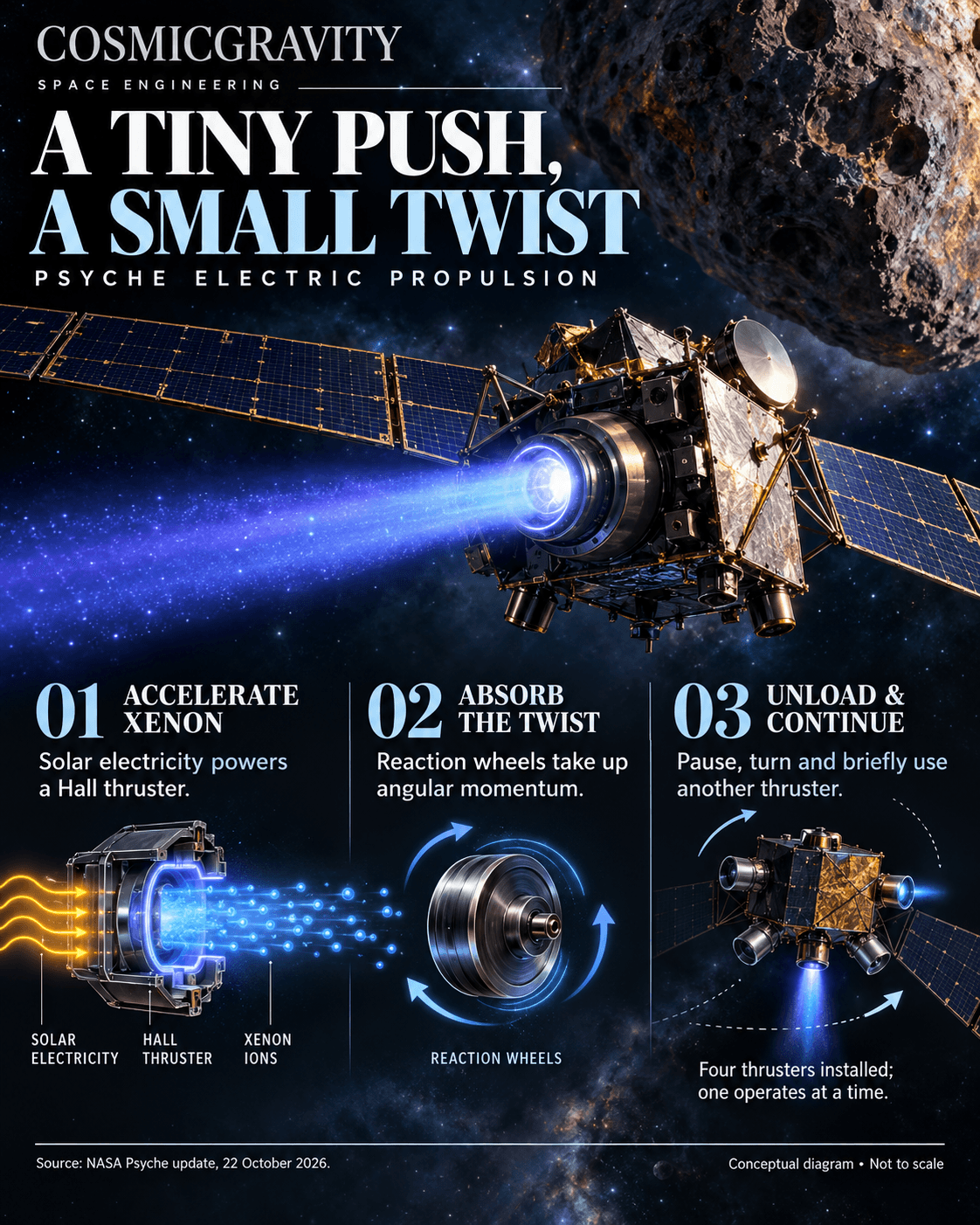
NASA’s spacecraft guide describes four Hall-effect thrusters, with one operating at a time. Solar arrays supply electricity, and electromagnetic fields accelerate xenon ions out of the thruster. Throwing that material backward pushes the spacecraft forward.
The force is small, but it can act for long stretches. Think of a slow, persistent change in motion rather than a short, dramatic rocket burn. This is why cruise operations deserve attention: tiny changes accumulate into a substantial journey.
The power supply also changes with distance. NASA’s guide lists about 21 kilowatts of solar-array power near Earth, falling to roughly 2.3–3.4 kilowatts at the asteroid. The spacecraft must work with the sunlight available where it is.
The twist hidden inside the thrust
In the latest mission report, NASA describes “swirl torque”: the ions’ swirling motion creates a small twisting force. Reaction wheels absorb angular momentum. Periodically, the team pauses propulsion, turns the spacecraft and briefly fires a different thruster at low power to unload those wheels.
The agency expects thrusting for about 90 percent of the remaining cruise time, with interruptions including weekly check-ins. Summer 2029 remains the planned rendezvous. A plan is not a guarantee, but it explains why a pause in thrusting does not automatically signal a fault.
This is an engineering trade: useful propulsion has side effects, and the control system has to account for them. The interesting question is not whether the spacecraft ever stops thrusting. It is whether those stops fit the intended operating pattern.
A possible planetary core, not a proven one
NASA’s mission overview frames the destination as a metal-rich asteroid that may preserve material from the interior of an early planetary building block. The exposed-core explanation is a hypothesis the mission will test, not something a picture of a metallic-looking world has already established.
Getting there and finding out are separate achievements. Scientists need measurements of the asteroid itself before they can decide how well that origin story holds up.
For another example of the patience behind interplanetary travel, see our BepiColombo arrival guide. Electric propulsion and gravity assists turn a voyage into a carefully managed sequence, with years of quiet work between the headline moments.



latest video



news via inbox
Subscribe to our Cosmic newsletter to get notified when we have new articles.