The Nebra Sky Disc and Europe’s Forgotten Astronomers
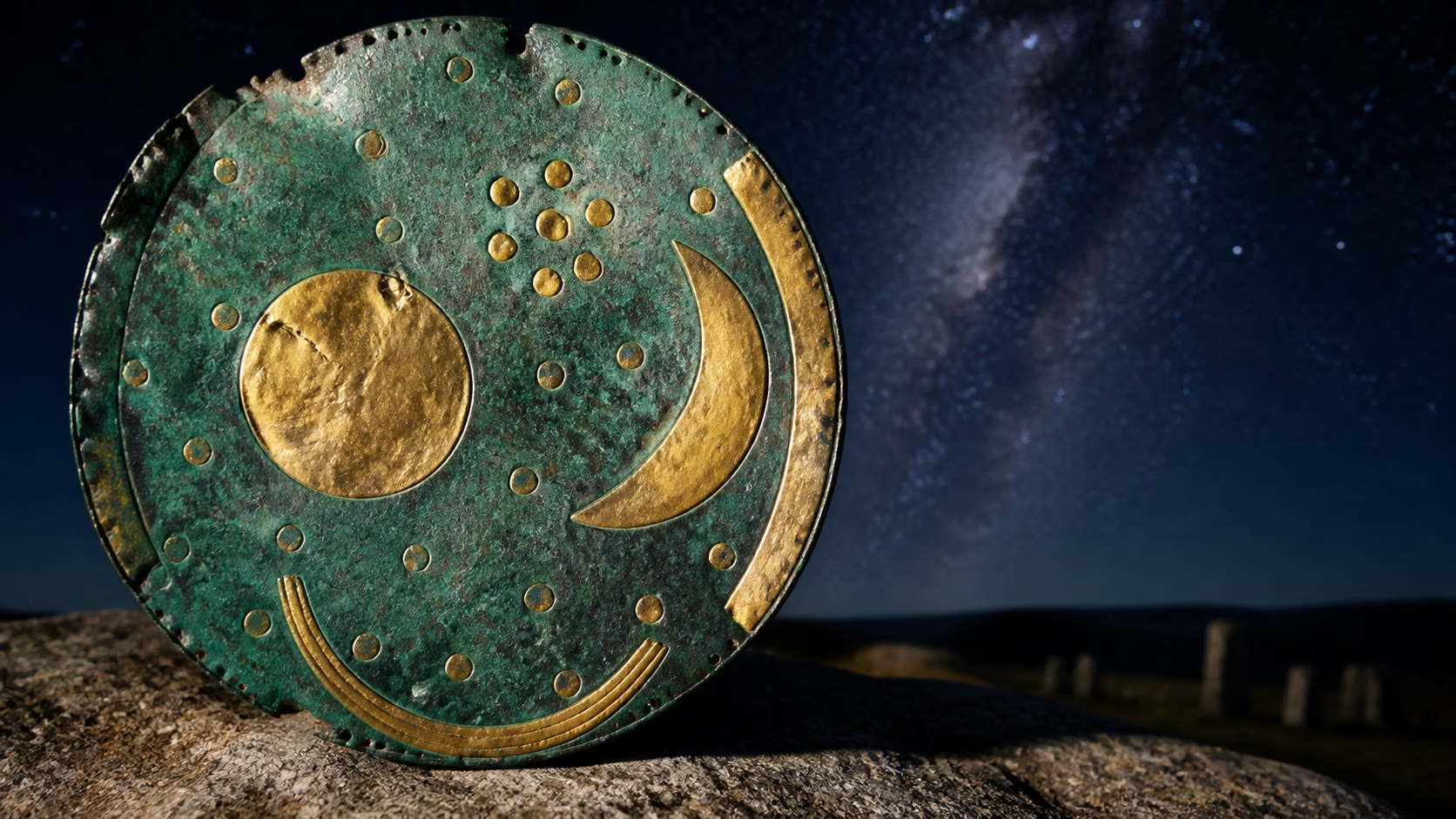
About 3,600 years ago, someone placed a group of gold shapes onto a bronze disc. There was a round object, a crescent, a cluster of seven stars and many smaller points scattered across a green surface. Later hands added golden arcs at the edges and another curved element below.
The result is the Nebra Sky Disc, one of the oldest known concrete representations of the heavens. It is not a modern star chart and not a simple decoration. The object combines observation, seasonal knowledge and ritual meaning in a form unique to Bronze Age Europe.
A discovery outside normal archaeology
The disc was not found during a controlled excavation. Looters uncovered it in 1999 near the Mittelberg hill in Germany, together with bronze swords, axes, arm rings and a chisel.
Because the find was illegally removed, archaeologists initially lacked the context normally used to date and interpret an object. German authorities recovered the disc in 2002 during a police operation.
Investigators later reconstructed the findspot and examined soil adhering to the objects. The associated weapons and other evidence placed deposition around 1600 BCE, although parts of the disc’s manufacturing history may be older.
What the gold symbols show
The large round symbol may represent the full Sun or a full Moon. The crescent is clearly lunar. Seven closely grouped stars are widely interpreted as the Pleiades, a cluster visible to the naked eye.
The remaining stars do not form an obvious modern constellation map. Their arrangement may be symbolic rather than a literal copy of the sky.
The Pleiades were seasonally important to farming societies. Their first and last visibility can help mark times for planting and harvesting. Similar associations appear in later traditions across several cultures.
The horizon arcs
Two gold arcs were added to opposite edges during a later phase. One is missing, but their span corresponds approximately to the angle between sunrise at the summer and winter solstices at the latitude of central Germany.
If the disc was held horizontally and aligned with the local horizon, the arcs could connect the extreme rising or setting positions of the Sun during the year.
That does not make it a precision instrument like a modern sextant. It may have served as a teaching object, memory device or symbol of specialist knowledge.
The problem of the lunar calendar
A lunar year of twelve months is about eleven days shorter than the solar year. Without correction, months drift through the seasons. Ancient societies solved this by occasionally adding an extra month.
Researchers have proposed that the disc helped identify when such an intercalary month was needed by comparing the crescent Moon with the Pleiades. This interpretation is plausible but debated; the object carries no written instructions.
Even if it was not used for calculation, its imagery shows that lunar, stellar and solar cycles were understood as connected.
The mysterious lower arc
A final gold arc was added near the bottom. Its curved lines have been interpreted as a solar boat—the mythic vessel carrying the Sun through night or across the heavens.
Solar boats are known from ancient Egyptian and northern European imagery, but the exact meaning here is uncertain. The addition may mark a change in the disc’s function from practical celestial knowledge toward a more explicitly ritual object.
Was it really made in Europe?
Scientific analysis traced the copper to Alpine sources and linked the gold to deposits in Cornwall. These results reveal long-distance networks carrying raw material and ideas across Bronze Age Europe.
The disc did not require contact with an unknown advanced civilisation. It emerged from communities already trading metals over enormous distances and building sophisticated social systems.
That network may also have transmitted astronomical knowledge. Ideas do not need writing to travel; they can move with craftspeople, traders, marriages and ceremonies.
Why authenticity was debated
The unusual appearance and illegal discovery encouraged claims that the disc was a modern forgery or belonged to a later period. Metallurgical analysis, corrosion, soil evidence and the associated hoard have supported its authenticity and Bronze Age context.
Debate is healthy because provenance matters. An extraordinary object without excavation records should face careful testing.
The stronger conclusion did not come from visual excitement. It came from different scientific methods agreeing.
What the disc tells us
The Nebra Sky Disc does not prove that Bronze Age Europeans possessed modern astronomy. It shows that specialists observed long celestial cycles, connected them with seasonal time and embodied that knowledge in a carefully altered object.
Its meaning probably changed. It began with stars and Moon, gained horizon arcs and finally acquired a solar boat before being buried with valuable weapons.
The disc is therefore more than a sky picture. It is a biography of knowledge—observed, reshaped, ritualised and finally removed from the world.
Related reading


latest video



news via inbox
Subscribe to our Cosmic newsletter to get notified when we have new articles.