The hydrogen line that placed Dún Aonghasa 630 million years after the Big Bang
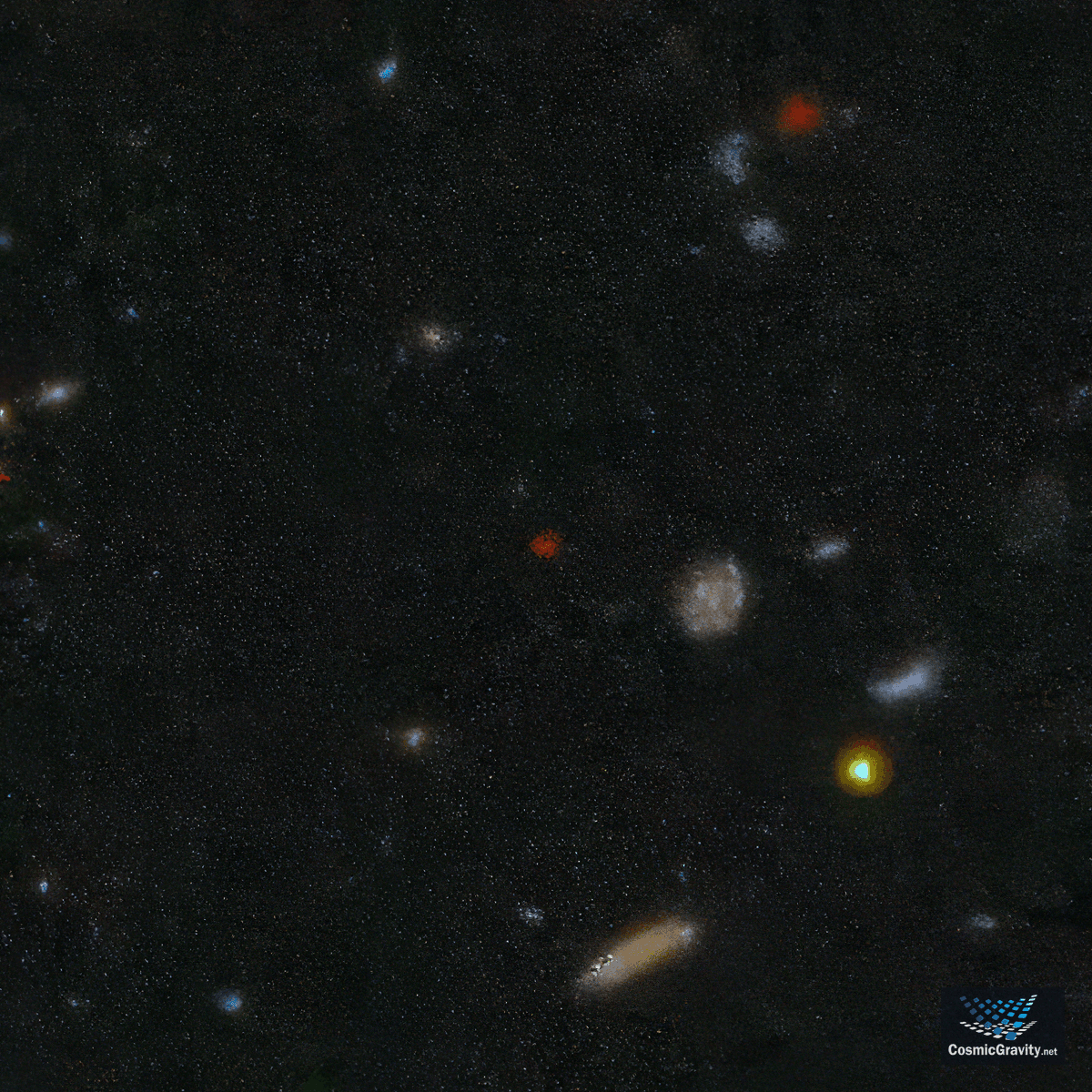
In Euclid’s image, the Dún Aonghasa quasar is a red speck among objects that look much like it. The decisive clue to its age arrived as a line of hydrogen light. Astronomers know where that line falls in a laboratory. By the time this light reached a telescope, the expansion of the universe had stretched its wavelength more than ninefold.
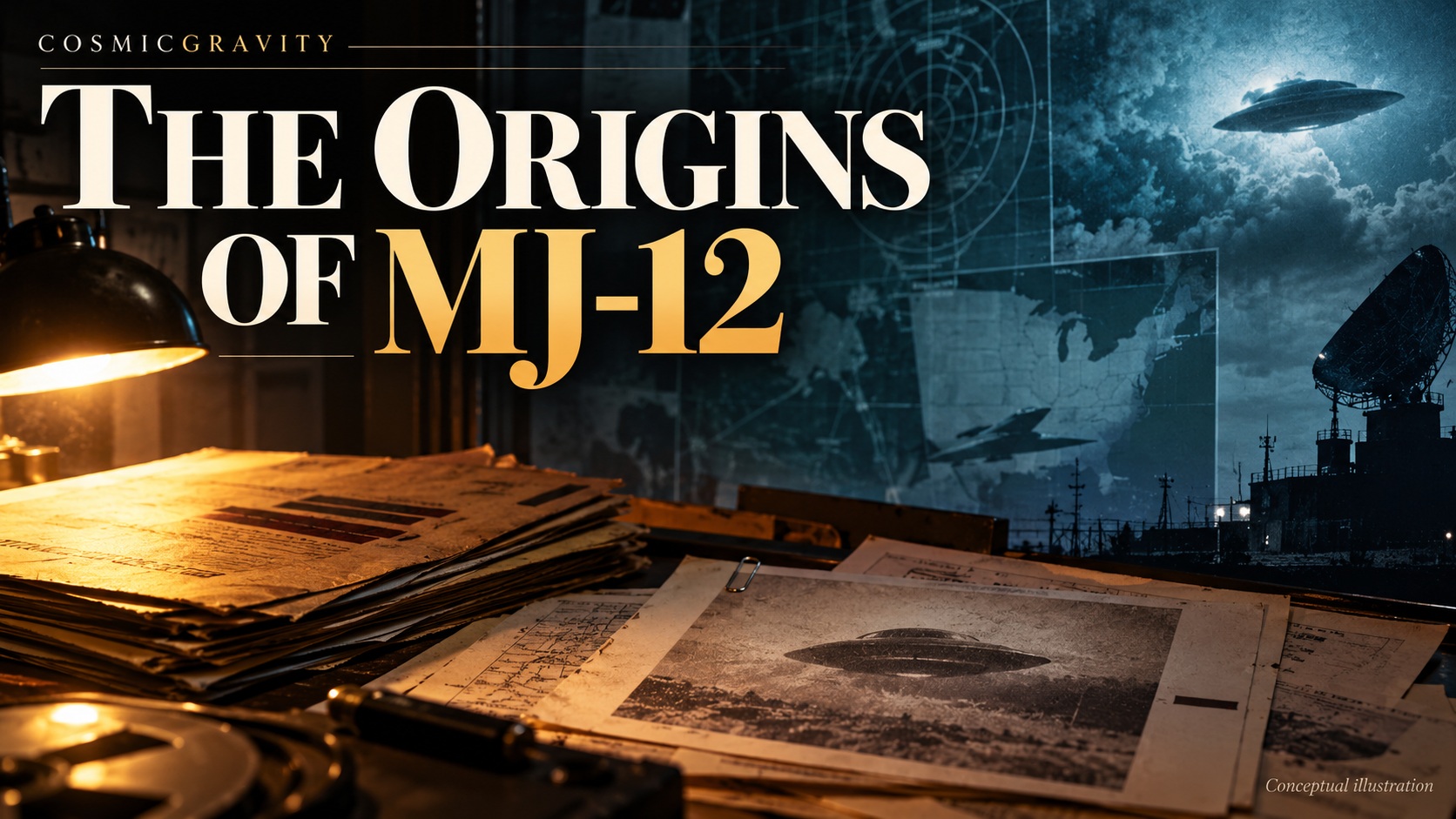
Feature image: Euclid field of J1504+6252. ESA/Euclid/Euclid Consortium/NASA, Wolf et al. 2026. Cover layout and infographic adaptation by CosmicGravity, CC BY-SA 3.0 IGO. Original image. Image licence.
Julien Wolf and colleagues reported the measurement on November 24, 2026. Their target, J1504+6252, was already shining when the universe was about 630 million years old. It takes a second measurement to say how massive its black hole was. There is a neat feature of the discovery paper worth looking for: different parts of the same hydrogen emission feature help answer both questions.
How the Dún Aonghasa quasar stood out
Euclid sees the sky through several filters. This source appeared in its near-infrared data and dropped out of its optical image. A very distant quasar can have that pattern because intervening hydrogen absorbs light at the short-wavelength end, and expansion moves the break into the bands telescopes can see. A few brightness measurements nominated an object worth scarce telescope time. They also left considerable freedom in the answer.
Follow-up observations included Keck, Hubble and the Large Binocular Telescope. Webb ultimately supplied the infrared spectrum that pinned down the distance in cosmic time. A spectrum breaks the light into wavelengths, allowing astronomers to locate the centre of an emission line even when the whole galaxy occupies little more than a point on the sky. The Euclid Consortium’s account and discovery image let you compare the modest-looking target with the work that went into identifying it.
Read the line in two ways
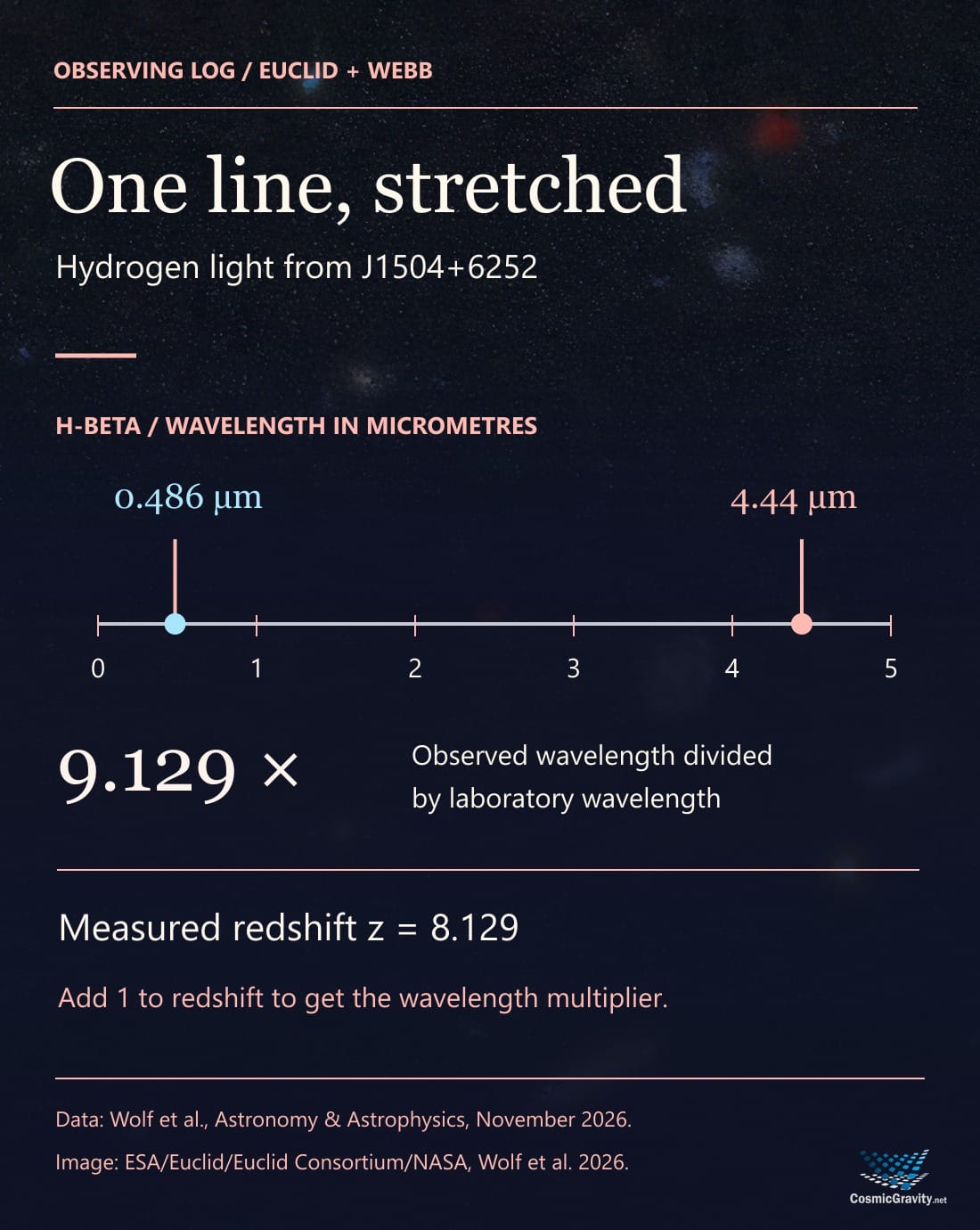
The team measured a redshift of 8.129 from the narrow component of hydrogen’s H-beta line. Add one to the redshift to get the wavelength multiplier. H-beta’s laboratory wavelength of about 486 nanometres therefore becomes roughly 4,440 nanometres, or 4.44 micrometres. A camera built for ordinary visible light misses that part of the spectrum altogether.
Now look at the broader component. Gas moving rapidly toward and away from us emits light shifted by different amounts, spreading the line across a range of wavelengths. Its width, together with a luminosity measurement and an empirical calibration, gave the team a black-hole mass estimate of about 360 million Suns. The paper reports substantial calibration uncertainty. The central mass estimate is much less precise than the quoted redshift.
A deadline for growing a black hole
The earlier Euclid quasar record placed an active nucleus at a cosmic age of about 670 million years. This particular black hole had roughly 40 million fewer years available. Yet the team inferred that, when the light left it, it was feeding at a relatively modest fraction of the rate associated with the Eddington limit. That limit describes the balance between gravity pulling matter in and radiation pushing it away.
There is no reason to assume the observed pace held throughout the black hole’s life. A more massive starting object, episodes of faster growth, or both could help it reach the inferred mass. The spectrum preserves one moment. Its value is that any growth history proposed for this object now has to get a black hole of broadly the right size to that moment on time.


latest video

news via inbox
Subscribe to our Cosmic newsletter to get notified when we have new articles.