Why a GPS satellite clock would gain 38 microseconds a day
A GPS satellite clock would gain about 38 microseconds on an Earth reference clock every day if engineers left it to run at its nominal rate. The GPS relativity correction accounts for this difference before your phone ever draws a blue dot. The surprising part is the sign. A fast-moving clock loses time, so how can a clock travelling thousands of kilometres an hour come out ahead?
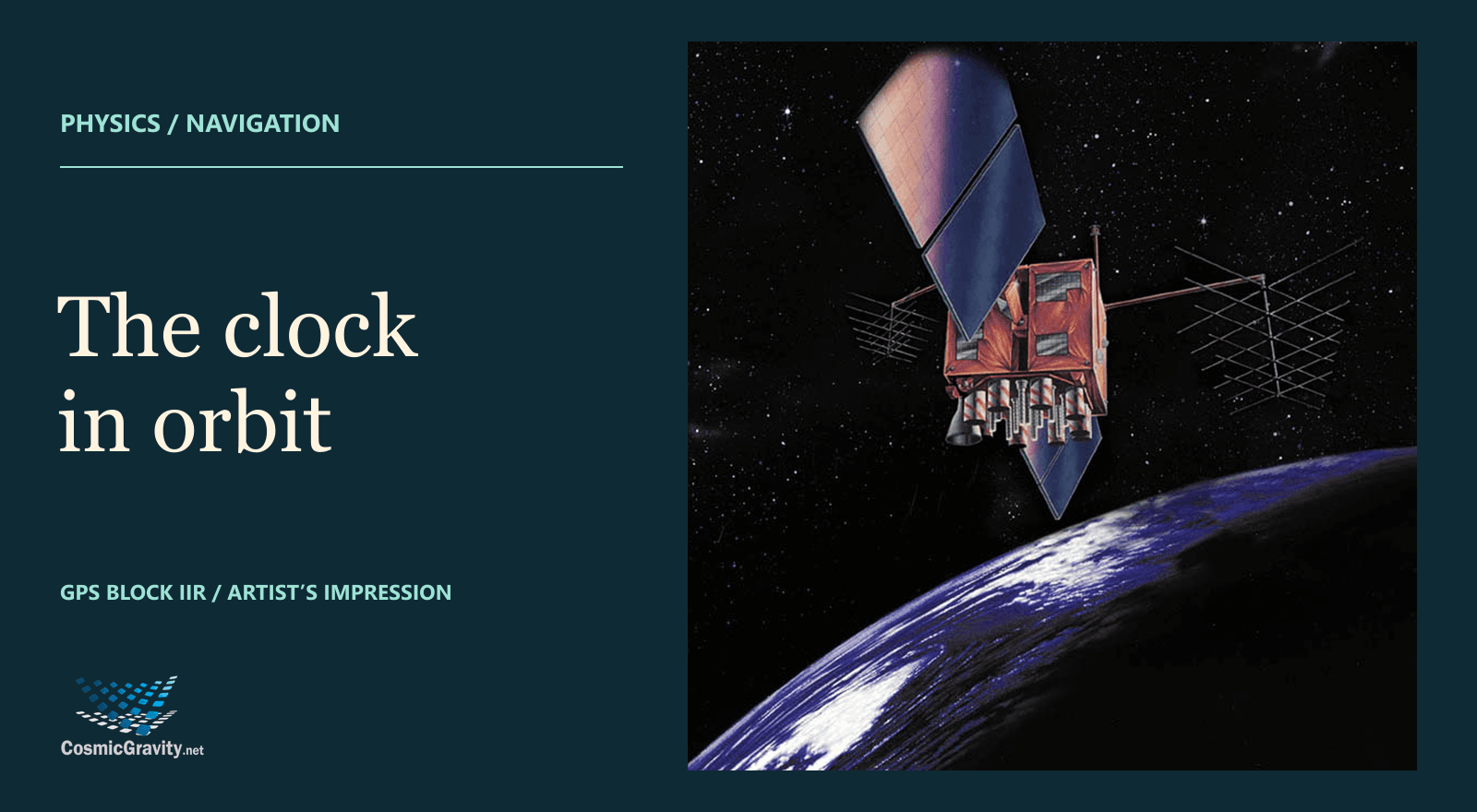
Feature image: Artist’s impression of a GPS Block IIR satellite. U.S. National Executive Committee for Space-Based Positioning, Navigation, and Timing, via Wikimedia Commons. Public domain. View the original.
The GPS relativity correction has two parts
Put two ideal clocks side by side and set them to agree. Leave one on Earth’s reference surface, called the geoid, and imagine the other established in a typical GPS orbit, about 20,200 kilometres above Earth’s surface. “Ideal” matters here. We’re asking what would happen even if both clocks were perfectly built. They measure time along different paths.
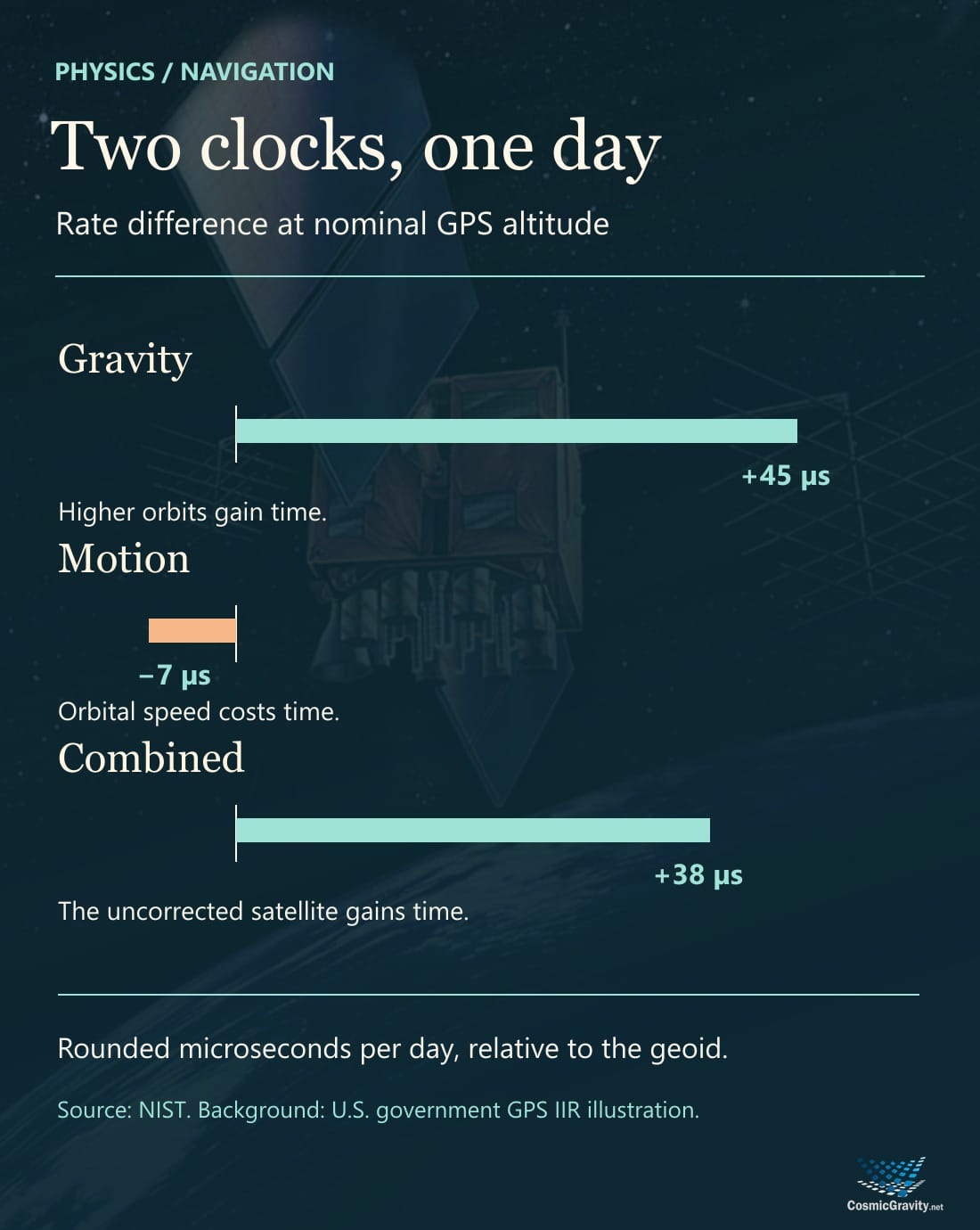
Motion gives the first part of the answer. Special relativity predicts that the speed of the orbiting satellite costs it roughly seven microseconds per day in this comparison. Gravity supplies a larger effect with the opposite sign. A clock higher up in Earth’s gravitational field runs faster than its counterpart on the ground. At GPS altitude the gain is about 45 microseconds per day. Combine the two and the orbiting clock gains roughly 38. NIST describes the two contributions.
What a microsecond looks like to a receiver
A satellite broadcasts a time stamp and information about its orbit. Your receiver compares the transmission time with its own estimate of the arrival time. Multiply the difference by the speed of light and you have a first estimate of distance. A microsecond of radio travel corresponds to nearly 300 metres. On that scale, 38 microseconds amounts to about 11.4 kilometres of signal travel.
That last number is easy to misuse. It describes the range equivalent of a timing offset. A phone’s position comes from solving several range measurements together, and the receiver estimates its own clock error in the same calculation. You cannot draw an 11.4-kilometre circle around your home and call it tomorrow’s predicted GPS error. The FAA’s receiver walkthrough explains why a fourth satellite normally lets a receiver solve for its clock offset along with three position coordinates.
Where the correction happens
Engineers can compensate for the average rate difference by giving the satellite frequency standard a small offset. Once in its intended orbit it keeps pace, on average, with the system time used on Earth. There is also a smaller periodic correction. Real orbits have some eccentricity, so a satellite’s speed and distance from Earth vary along its path. The navigation calculation accounts for that changing offset. Physicist Neil Ashby lays out both effects in his account of relativity in GPS.
The distinction helps explain why building a better clock and adjusting for relativity solve different problems. A more stable clock gives a more dependable sequence of ticks. It can still tick at a predictably different rate from an equally good clock somewhere else. Researchers pursuing a clock based on a transition in thorium face that same distinction whenever two precision clocks are compared across a difference in height.
Your phone can navigate without carrying an atomic clock because part of the work has already been done in orbit, and part is done afresh each time the receiver compares arriving signals. Einstein enters the calculation at both ends of an ordinary journey.



latest video



news via inbox
Subscribe to our Cosmic newsletter to get notified when we have new articles.