UK UFO files: how to find the records and follow the evidence
The UK UFO files are easier to explore once you know which kind of document you are looking at. A short sighting log, a witness’s letter and an internal policy briefing can all concern UFOs, yet each preserves a different piece of the story. Britain’s public records include all three. For readers following the current debate over government disclosure, they offer a practical way to investigate what was reported, how officials responded and which questions the surviving paperwork can answer.
This is a guide to existing records, checked in November 2026. The National Archives’ UFO research guide points to material about sightings, correspondence, parliamentary questions and official policy. GOV.UK separately provides annual Ministry of Defence sighting logs for 1997–2009. The National Archives’ research guide; the annual sighting logs.
Where can you find the UK UFO files?
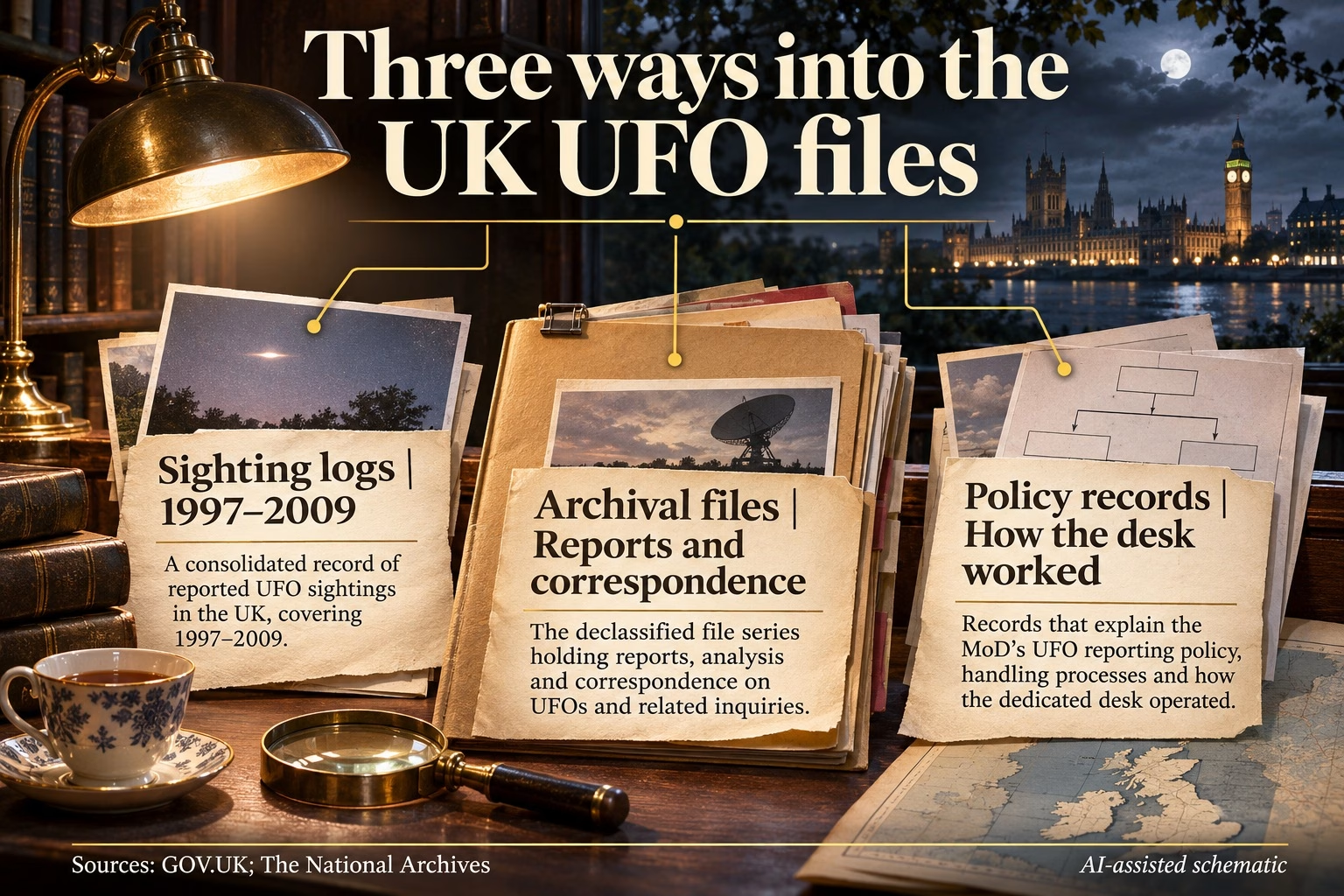
Start with the GOV.UK collection if you want a quick view of reports from a particular year. Its PDFs list dates and times, places, brief descriptions and, where relevant, the reporter’s occupation. The entries vary in detail. Some include a time; others record that it was not supplied. A location and a few lines of description can help you identify an account to research further.
The National Archives’ guide serves a broader purpose. It directs researchers toward archival files and the Discovery catalogue, including records in the DEFE, AIR, FCO and BJ series. Those references identify collections and individual files. They are useful when a newspaper article mentions a case without linking the underlying material. Some records are online; other material may require a visit or a copy request. Check the catalogue’s access information for the item you actually need.
For example, finding a sighting in a yearly log gives you a date and place to compare with a fuller case file. Finding a policy file gives you a different starting point: the department, the period it covered and the decisions being discussed. Keeping those routes separate makes the search more manageable.
How to read a sighting log
A log condenses a report into a small space. The 2009 Ministry of Defence PDF makes that clear through its column headings and its many short entries. Descriptions of colour, movement and shape are recorded alongside the date and location. A reader can see the range of experiences people chose to report.
The next step is to establish whose words the entry represents. Is it a summary of a witness’s account, a quotation from a letter or an investigator’s conclusion? Those distinctions become especially important when a description includes a claim about speed, size or origin. A brief log may preserve the claim without preserving the observations needed to assess it.
It helps to keep a simple research note: document reference, page, sighting date, report date where supplied, and the exact part you are discussing. If a later source adds detail, record where that detail came from. This lets another reader follow the same route and see how the account developed.
What policy records add to the UK UFO files
The administrative files explain why particular reports received attention and what officials thought their job required. The National Archives’ 2013 release material describes the final years of the Ministry of Defence’s UFO desk and its closure in 2009. It records rising correspondence and the department’s assessment that the work was not serving a defence purpose. The archive’s 2013 release briefing.
That is a documented account of an institutional decision. It should be read alongside the relevant correspondence and case material. A government department can assess whether a report appears relevant to national security while leaving other questions about an observation open.
In his accompanying 2013 release commentary, researcher David Clarke also discusses how publicity and familiar airborne objects could influence the number of reports. That provides a useful question for anyone comparing annual totals: what changed in reporting, awareness or collection practice? A higher total alone cannot tell us which of those factors mattered most.
Following the surviving paper trail
The archive is a surviving collection, shaped by retention decisions and the purposes for which documents were created. Its research guide notes that earlier destruction policies left gaps. A catalogue search therefore needs a clear scope: which department, which years and which type of record? A missing result can be a reason to refine that search.
For comparison with other countries, our Global UAP Transparency Tracker follows the different routes governments use to release material. The British collection rewards a closer look at the records themselves. Start with a reference, read the surrounding pages and distinguish the original observation from each later interpretation.

latest video



news via inbox
Subscribe to our Cosmic newsletter to get notified when we have new articles.