Euclid Was Mapping Galaxies. Then a New Comet Crossed Its View.
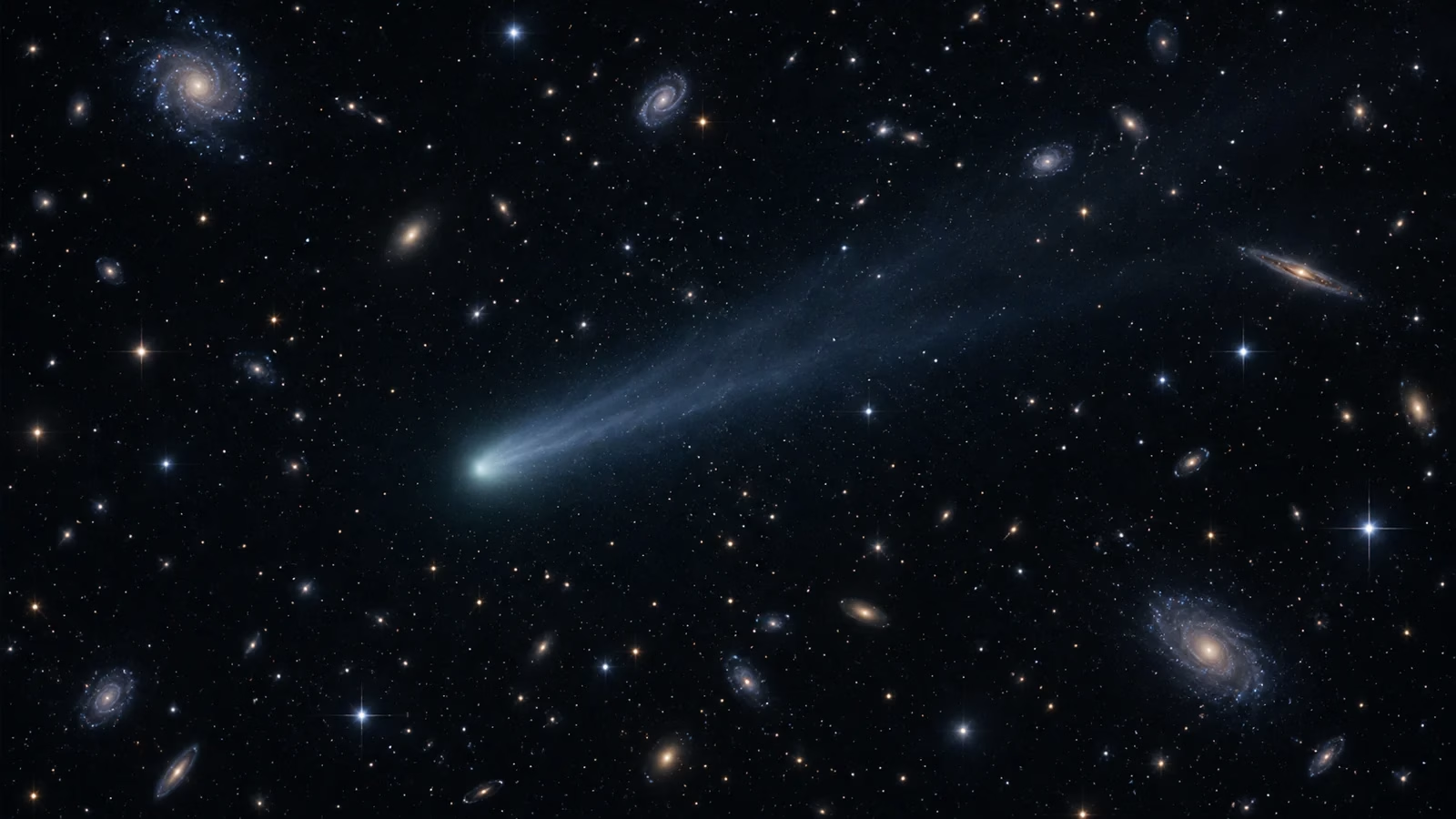
Feature image: AI-generated editorial illustration; not an observation or verified reconstruction.
The latest Euclid comet discovery began with something a galaxy survey would normally try to remove: a moving streak. While ESA’s telescope was photographing the distant Universe, a much closer visitor crossed its images. The object is now known as C/2026 S1 (Euclid), the mission’s first discovery of a previously unknown comet.
ESA announced the finding on 19 October 2026. It is a neat reversal of perspective. A telescope built to investigate the Universe on its largest scales has helped uncover a small object in our own Solar System. ESA’s discovery report describes how the identification was confirmed.
How the Euclid comet discovery happened
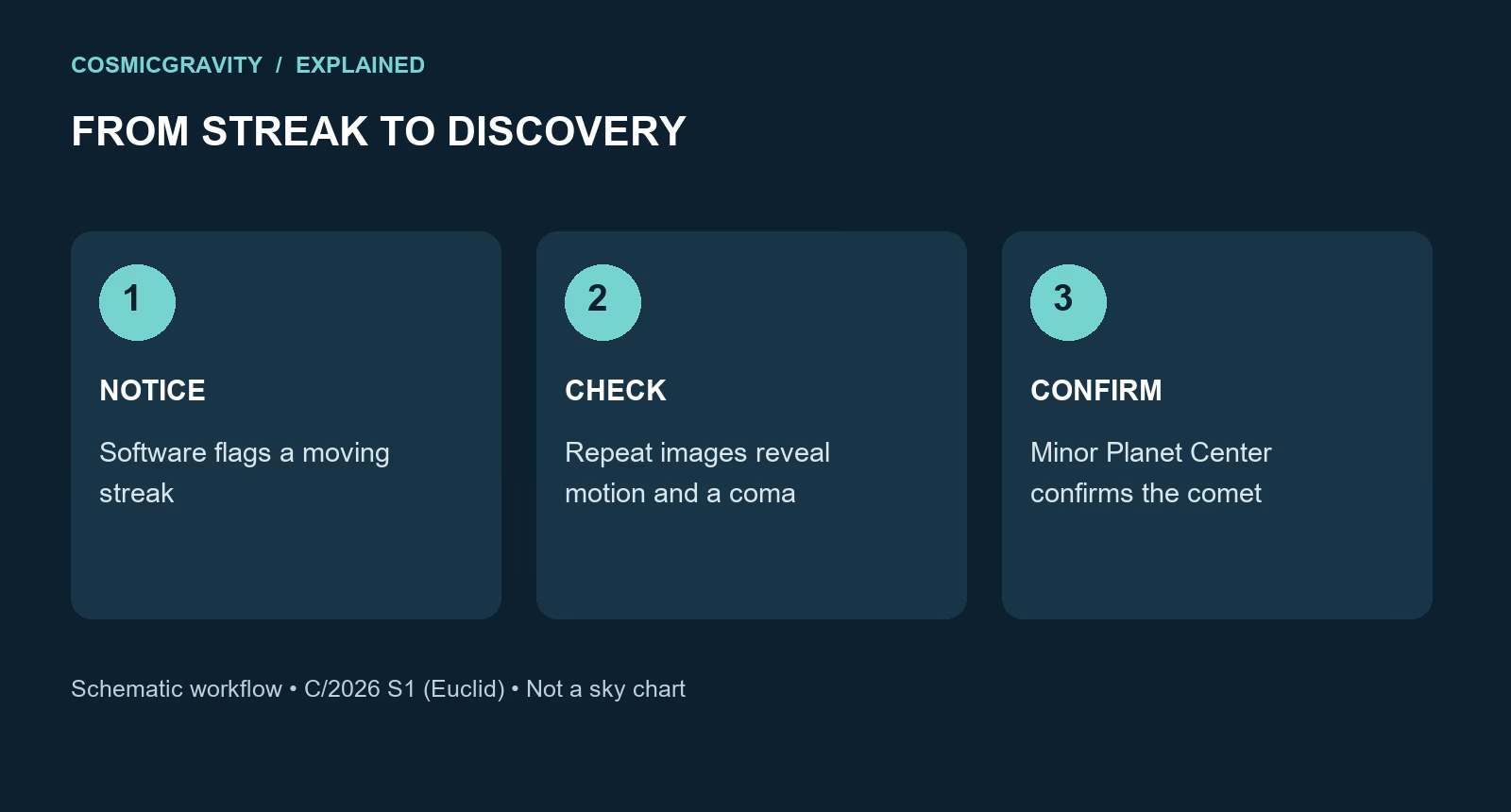
Moving-object software developed by University of Helsinki researcher Mikko Pöntinen flagged the streak. Images taken between 16 and 24 September supplied repeat sightings, while a diffuse cloud around the object suggested cometary activity. The Minor Planet Center confirmed the comet on 8 October.
The distinction matters: Euclid had seen known comets before. This was the first one it found that had no existing catalogue match. It also required follow-up, rather than a decision based on one unusual-looking frame.
A different kind of target
Euclid’s main job is to map the large-scale structure of the Universe. By observing billions of galaxies, researchers investigate how cosmic structure developed and how dark matter and dark energy influence it. The mission overview sets out that wider goal.
A moving comet and a distant galaxy pose different problems. A long exposure can make a travelling object look stretched, even when its physical shape is quite different. That is why the observed streak should not be mistaken for a close-up portrait of a comet’s nucleus.
Why an early discovery is useful
Comets preserve material from the early Solar System. As sunlight warms their volatile material, gas and dust can escape, producing the surrounding coma. The ESA comet guide explains why this activity makes them valuable scientific targets.
Finding a comet early gives observers more time to arrange measurements and refine its orbit. ESA says this discovery also tested coordination relevant to its future Comet Interceptor mission. C/2026 S1 itself is not a suitable target for that mission.
Will it become a bright comet?
The announcement is a discovery report, not a promise of a naked-eye spectacle. Those are different stories, and the second needs its own evidence. For now, the interesting result is the detection process: software noticed a moving object, repeated images supported the identification, and other observers helped confirm it.
A survey can be carefully designed and still leave room for surprise. In this case, the surprise was passing through the foreground.
Continue exploring
The almost invisible galaxy studied with Euclid
Sources and further reading



latest video



news via inbox
Subscribe to our Cosmic newsletter to get notified when we have new articles.