Arquivos do Céu: Brazil’s New UFO Series and the Evidence Behind the Stories
Brazil’s UFO history is back on screen. Arquivos do Céu, the new Globoplay documentary series released on 29 October 2026, brings witnesses, archives and competing explanations into the same conversation. For English-speaking viewers, the useful question is where those stories lead when the credits stop rolling.
This is a guide to the announced programme and its evidence questions, based on Globo’s production announcement and the platform’s episode listing. It is not a review claiming that we have independently watched or authenticated every interview.
What is Arquivos do Céu?
Globo says its journalism team produced the series, with narration by musician Lulu Santos. Its launch announcement describes testimony, historical documents and scientific discussion, including natural phenomena and possible military technology as explanations to consider. Scientist Marcelo Gleiser participates.
The official Globoplay listing currently contains five episodes. One paragraph in the launch announcement refers to six, while its headline summary says five. The platform’s actual five-entry catalogue is the clearest guide to what is presently listed.
That small discrepancy is a useful reminder: even a straightforward production fact deserves a check against the most direct record. A programme description is a starting point, not a substitute for the underlying material.
Which UFO stories does it cover?
The episode summaries move from reported lights in Pará and the Brazilian Air Force’s investigation to the testimony associated with Operação Prato. They also describe the gathering at Casimiro de Abreu, medical claims linked to the name Chupa-Chupa, and Brazil’s UFO Night. The final instalment turns towards alleged secret files and American connections, including Roswell.
These are descriptions of the programme’s subjects. In particular, the catalogue’s account of a doctor associating symptoms with reported lights does not itself establish a medical cause. Nor does a claim that photographs were taken abroad establish who received them or what they showed. Those questions require records beyond a synopsis.
Three questions to take into the documentary
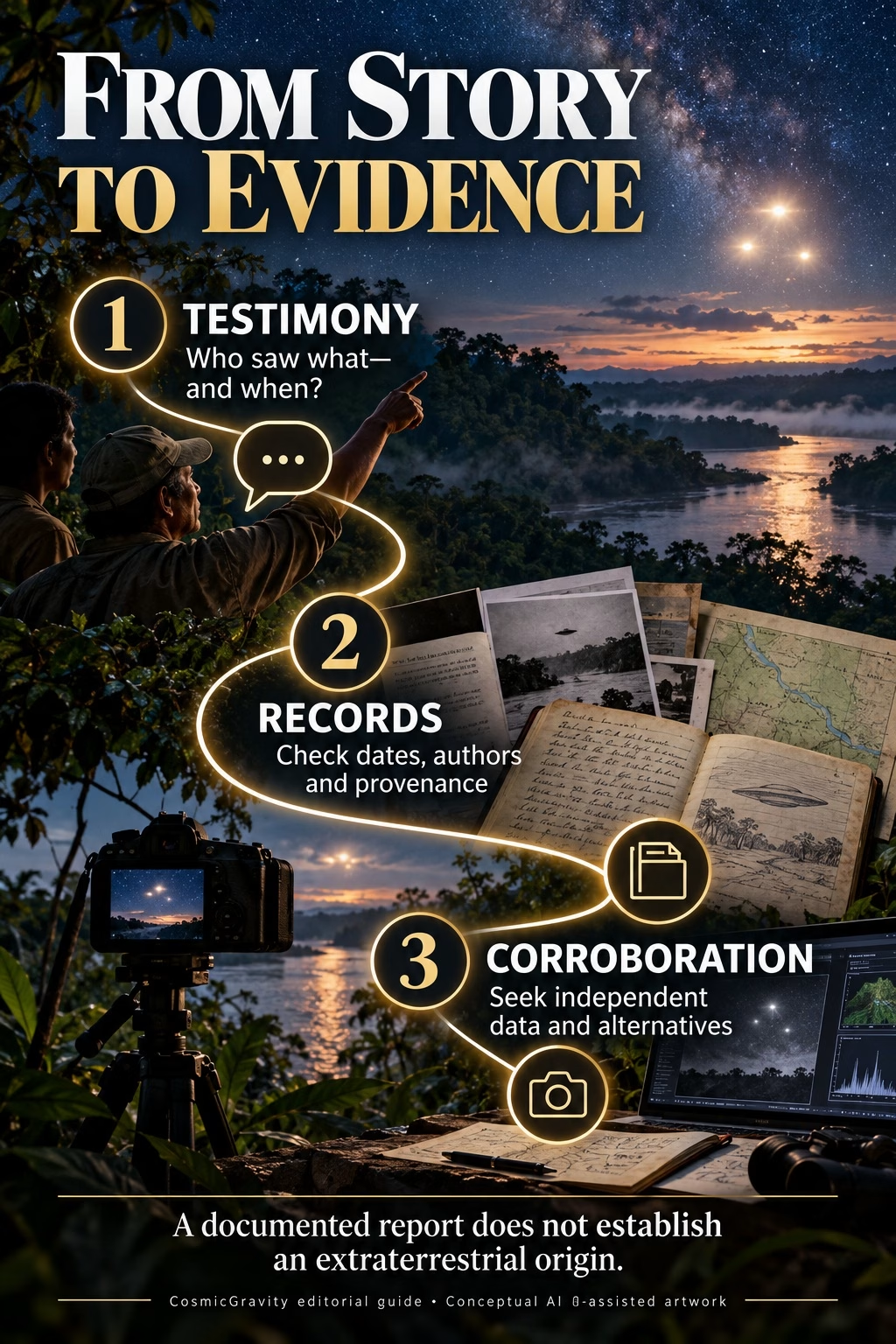
Start with the witness. What did that person observe directly, and what did someone else tell them? A recollection of seeing a light and a recollection of hearing about a captured object have different evidential roles. Both may deserve recording; they cannot answer the same questions.
Next, look at the document. Who wrote it, when, and for what purpose? A report can establish that an institution received an account without establishing the account’s explanation. A file stamped with an official heading still needs to be read for the author’s actual conclusions.
Finally, ask whether the corroboration is independent. Two interviews repeating one original story are different from two observations recorded separately at the time. Dates, locations, photographs with provenance and instrument records can help make that distinction. An edited sequence may place these materials together without proving they describe one event.
Why uncertainty should remain visible
An unresolved observation can be interesting without a settled explanation. The productive next step is to identify the missing evidence precisely: an original negative, a dated report, an instrument log or a fuller interview. Calling everything unexplained can conceal those differences.
Equally, a plausible alternative needs to fit the particulars. Suggesting an aircraft, a natural light or a military activity is a hypothesis until the timing and observations support it. The same standard should apply to an extraordinary interpretation. An appealing story cannot supply measurements that were never made.
Where to watch Arquivos do Céu and what to read next
The official destination is Globoplay. Check the programme page for access, territorial availability and language options; an English-language guide does not mean English subtitles are available everywhere. We are linking the authorised listing rather than presenting an unofficial upload as the documentary.
For a deeper comparison of testimony and records, read our Varginha investigation and Roswell evidence guide. They provide useful companion questions without turning these distinct Brazilian cases into one combined story.
Arquivos do Céu gives viewers a timely reason to revisit Brazil’s UFO archives. Its lasting value will depend on how clearly the documents, recollections and interpretations can be followed outside the narrative assembled for the screen.

latest video



news via inbox
Subscribe to our Cosmic newsletter to get notified when we have new articles.